Student productions are expected to follow the program’s typography and font usage guidelines when creating titles, credits, posters, graphics, promotional materials, and other official production-related design assets. This includes using approved fonts where required and maintaining professional formatting standards across deliverables.
Consistent font usage helps create clearer, more professional presentation materials while supporting a more unified visual identity across the program. Typography is an important part of visual communication, and following established standards helps students develop stronger design habits while ensuring that production materials remain clean, legible, and appropriate for exhibition and distribution contexts.
Limitations on Usage
Fonts, like music and images, are protected by intellectual property law. Their use is governed by licensing agreements, and improper usage can lead to legal complications and limit a film’s ability to be distributed. To model professional industry standards and ensure that student work respects the rights of font creators, all fonts used in student productions must be properly licensed and accompanied by a verifiable chain-of-title.
Researching and clearing font licenses requires time from both students and faculty. On early production cycles, which operate on short post schedules, this time is better spent on core filmmaking tasks. These projects are therefore limited to vetted font sources with clear, institutionally-approved licensing. Greater flexibility is granted on capstone cycles, where students have more time and are expected to take responsibility for securing proper font rights.
F1 • F2 • F3 • M1 • M2 • M3
Students may only use fonts from the following sources:
Productions involving prop firearms or other weapons require clear and proactive communication with faculty, staff, campus officials, property owners, law enforcement, and other relevant parties. These email templates are designed to help productions provide consistent, professional notifications when weapons-related elements are being used during filming.
Weapons-related communication protocols exist to prioritize safety, reduce misunderstandings, and help productions operate responsibly within both university and public environments. Even clearly fictional or non-functioning prop weapons can create concern if their use is not communicated properly in advance. Standardized notification procedures help productions meet safety expectations while reinforcing the professional responsibility filmmakers have when working with sensitive production elements.
Public Locations
To: Local Jurisdiction Police or Sheriff’s office
CC: ejacob@fsu.edu (FSUPD Lieutenant Edwin Jacobs) CC: jstone@fsu.edu or tciarlariello@admin.fsu.edu (Head of Production)
Subject: FSU Film School: Prop Weapon Use Acknowledgement (Public Property)
Hello, my name is [#########]; I am a film student here at the FSU College of Motion Picture Arts. I’m producing a student short film that will be filmed on [Date] & [Dates], which will include the filming of a non-fireable prop weapon [describe weapon, and how many]. We will have an assigned student armorer managing the weapon(s) at all times, except when the actors prepare for the scene, at which point the armorer will announce and transfer the weapon to the actor. When the actor completes the scene, they will transfer the weapon back to the armorer, who will then announce that they are in possession.
We’ll be filming at the [insert information on location and address], which is open to the public and/or visible from the outside. We will be posting signs alerting the public that filming is in progress.
The 1st Assistant Director will make safety announcements involving the weapon at the start of the day and when the scene is being set up for filming.
The Producer will contact local jurisdiction dispatch and/or Consolidated Dispatch, and FSU dispatch when the scene is within 30 minutes from being filmed.
As per university requirements, I am attaching our Prop Weapon Authorization Request to inform your department(s) about our project and use case. It is for acknowledgement purposes for local law enforcement. It highlights the address, the filming dates, the armorer on set, and how the prop weapon will be used during filming.
Thank you for supporting the Film School, and please let us know if you have any questions whatsoever. We appreciate your time.
Best,
[Name] Producer, [Show Number & TItle] [Contact Number] [Contact Email]
Private Location
To: Local Jurisdiction Police or Sheriffs office
CC: ejacob@fsu.edu (FSUPD Lieutenant Edwin Jacobs) CC: jstone@fsu.edu or tciarlariello@admin.fsu.edu (Head of Production)
Subject: FSU Film School: Prop Weapon Use Acknowledgement (Private Property)
Hello, my name is [#########]; I am a film student here at the FSU College of Motion Picture Arts. I’m producing a student short film that will be filmed on [Date] & [Dates], which will include the filming of a non-fireable prop weapon [describe weapon, and how many]. We will have an assigned student armorer managing the weapon(s) at all times, except when the actors prepare for the scene, at which point the armorer will announce and transfer the weapon to the actor. When the actor completes the scene, they will transfer the weapon back to the armorer, who will then announce that they are in possession.
The 1st AD will make safety announcements involving the weapon at the start of the day and when the scene is being set up for filming.
We’ll be filming at the (insert information on location and address), which is on private property and not visible to the public. (Update this If visible to the public.)
The Producer will contact local jurisdiction dispatch and/or Consolidated Dispatch, and FSU dispatch when the scene is within 30 minutes from being filmed.
As per university requirements, I am attaching our Prop Weapon Authorization Request to inform your department(s) about our project and use case. It is for acknowledgement purposes for local law enforcement. It highlights the address, the filming dates, the armorer on set, and how the prop weapon will be used during filming.
Thank you for supporting the Film School, and please let us know if you have any questions whatsoever. We appreciate your time.
Best,
[Name] Producer, [Show Number & TItle] [Contact Number] [Contact Email]
Thumbnail images are often the first point of contact audiences have with a film online, making them an important part of a project’s overall presentation and discoverability. This post provides standardized thumbnail templates to help maintain visual consistency across school-related promotional materials and online showcases.
The use of templates ensures that projects meet technical specifications while encouraging students to think strategically about visual communication and audience engagement. Effective thumbnails should clearly represent the tone and identity of the project while remaining legible and visually compelling across a range of screen sizes and platforms. Developing an understanding of these presentation standards is increasingly important in contemporary distribution environments.
Instructions
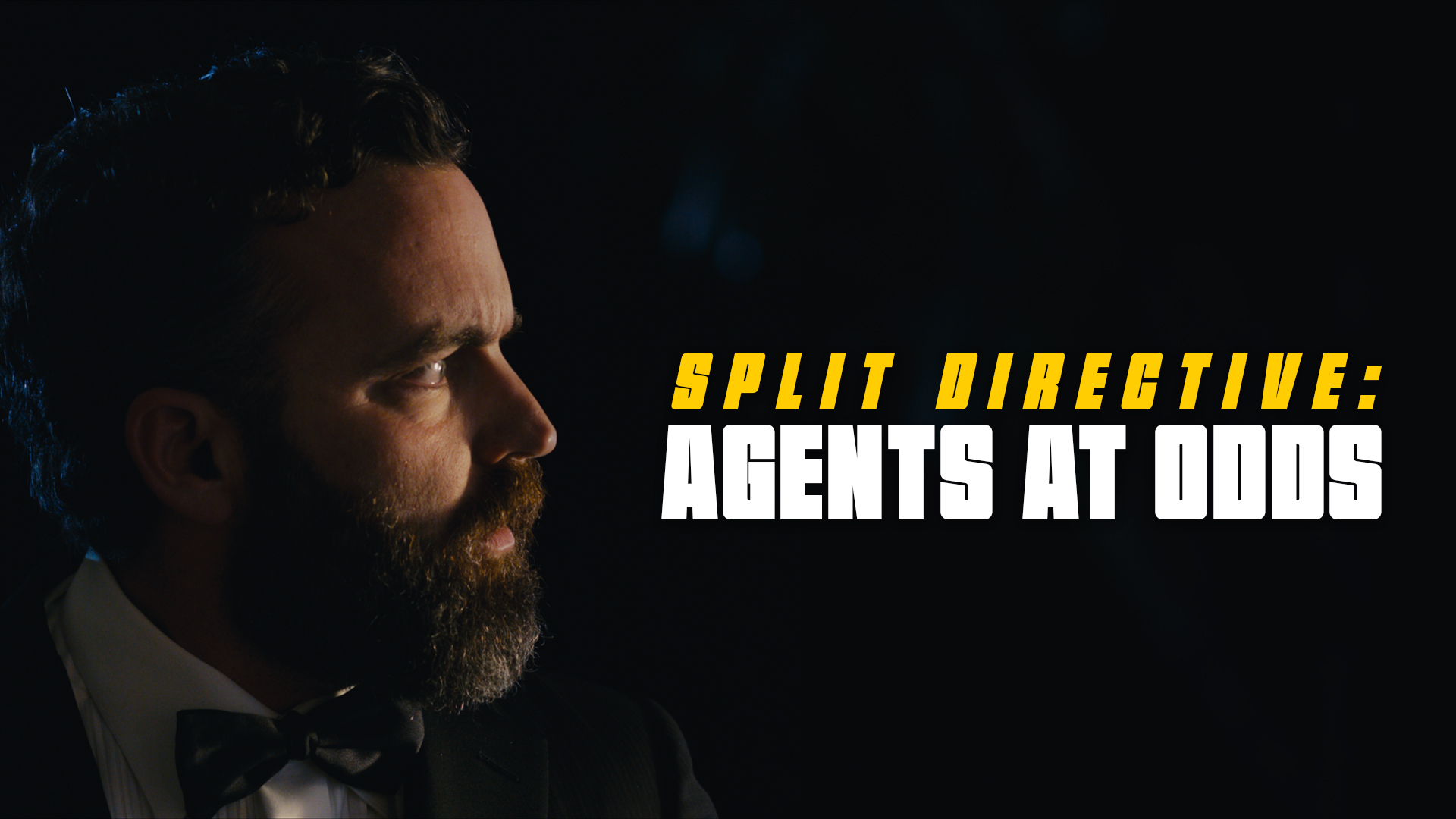
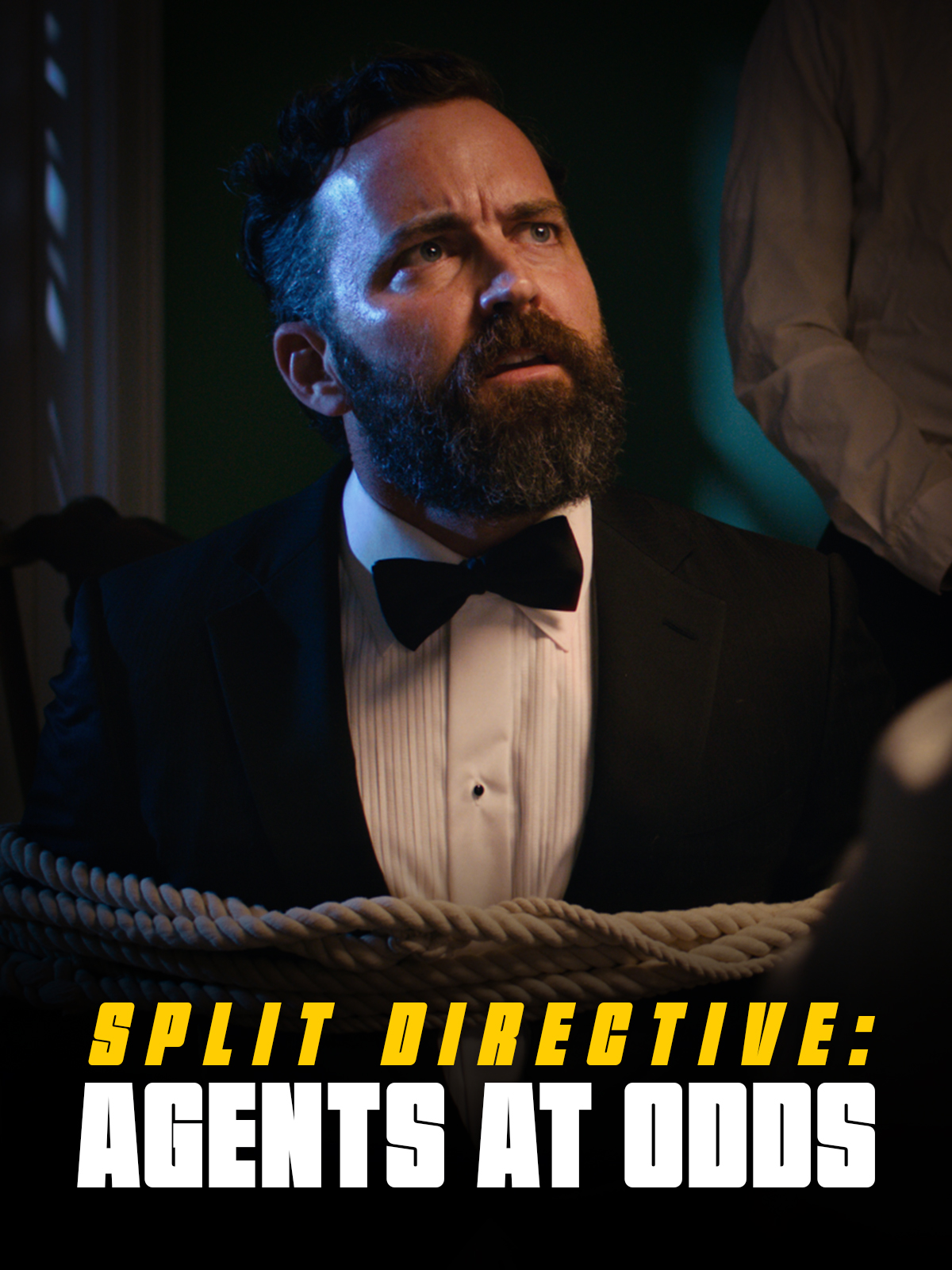
Use these templates to create your thumbnails. To ensure your film is properly represented across a range of platforms, you must create both a horizontal and a vertical thumbnail.
Each thumbnail should contain two elements:
A carefully selected image that fills the entire frame (i.e., no letterboxing or black bars). This image is typically derived from either the poster or one of the production stills.
The title of the film. Ideally, for consistency of branding, this should match the font design of the title on the poster. No other text should appear in the thumbnail.
Examples:
Horizontal (1920x1080px)Vertical (1200x1600px)
Delivery:
Deliver the finished files for each in two formats:
A layered PSD file (include any custom fonts used)
The location list serves as part of the project’s final delivery materials, providing a comprehensive record of all filming locations used during production. In addition to serving as an archival and administrative document, the report helps productions verify that all location-related materials and required paperwork have been properly completed and submitted during the delivery process.
Maintaining accurate location records is important both for redundancy and long-term project documentation. The report provides the school with a centralized reference point in case materials submitted elsewhere become incomplete, missing, or incorrectly labeled. It also encourages productions to carefully review their delivery materials and confirm that all locations, agreements, permits, and related documentation have been properly accounted for before final submission.
Export Instructions
Navigate to the Location Database board in FSU Greenlight.
Select the “My Shows” view at the top.
Batch-select all the items for the show.
Select “Export” from the menu at the bottom.
Delivery Instructions
Locate the exported Excel file on your local drive.
Rename the Excel file, using the following naming convention: 01m2-LocationList.xlsx
The cast list is submitted as part of the project’s final delivery materials and provides a complete record of all performers involved in the production. In addition to serving as an archival and administrative document, the report helps productions verify that all cast-related materials and required paperwork have been properly completed and submitted during the delivery process.
Maintaining accurate cast records is important both for redundancy and long-term project documentation. The report provides the school with a centralized reference point in case materials submitted elsewhere become incomplete, missing, or incorrectly labeled. It also encourages productions to carefully review their delivery materials and confirm that all performer credits, agreements, releases, and related materials have been fully accounted for before final delivery is approved.
Export Instructions
Navigate to the Cast Database board in FSU Greenlight.
Select the “My Shows” view at the top.
Batch-select all the items for the show.
Select “Export” from the menu at the bottom.
Delivery Instructions
Locate the exported Excel file on your local drive.
Rename the Excel file, using the following naming convention: 01m2-CastList.xlsx
Credits sequencing establishes the standardized order and formatting conventions used for on-screen titles and end credits within student productions. These guidelines help ensure that cast, crew, departments, acknowledgments, and institutional requirements are presented consistently and professionally across projects.
Credit order carries both professional and practical significance within film production. In professional filmmaking environments, credit placement and sequencing are often governed by contractual obligations negotiated through unions, guilds, and individual talent agreements. Standardized sequencing helps ensure that contributors are recognized appropriately, prevents omissions or inconsistencies, and creates a cleaner delivery workflow during finishing and final export. Learning industry-standard crediting practices also helps students better understand both the collaborative structure of film production and the professional conventions that govern screen credit attribution.
The Overall Sequence
While every production’s titles and credits are slightly different, the general order goes:
FSUFILM Leader
Lead Titles
Content (Story)
End Credits
Logos
Copyright
A production can choose whether or not to include any Lead Titles at the start of the film. That decision will impact the order of the end credits, as outlined below.
Sequencing for Lead Titles
If lead titles appear at the head of the film, they must appear in this order:
FSUFILM Leader
Above-Title Cast
Title
Supporting Cast
Original Score by
Production Designer
Sound Designer
Editor
Director of Photography
Producer
Writer
Director
Sequencing for End Credits
The order for end credits, if not shown in the lead titles, are:
Director
Writer
Producer
Director of Photography
Editor
Sound Designer
Production Designer
Original Score by
The remaining end credits appear in the following order:
Final title and credit materials must be delivered in a format that allows editorial, finishing, and archival workflows to proceed cleanly and consistently. This includes the submission of properly formatted title cards, end credits, associated project files, and any other required assets needed for final mastering and delivery.
Careful preparation of titles and credits is important because even small formatting errors, missing names, spelling mistakes, or incompatible files can create significant problems late in post-production. The delivery process is designed both to maintain technical consistency across projects and to encourage students to carefully verify the accuracy and completeness of all credited information before final submission.
Delivery Specs
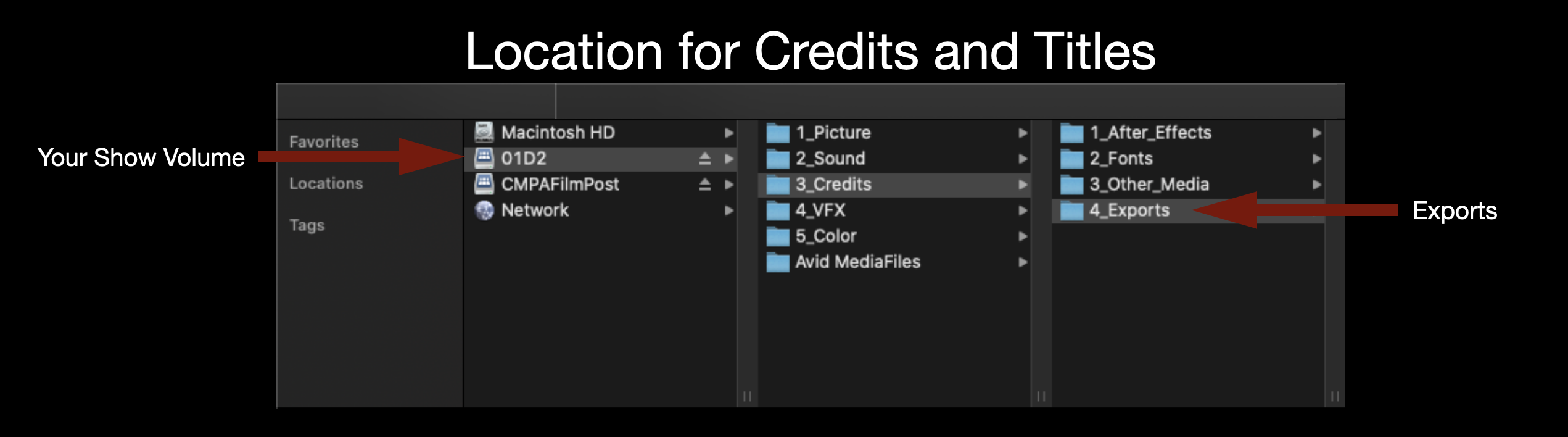
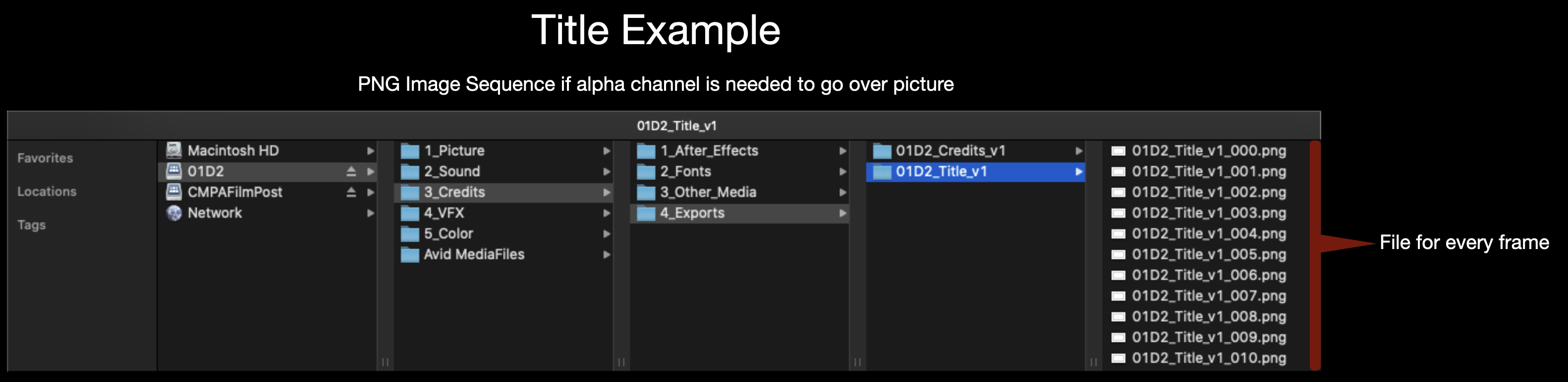
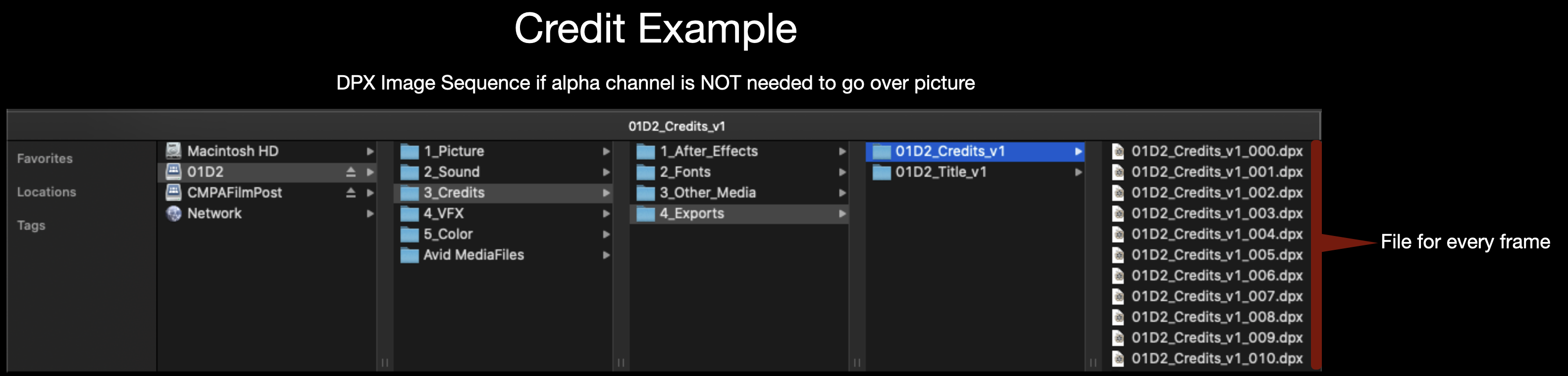
All Credits and Titles should be made in After Effects and delivered as either a DPX sequence or a PNG sequence. A DPX sequence should be used if the titles are going over black and a PNG sequence should be used if the titles need to go over picture since it holds an alpha channel. Either image sequence should be exported for 1920×1080 at 24fps. Make sure to name the image sequence appropriately (Example: 01M2_Credits_v1).
Location to Deliver Credits and TitlesNaming convention for TitlesNaming convention for Credits
Dual-system sound workflows record audio separately from the camera using dedicated sound recording equipment, requiring synchronization between picture and sound during post-production. This post outlines the cadence procedures, file management expectations, and synchronization practices used to maintain organized dual-system workflows throughout production and editorial.
Because dual-system recording involves managing multiple sources of media simultaneously, consistency and organization are critical to avoiding sync issues, missing files, or editorial confusion later in post-production. These procedures help students develop professional habits related to sound workflow management, metadata organization, and cross-department coordination within more advanced production environments.
Cadence
This is the correct cadence for productions using dual-system sound. What the 1st AD says is highlighted and said over walkie. It is important that all 1st ADs adhere to this cadence. This enables consistency from show to show, which facilitates clear communication and efficiency on set.
“PICTURE’S UP!”
When you’re ready to go for picture.
“LAST LOOKS!”
“Last Looks” is only for Hair & Makeup and Costumes to do any final touches.
“LET’S LOCK IT UP! WE’RE GOING FOR PICTURE!”
“Lock it up” is to notify everyone to be quiet.
“ROLL SOUND!”
2nd AD/PAs call “Rolling!”
Sound voice-slates into the sound recorder and then calls “Sound Speeds”. This is usually called by Boom Ops if they are in communication with the Sound Mixer. If not in communication, the Sound Mixer makes the call.
1st AC speeds the camera and (if necessary) signals to 2nd AC that it’s speeding.
2nd AC calls “Mark” ( A-Camera Mark, B-Camera Mark, etc.) and slates.
If tail-slating, call “Tail-Slating” at this point. After “Cut” is called, slate will enter frame upside down. Call “Mark” and clack the sticks, then turn the slate so it’s readable before the camera is cut.
Operator calls “Set” when they are framed up, in focus, and ready to go.
Director or AD will call “Action”/”Background” and Directors only will call “Cut” and/or “Setting”, with ADs echoing this.
After each “Cut,” the 1st AD checks with camera and sound to see how it was for them, then they check with Director to see if they want to go again.
“WE’RE GOING AGAIN!”
Make sure everyone is ready. Then call the Roll once more.
“PICTURE’S UP! LOCK IT UP! ROLL SOUND!”
Call goes as above until the Director calls “Cut”. AD repeats the “Cut” and PAs follow after AD on walkie.
AD continues to ask “Going again?” until they are told “Got that”.
Once 1st AD hears “Got that” they then call:
“GOT THAT! MOVING ON! THANK YOU.”
Moving on…
“NEW DEAL! CAMERAS MOVE! WE’RE GOING TIGHTER!”
“New Deal” means the camera(s) are moving to their next setup position.
“We’re going tighter” references that the set is moving on to a tighter frame. This is because we typically shoot scenes starting with the widest frame and then working towards the tightest frames.
If you’re moving on to the next scene then call:
“GOT THAT SCENE! MOVING ON TO SCENE ‘X’. LET’S CLEAR THE CREW AND BRING IN FIRST TEAM (OR CAST) TO REHEARSE.”
Visual effects deliveries to editorial include the transfer of completed VFX shots, updated versions, supporting media, and associated documentation needed for integration into the edit. Consistent delivery practices help editorial teams track versions, replace temporary shots efficiently, and maintain organized post-production workflows as projects move toward completion. This guide is only necessary if your show has approved VFX shots.
Because VFX work often involves multiple iterations across different departments, careful organization and communication are essential to avoiding missing shots, outdated versions, or broken workflows during finishing. Standardized delivery procedures help maintain clarity between editorial and VFX teams while reinforcing professional habits related to version control, file management, and collaborative post-production pipelines.
The Relationship Between Visual Effects and Editorial
In the industry, after a VFX vendor has finalized a shot and received the director’s approval, the shot is sent back to editorial to be cut back into the film. This handoff is between a VFX Coordinator on the vendor side and a VFX Editor or Assistant Editor on the picture editing side. When the VFX shots are received by editorial they are checked to make sure they meet the delivery specifications and the agreed upon frame count. In the industry, VFX shots are often finalized at different times by different vendors and sent to editorial to be cut into the film throughout the editorial process.
In our workflow, all VFX shots approved by the director during VFX will be turned back over to editorial all at once. Since the original editor of the show may now be working on another project, it is the primary responsibility of the director to do the work described in this guide. (If the editor is available during this time, they are encouraged to be present.)
Receiving VFX Delivery
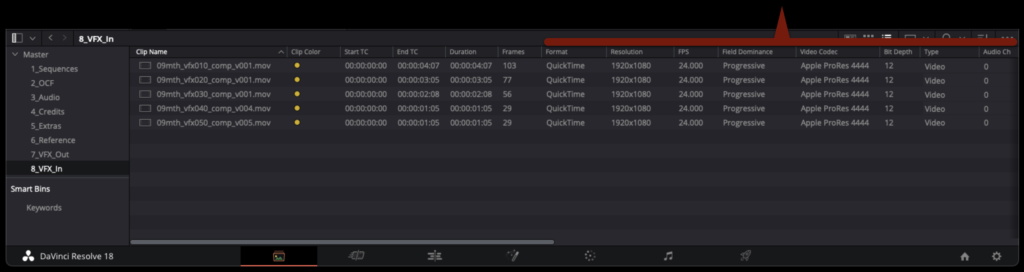
The VFX shots should already be delivered to your show volume in the VFX In folder. The only files in this folder should be the final version of each shot. They should be labeled show_shot#_comp_version. If the files are labeled in any other way or if you have more than one version of each shot in the VFX In folder, contact the person who completed the VFX shots so that they can fix anything necessary before proceeding.
Cut in VFX
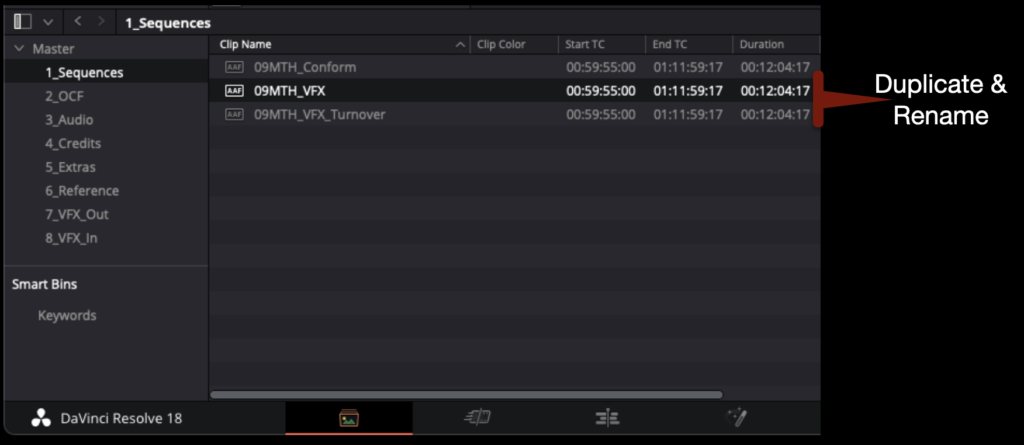
Open the show’s Resolve project. In the Media page, inside the Sequences bin, duplicate the sequence named “show#_VFX_Turnover” and rename the new sequence show#_VFX as shown in the example below.
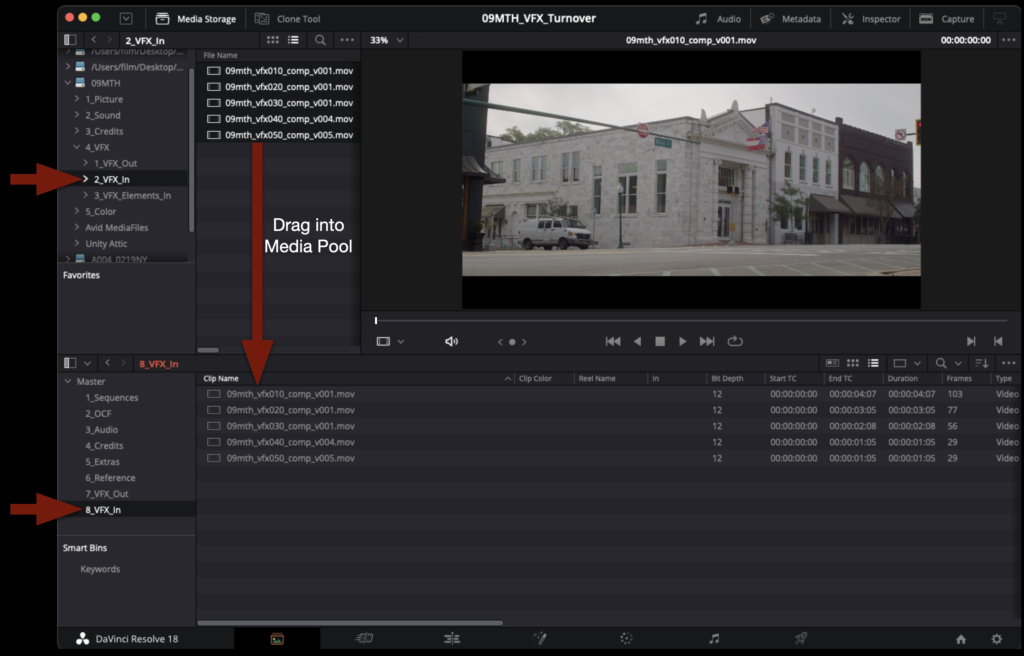
In the Media page, navigate through your media storage to your VFX shots and drag them into the Media Pool to import them.
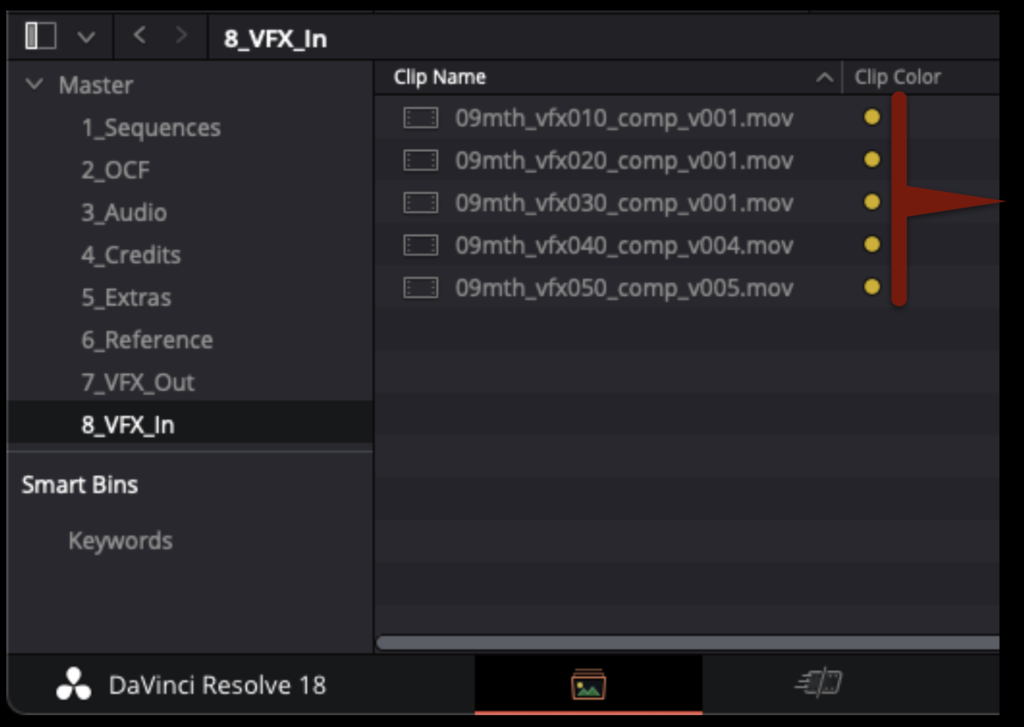
To denote that they are VFX shots, these clips should be changed inside of Resolve so that the clip color is yellow. In the Media Pool, you can highlight them all, right-click, and select clip color.
Check that the VFX shots have been delivered to the correct specifications. They should be 1920×1080 AppleProRes4444 QuickTimes at 24fps with no sound channels.
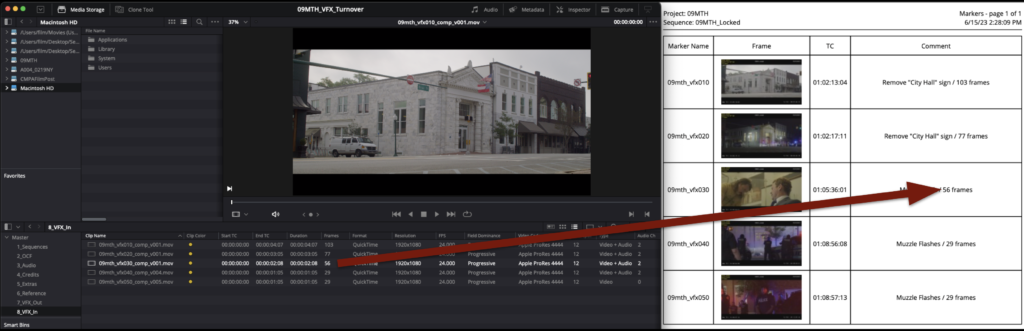
Also check the frame counts of each shot against the the VFX Turnover Sheet to make sure they match.
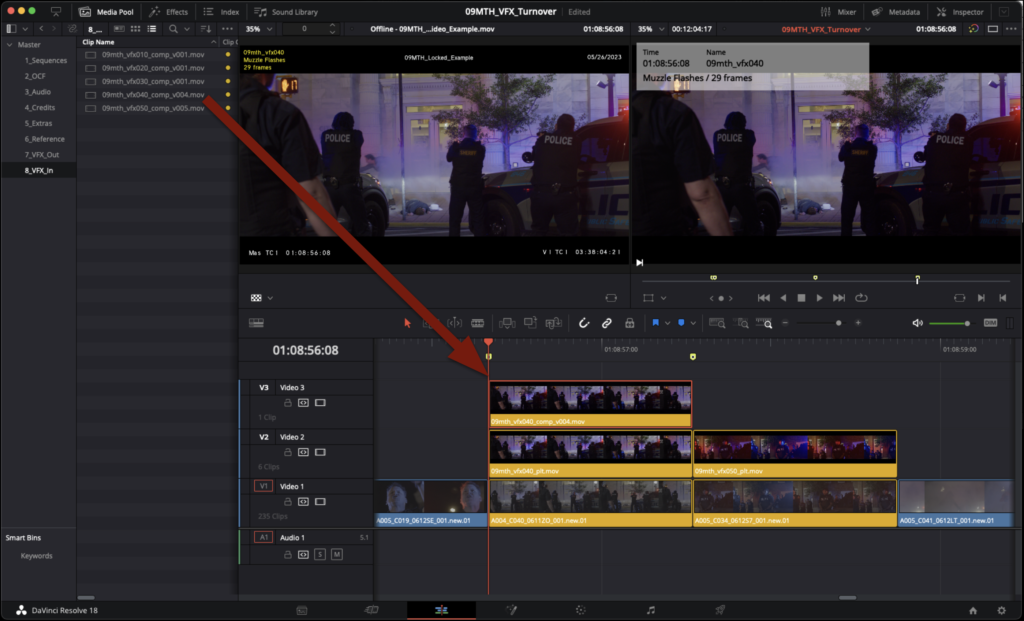
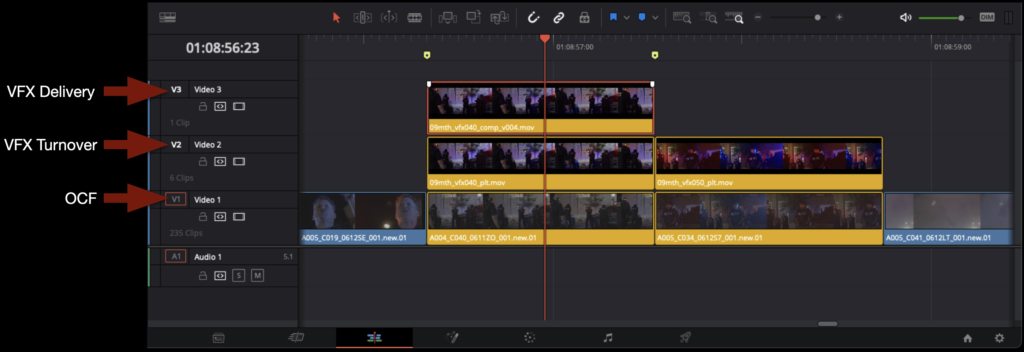
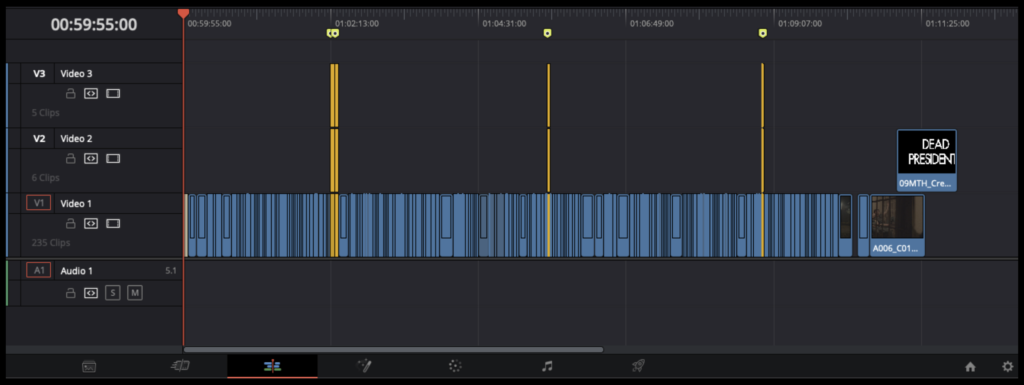
In the Edit page, cut in each VFX shot to Video Track 3.
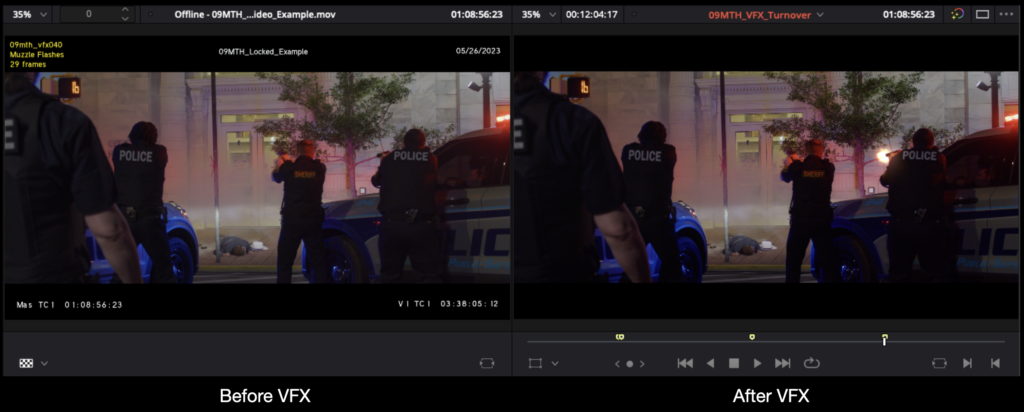
You should see the progression of the shot as shown in the example below.
Using the Offline Reference, you should be able to see how the finished VFX shot compares to the locked picture edit.
Repeat for the remaining shots.
Export Reference Video from Resolve
A new reference video will need to be exported for sound design and sound mixing reference.
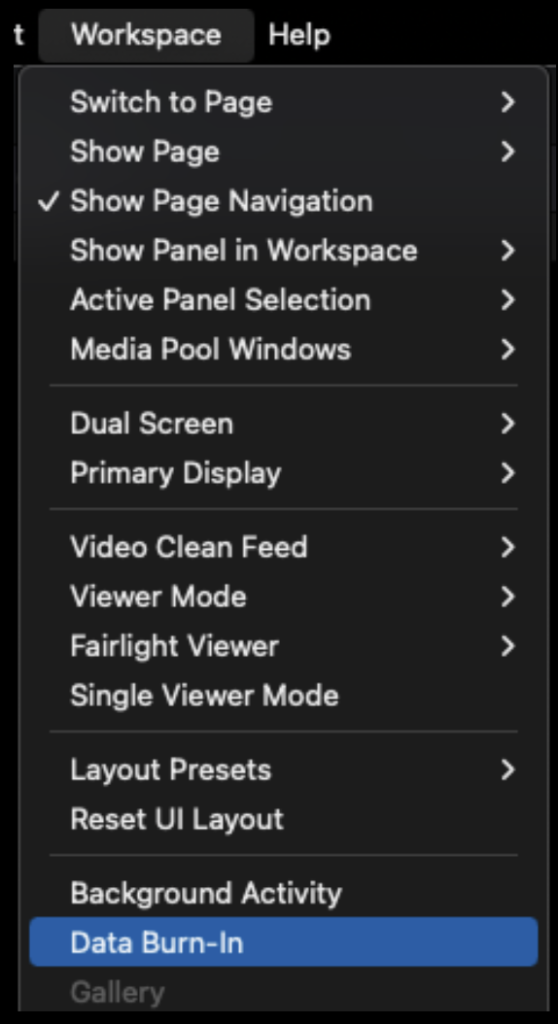
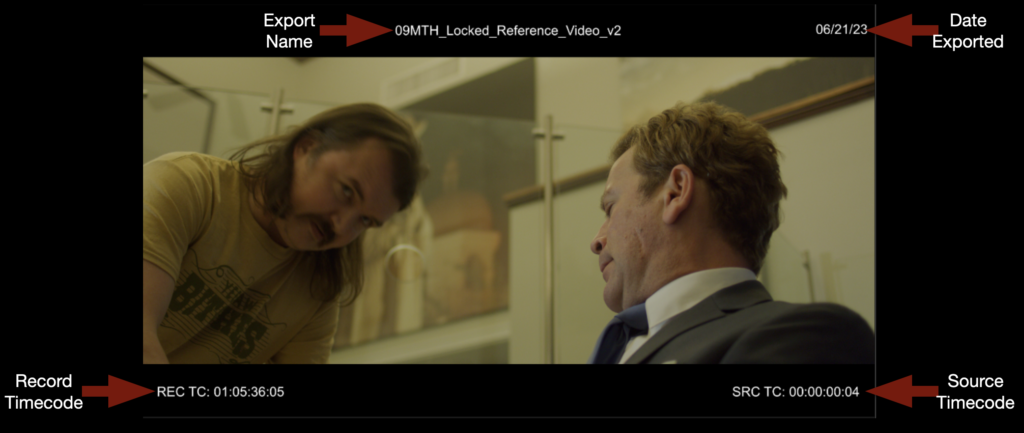
Before exporting, you will want to replicate the Timecode Burn-In Effect from Media Composer to match all the Burn-Ins on the original Reference Video. In Resolve, this is done using the Data Burn-In effect. It can be found under Workspace> Data Burn-in.
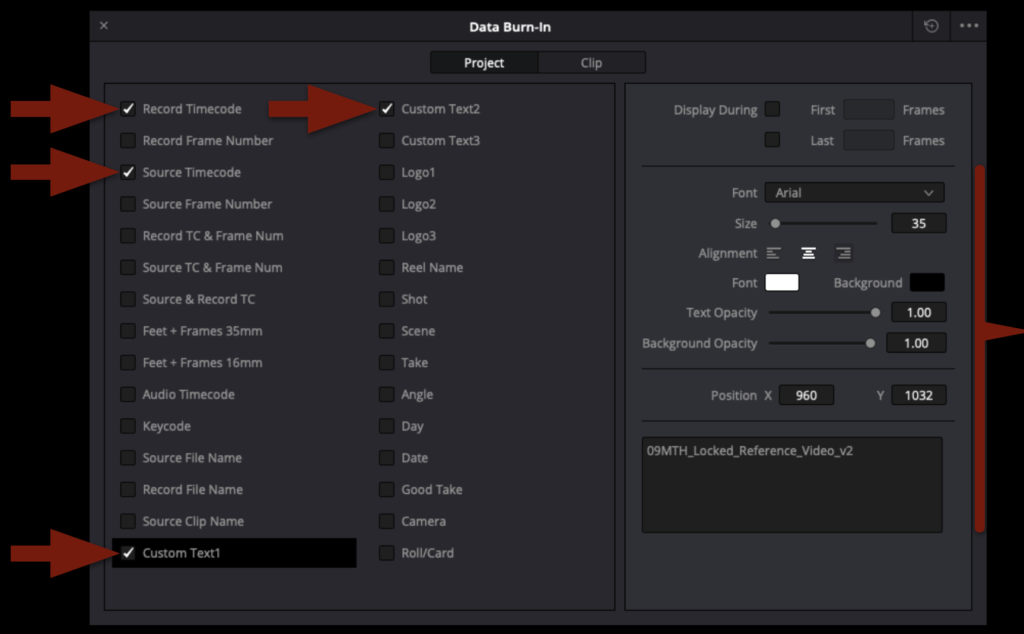
When the effect opens, you will see it is laid out in roughly two sections. On the left, you can choose what metadata you want to select to be burned in. On the right, you can select how and where you want that to be displayed. Select the four boxes shown in the example below and choose the same font and font size. You will need to address the position of each burn-in manually.
In the example below, you can see what the result of the Data Burn-in effect should look like.
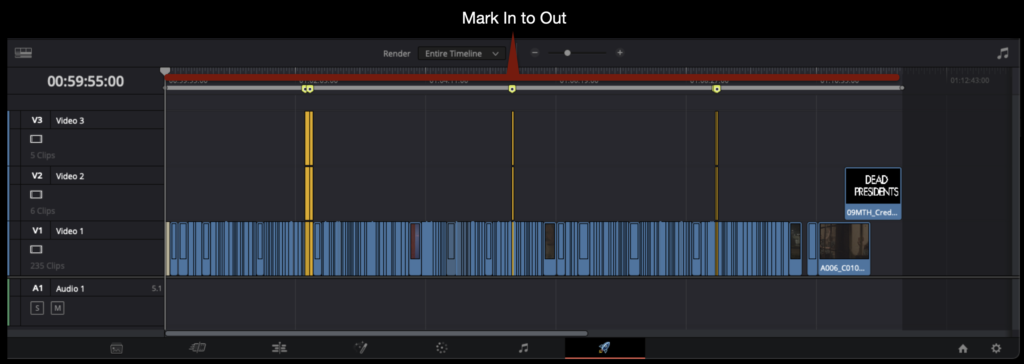
In the Deliver page, make sure you are marked In to Out around the entire sequence.
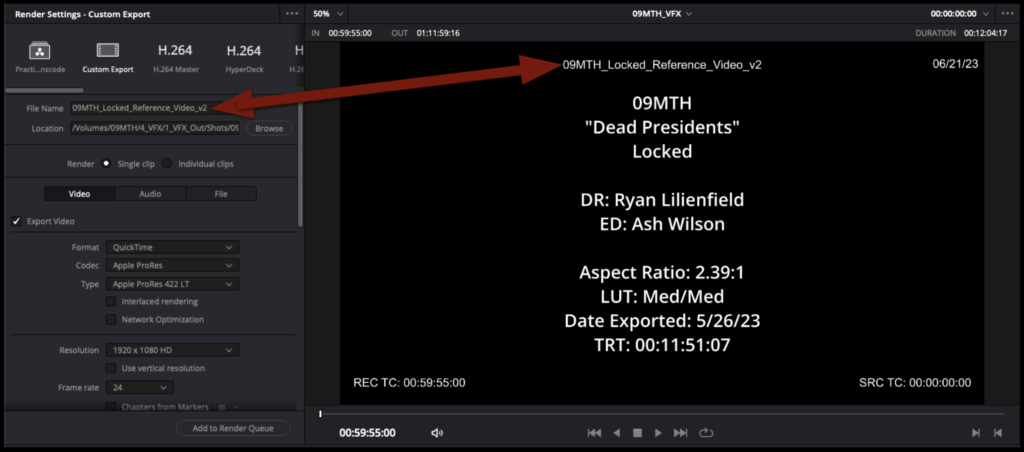
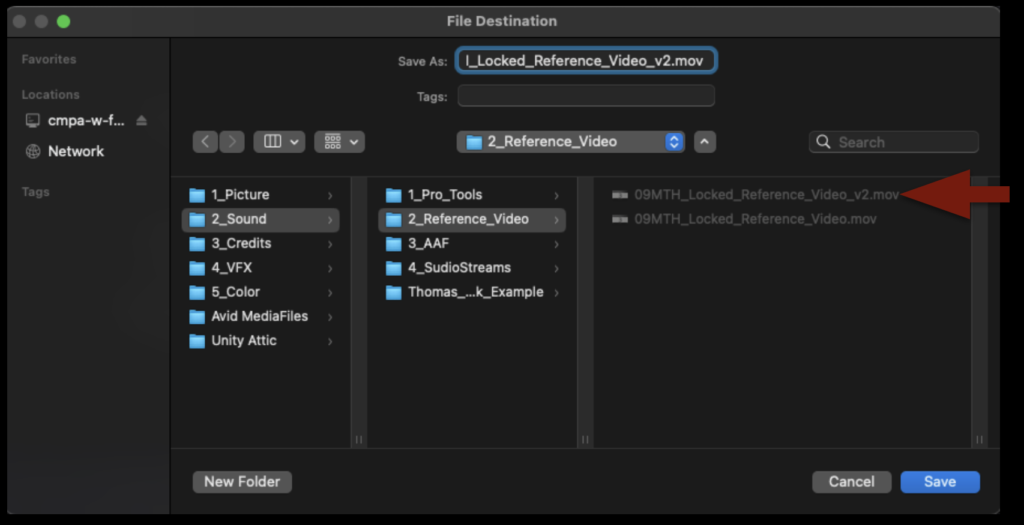
Change the filename to match the export name that you burned in. This name should be one version number up from any previous reference video.
Point the export to the Sound > Reference Video folder on your Show Volume.
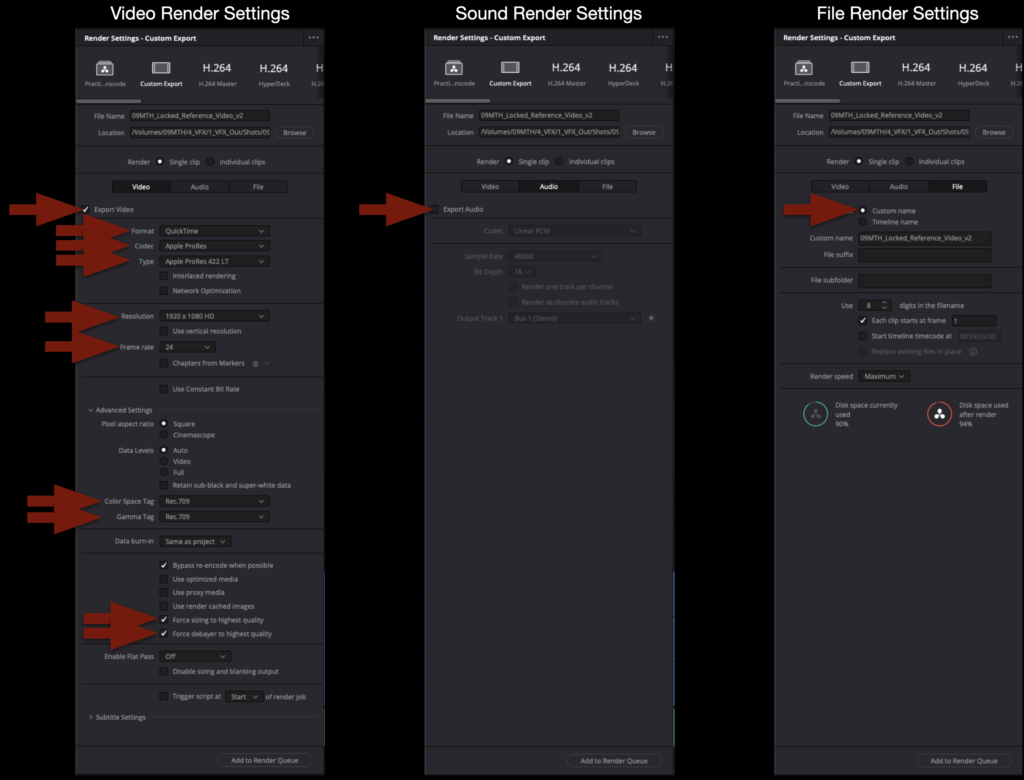
Below are the Render Settings for all reference videos exported from Resolve. Double-check the settings carefully before exporting.
When the export is complete, navigate in the Finder to where it was exported and open it in QuickTime Player to make sure everything is okay.
Wrap Up
Save the project by hitting “Command+S”. Then close the project and quit resolve by hitting “Command+Q”.
Turnover to VFX refers to the process of preparing and delivering editorial materials needed for visual effects work, including locked shots, reference media, metadata, plates, notes, and other supporting assets required for VFX production. This guide is only necessary for shows with approved VFX shots.
A well-organized turnover process is critical because incomplete or inconsistent materials can create major delays, confusion, and unnecessary rework within the visual effects pipeline. Clear turnover standards help ensure that VFX artists receive accurate technical information and creative direction while teaching students the importance of communication, organization, and pipeline management in collaborative post-production environments.
The Relationship Between Editorial and Visual Effects
In the industry, VFX are rarely completed in the NLE that the editor is using to cut picture. It is common practice for editors or assistant editors to create rough versions of VFX shots inside the NLE as a proof of concept while editing; these are sometimes called “slap comps” and are useful to evaluate how the VFX shot will work in the context of the edit. For the final shots, though, VFX vendors are contracted to do the work. This is for four primary reasons:
The editor is cutting with “offline” quality footage which is of lesser quality
The picture editing application is rarely the best tool to accomplish the required visual effect
The editor is not normally the person with the expertise to accomplish the required visual effect
The editor’s time is more valuably spent on the storytelling aspect of editing
The editorial department coordinates with the VFX vendor to send them all the high quality elements, references, and notes required to create the final shots. It is this process of creating and packaging everything that the VFX vendor needs that is referred to as a “VFX Turnover”. This would normally be done by an assistant editor or VFX editor in the editorial department in coordination with the lab that is storing all the original camera files, and there may be several turnovers during the editorial process for different VFX vendors. In our workflow this responsibility rests on the editor at picture lock. The turnover is completed in DaVinci Resolve after the steps outlined in the Turnover to Color page.
Locked Reference Video
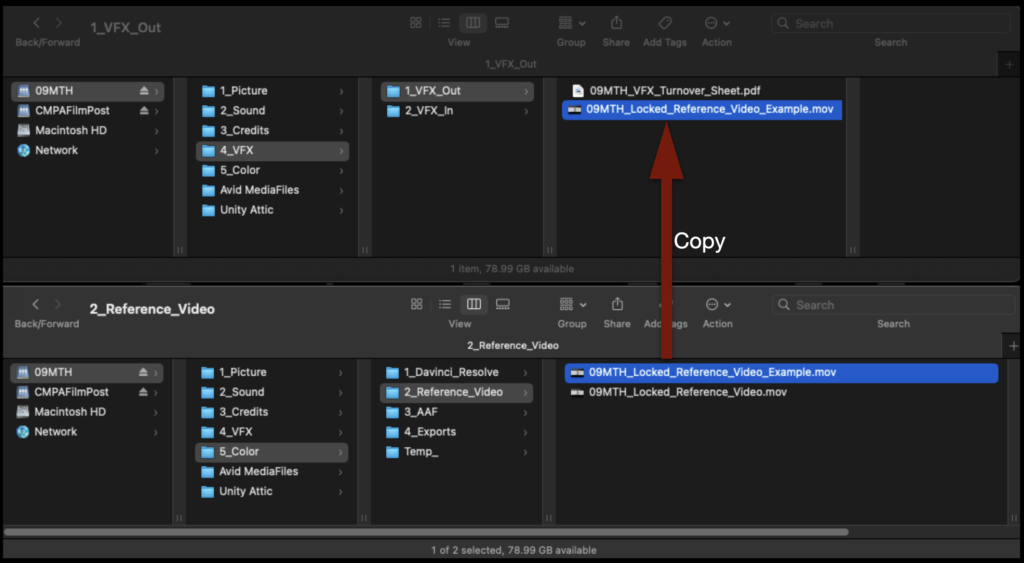
The editor will assemble the “turnover packet” that will be sent to the VFX department in the show volume inside the VFX Out folder. The VFX Out folder should already have the VFX Turnover Sheet that was made at picture lock and outlined in the Picture Lock – VFX Prep guide. The next thing that needs to be added to this folder is a copy of the Locked Reference Video. This is the same reference video that was used in the color and sound turnover.
Copy the Locked Reference Video (don’t move it) from the Color folder to the VFX Out folder.
Resolve Project Setup
Only proceed with these steps after you have completed everything in the Turnover to Color page.
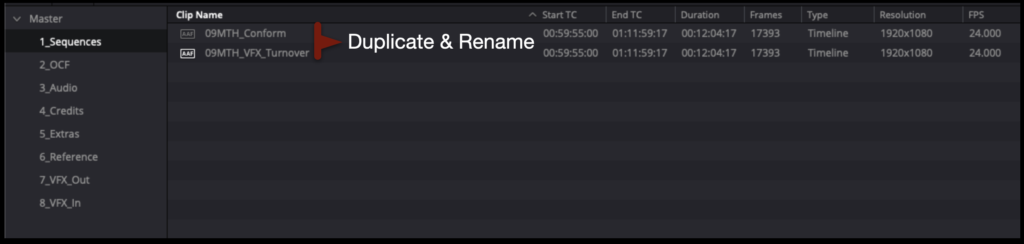
In the Media page inside the Sequences bin, duplicate the sequence named “Conform” and rename the new sequence VFX_Turnover as shown in the example below.
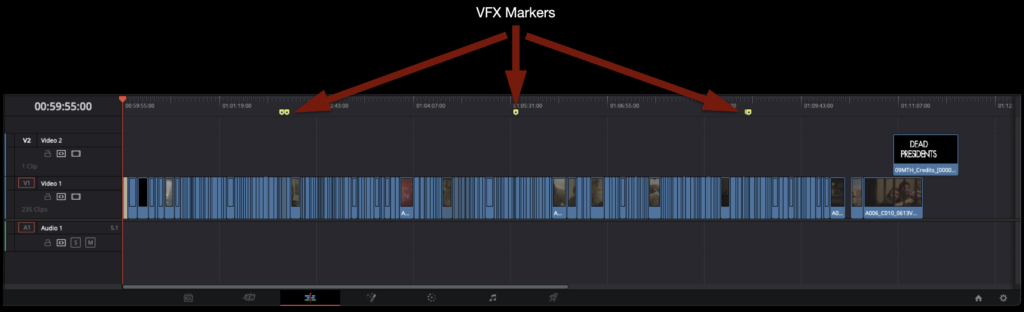
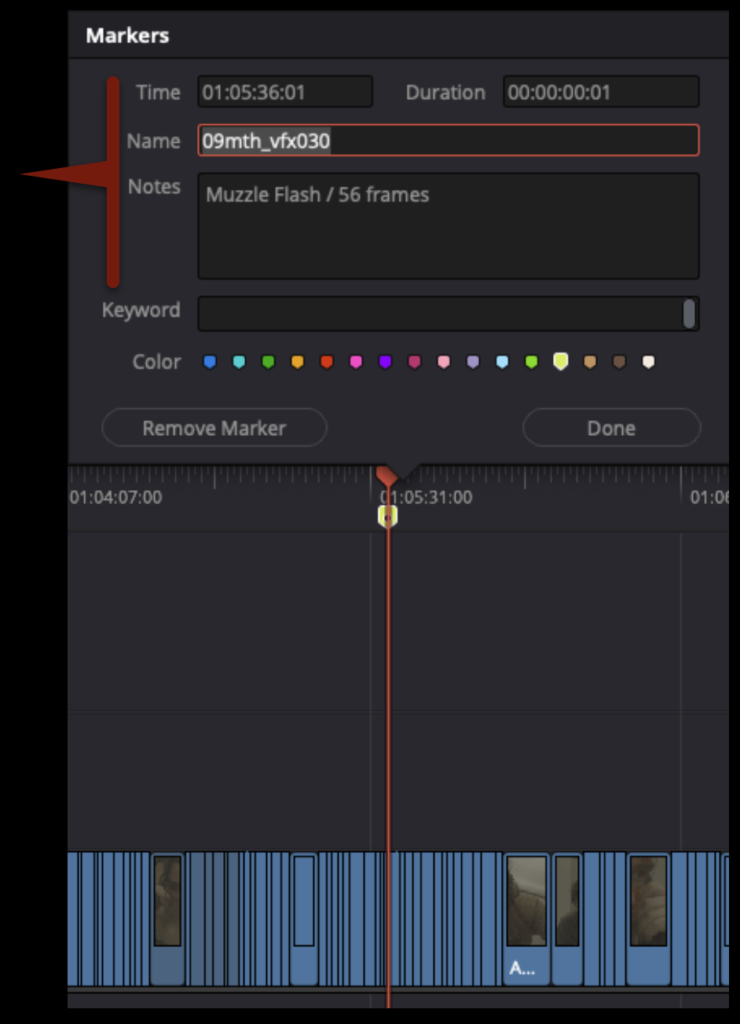
You will notice that the yellow VFX markers that you made in Media Composer to label and track the VFX shots have carried over into your Resolve sequence. In Resolve you can jump between markers quickly by using the keyboard shortcut “Shift + Up-or-Down Arrow”.
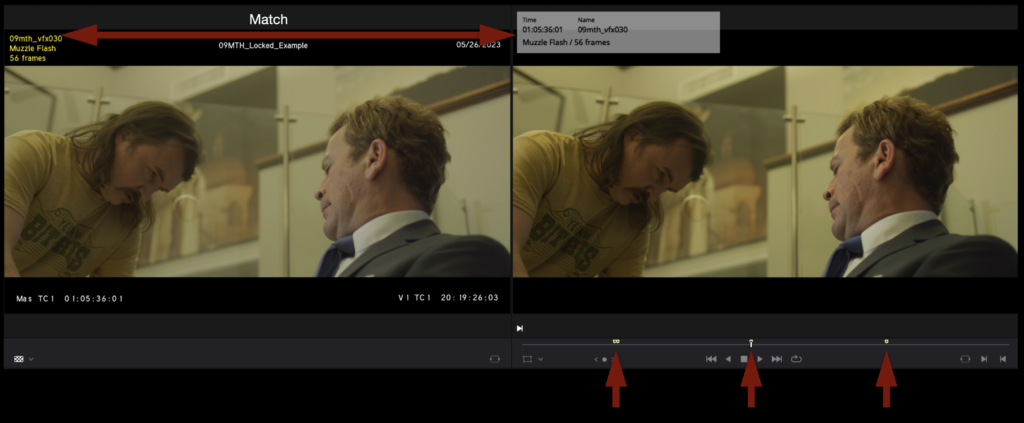
If you select one of the markers, you will see that all of the information that was logged into the marker in Media Composer and is in your VFX Turnover Sheet is present in the Resolve markers.
In the Media page comparing the online reference video and the Resolve sequence, you should notice that the VFX info burnt into the reference media matches the Resolve markers’ information.
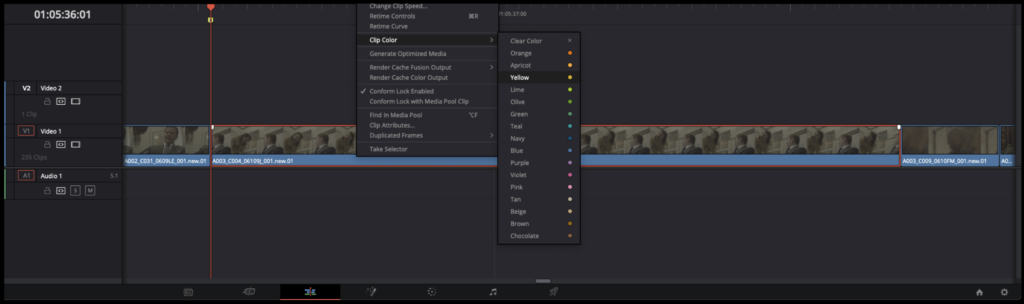
To make the following steps easier, you will need to change the VFX shots in the timeline to a different color. Right-click on each of the VFX shots and then select Clip Color > Yellow.
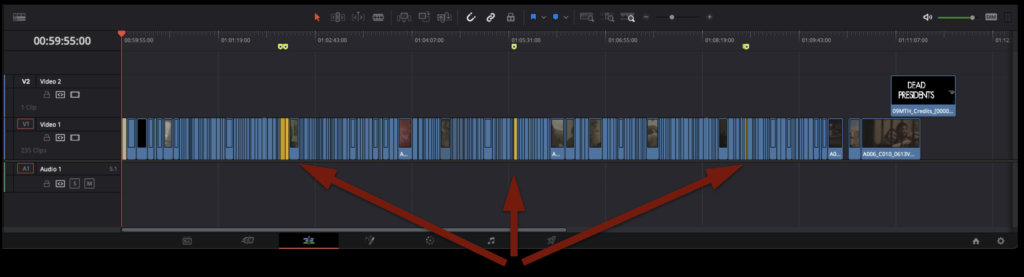
After you have changed the clip color to yellow for all of your VFX shots, your sequence should look similar to the example below.
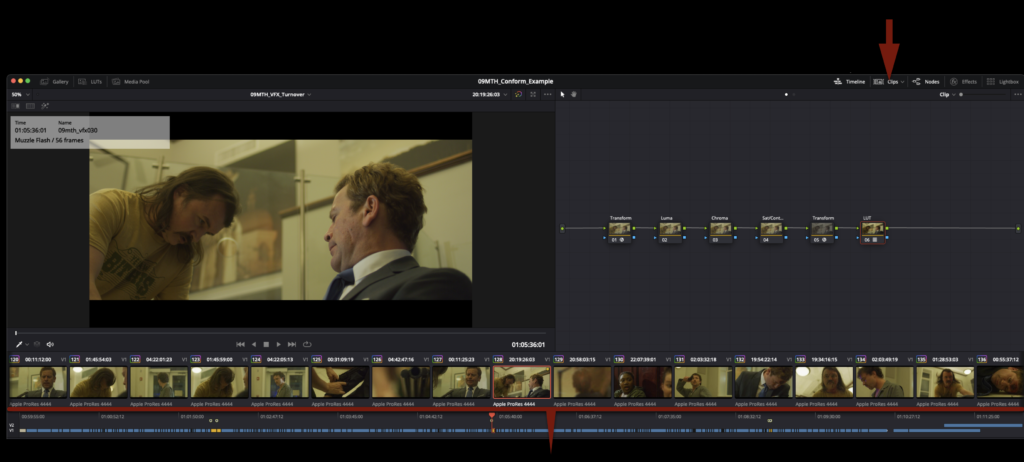
By default, the Clips Thumbnail Timeline in the Color page displays every clip in the sequence. But now that your VFX shots are tagged with a different color, you can sort by that color. Select clips as shown in the arrow bellow.
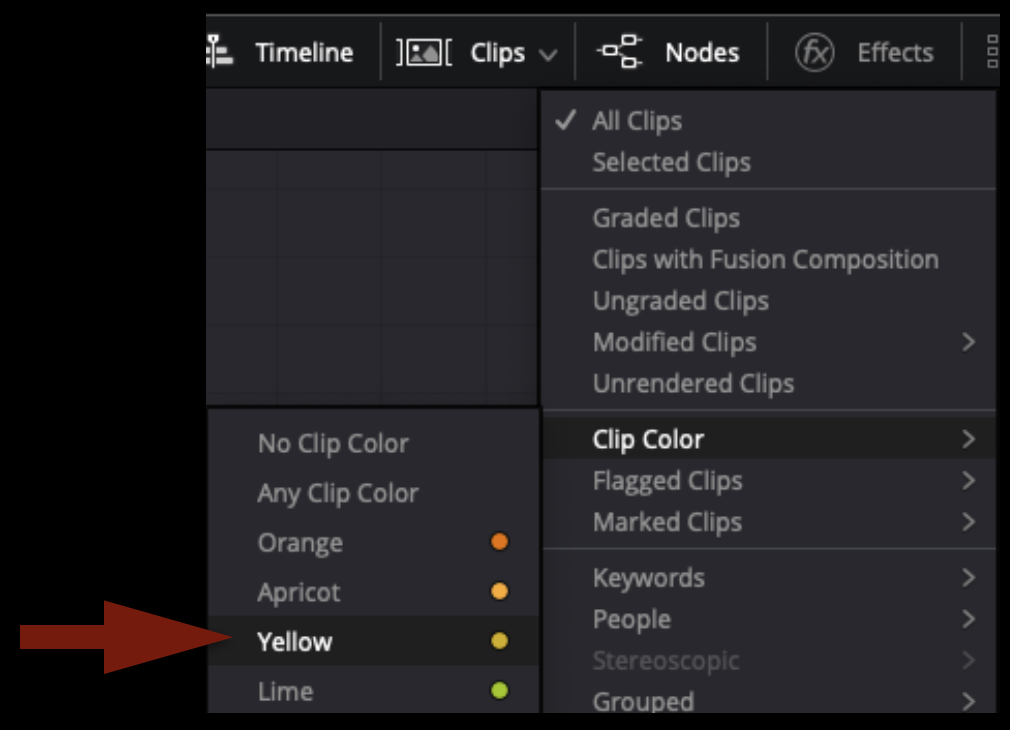
In the dropdown menu, select sort by Clip Color > Yellow.
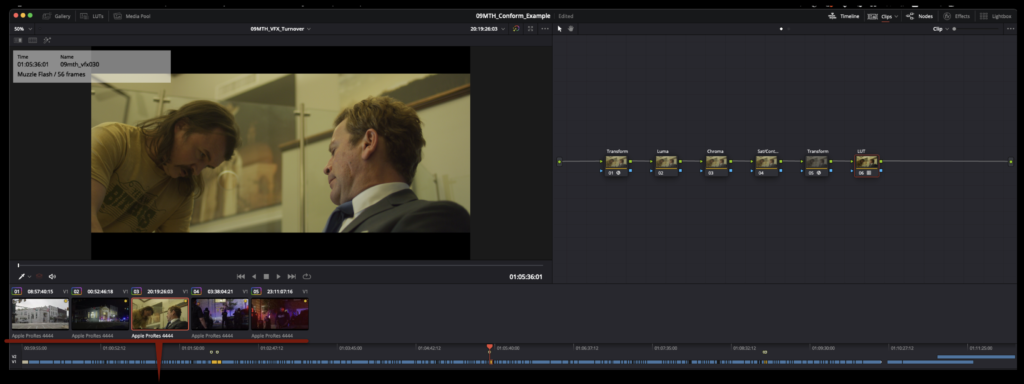
As you can see in the example below, only the VFX clips are now shown in the Clips Thumbnail Timeline.
Exporting VFX Elements
After that prep work is done, you are ready to begin exporting out the elements that will be sent to the VFX department. In our workflow these elements are the exact length as the shot that appears in the locked cut. Under certain circumstances the VFX Faculty may request that these elements get exported with “handles” (i.e., a number of extra frames on either side). However, the default turnover is “no handles”.
NOTE!This guide details how to turnover simple VFX shots requiring only one element or “plate”. This is why in the example shown there is only one “VFX element” per “VFX shot”. More complex VFX shots requiring the compositing of multiple live action elements captured during production are done the same way using the same naming logic. However, if your show has more complex VFX shots like this, please check with VFX Faculty and Post Staff before proceeding for more guidance.
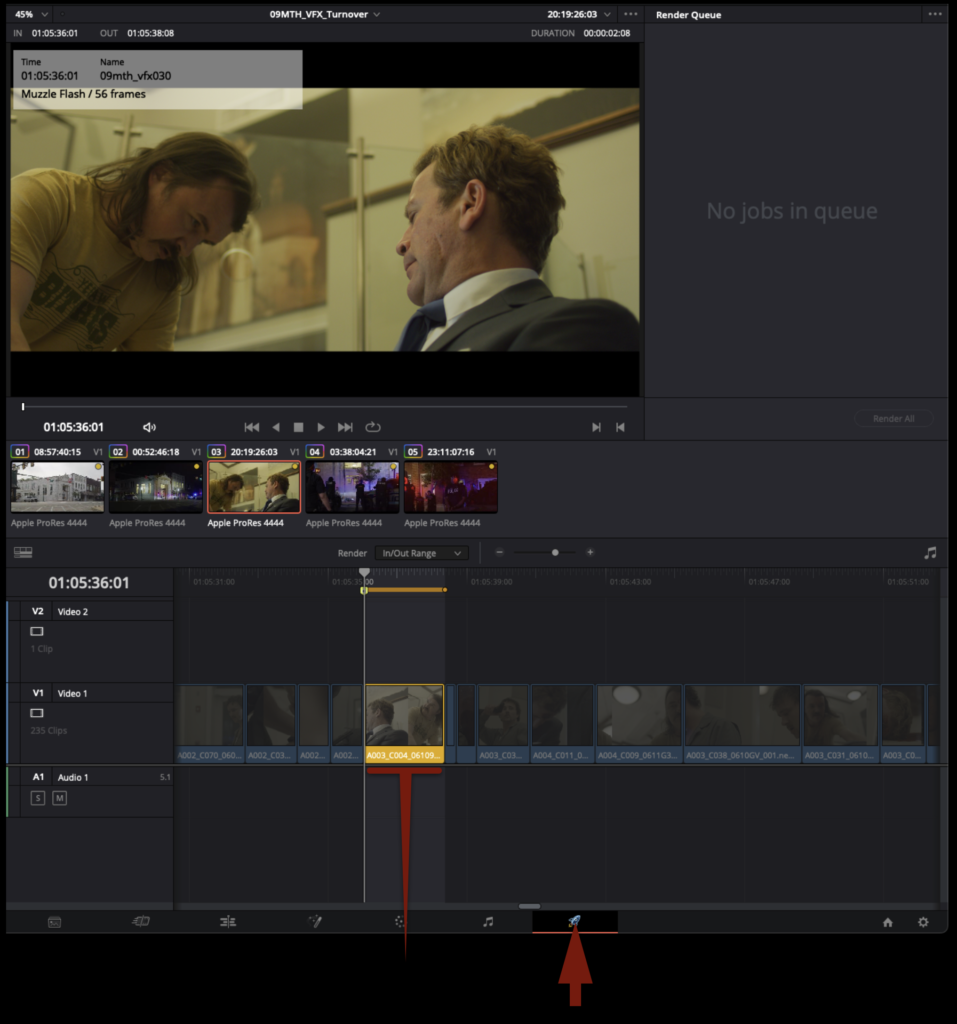
In the Delivery page, you can easily navigate to your VFX shots by selecting them in the Clips Thumbnail Timeline. Once selected, you can hit “I” and “O” on the keyboard to mark in and out around the selected clip. It is important in this step that you have marked around the entire clip and no additional frames on either side. You do not want to turn over elements with extra frames.
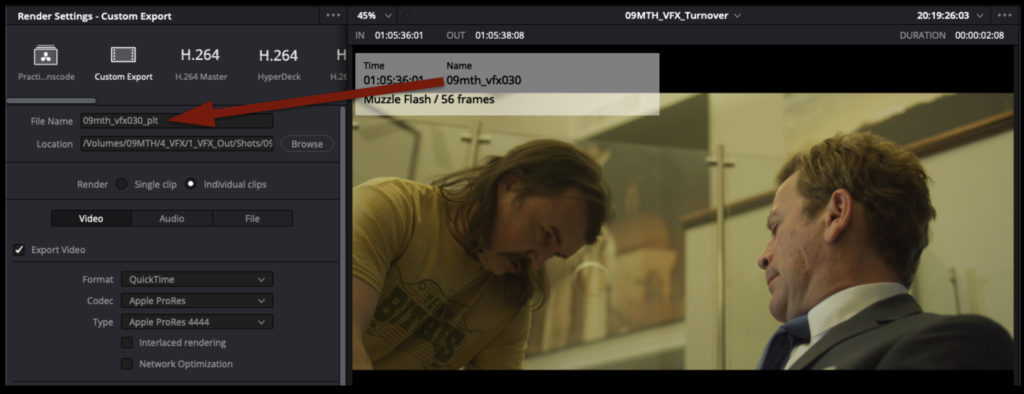
Under Render Setting on the Delivery page, you will need to label each element that you are going to export. The naming convention follows from the “names” or “shot code” that were assigned when the VFX shots were labeled in Media Composer (see the VFX Prep page). This naming convention MUST be followed.
Each element will be named with the assigned VFX name followed by “_plt”. In the example below the VFX shot is named “09mth_vfx030”. The element that is being turned over to the VFX department is a “plate” and thus should be labeled 09mth_vfx030_plt.
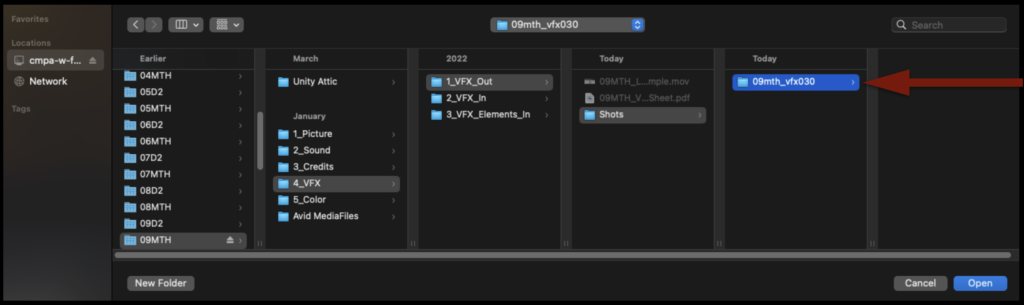
Select Browse to choose where to export. These plates should be exported to your show volume in the VFX > VFX Out > Shots folder. You will need to create the Shots folder and then a separate folder for each VFX shot, based on the VFX shot name.
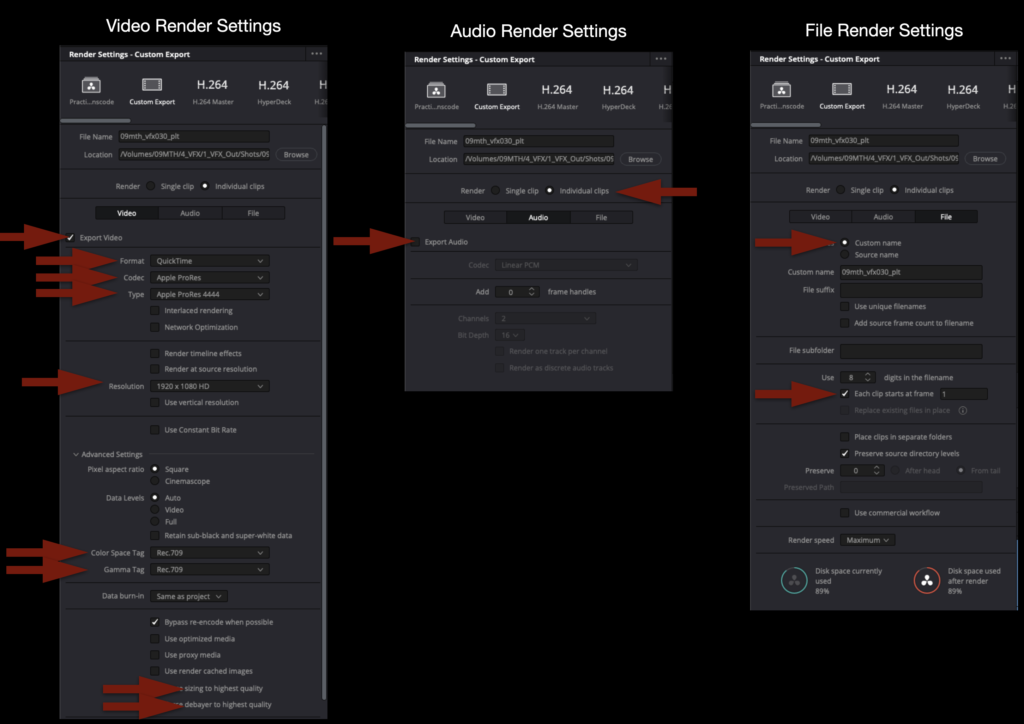
Below are the Render Settings for all VFX Turnovers. Double-check the settings carefully before exporting.
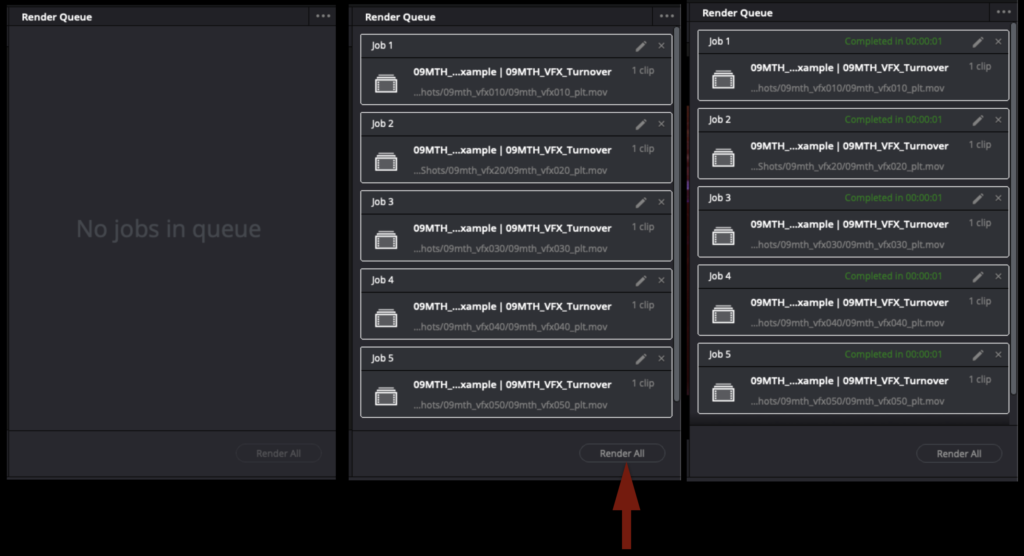
If you have more than one VFX shot or element to export, you can add each export job to the render queue and then render them all at once.
Once all of your renders are complete, it should look something like the example below. Notice how each VFX shot has its own labeled folder and inside that folder are the labeled VFX elements.
Check VFX Renders
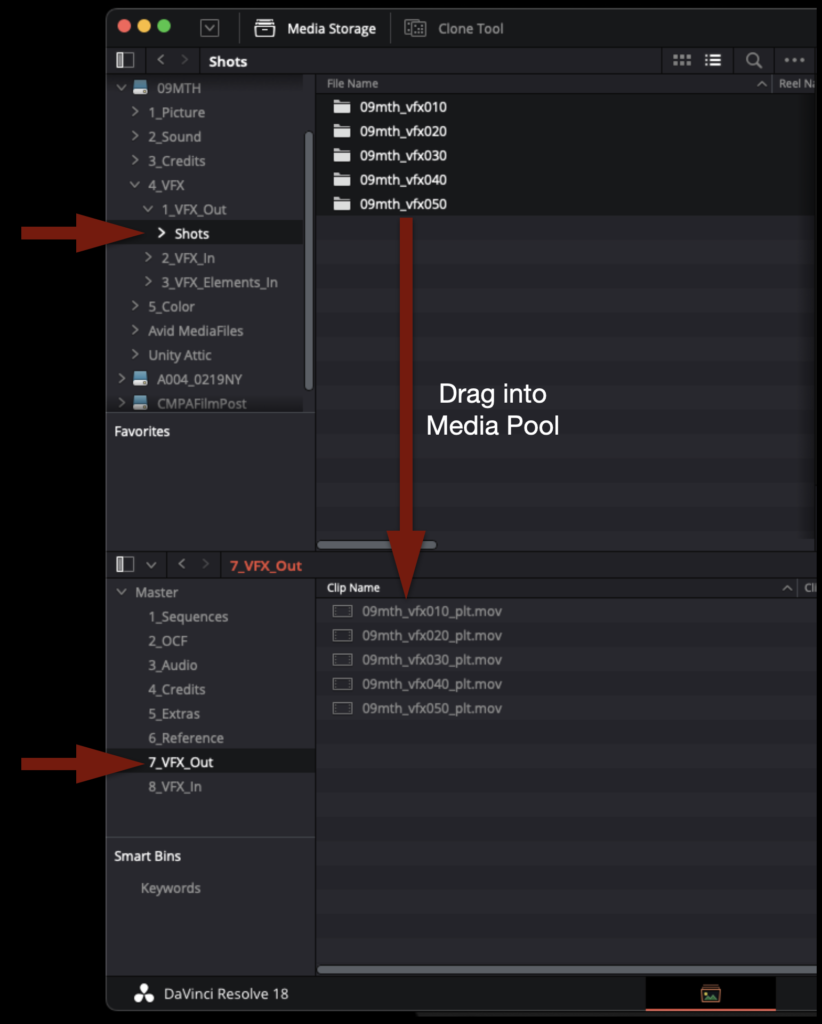
To check that the exports you made of each VFX element are correct, you will need to import them back into the Resolve project. On the Media page, navigate through your media storage to your VFX shots and drag them into the Media Pool to import them.
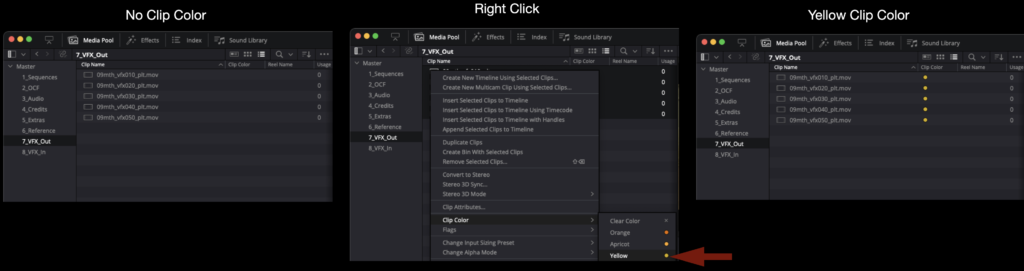
These clips should also be changed so that that the clip color is yellow inside of Resolve, to denote that they are VFX shots. In the Media Pool, you can highlight them all, right-click, and select clip color.
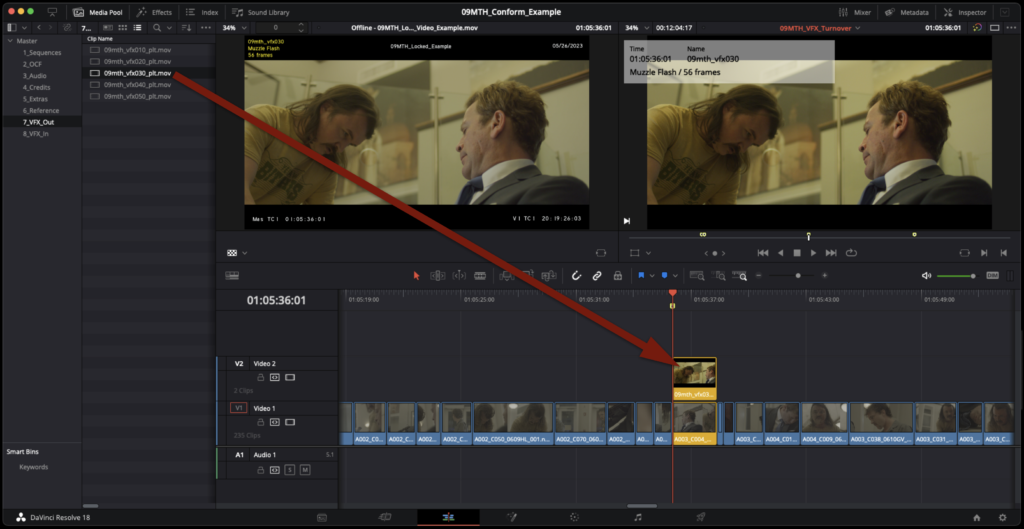
In the Edit page, carefully cut each turned-over VFX element back into the sequence on Video Track 2. This will ensure that you did not miss any VFX shots and that you exported out everything that needed to be turned over.
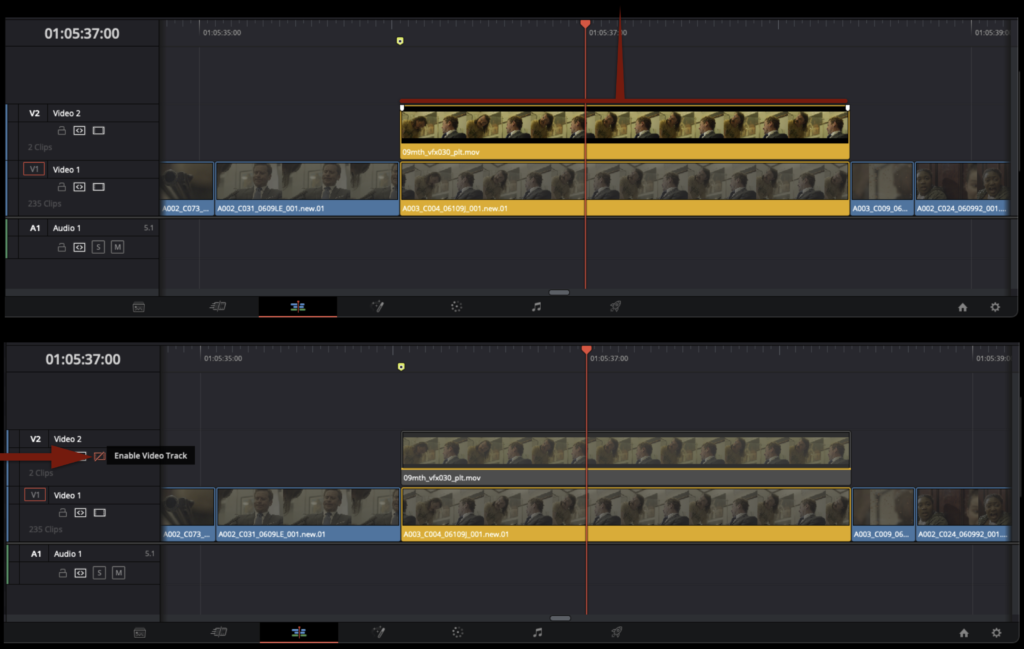
While the elements are on Video Track 2, you need to double-check two things. First, make sure that the export has the exact same number of frames as the clip below it. It should match exactly. Second, you can toggle Video Track 2 on and off to make sure that both layers are visually identical. You want to ensure that the elements turned over to the VFX department are identical to the Camera Original Files.
Wrap Up
Once you have checked each of the VFX elements that were exported, you should be left with a folder tree in the VFX Out folder that looks like the example below.
The VFX Turnover package, which consists of a Locked Reference Video, VFX Turnover Sheet, and all the VFX Plates are now ready for the VFX Department. In the industry, this package would typically be sent to the VFX Vendor over a secure, cloud-based application or loaded onto a hard drive and shipped. In our workflow, everything can stay in the VFX Out folder on the show volume. When the VFX cycle begins, the VFX artist will copy this folder to the VFX server and begin working from there.
Save the project by hitting “Command+S”. Then close the project and quit resolve by hitting “Command+Q”.