#paperwork

Certificate of Insurance

Overview

A Certificate of Insurance is a document issued by the university’s insurance provider verifying that approved production activities are covered under the institution’s insurance policies. Productions may need to provide this document to property owners, vendors, municipalities, or other outside parties before filming or conducting production-related activities.

Many locations and organizations require proof of insurance before granting permission for production activity to take place. The certificate helps demonstrate that the production has institutional coverage in place while supporting safer and more professionally managed relationships with outside partners and locations.

Instructions

The Producer of a film should submit this form to the Head of Production to request the issuance of a Certificate of Insurance by the College of Motion Picture Arts to a business or individual that has requested one.

If the College issues a Certificate of Insurance, it is solely to allow access to the facility and/or equipment that the business or individual is offering the production. The College is not liable for any damage or loss to said facility and/or equipment. The Producer and Director will be financially responsible for any damage or loss to said facility and/or equipment.

Animal Use Request

Overview

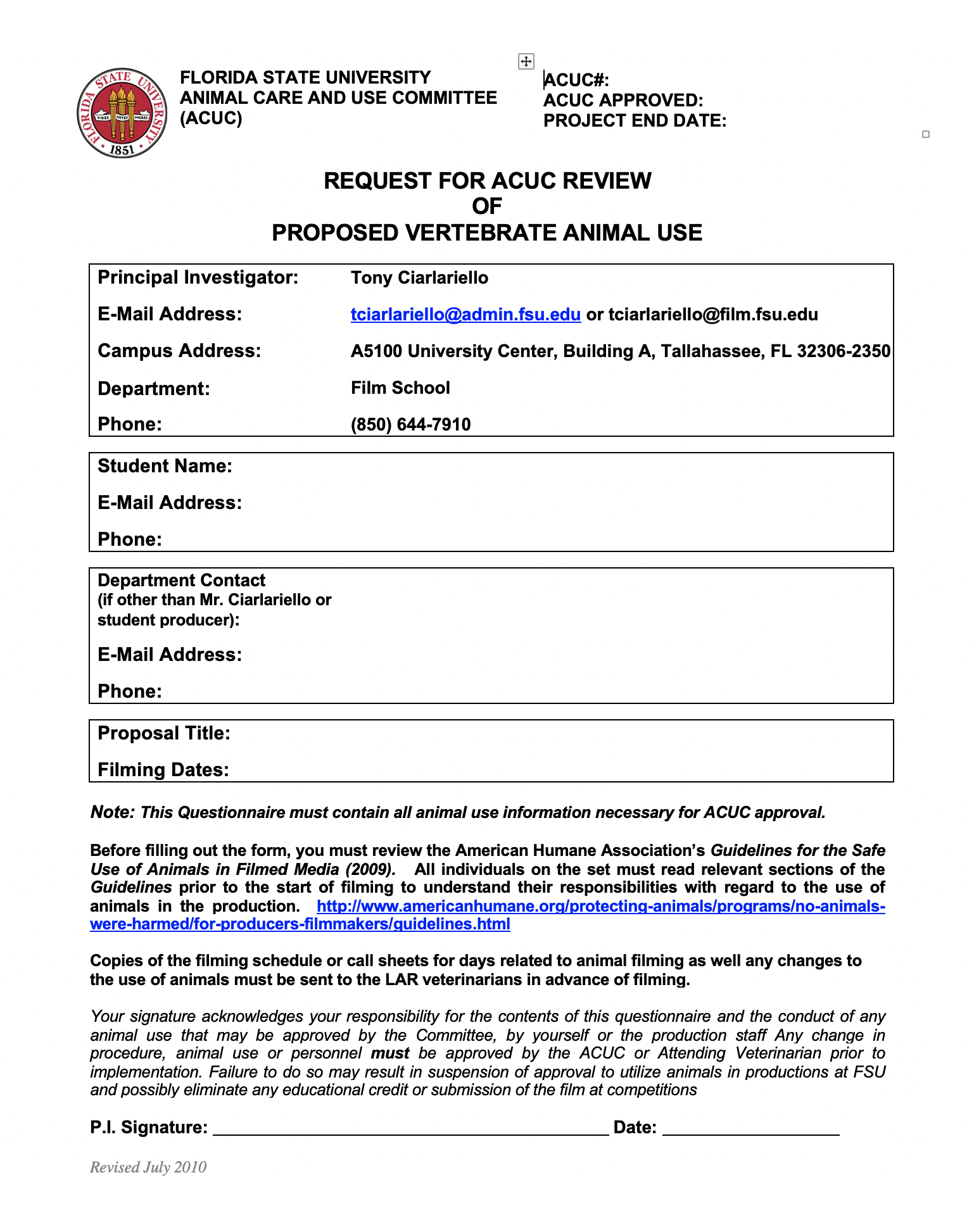
Productions wishing to include animals in filming activities must complete an Animal Use Request describing the proposed use of the animal, the conditions under which filming will occur, and the safety and handling procedures that will be followed during production. Approval comes from the FSU Animal Care and Use Committee.

Animals introduce additional safety, liability, scheduling, and welfare considerations that require careful review before approval is granted. The request process helps ensure that productions are planning responsibly, protecting the well-being of both the animal and the crew, and complying with university expectations regarding safe production practices.

FSU Animal Care and Use Committee

Producers are required by Florida State University policies to file a request for review of animal use on the production by the FSU Animal Care and Use Committee (ACUC).

Approval is required by federal regulation, but it also enhances the relationship of FSU with the public, demonstrating to the public that the University is concerned with all use of animals by the University community.

This request must be submitted well in advance of the start of the production, as it will usually take a number of weeks for a request to be approved. If a production does not receive approval from the ACUC in time for production, the use of an animal is not permitted.

Instructions

Prior to making a request for animal use, the Producer should review the relevant sections of the American Humane Association’s Guidelines for the Safe Use of Animals in Filmed Media.

Should a production require ACUC approval, ACUC requires that the ACUC Film School Protocol Form and a PDF of the script (highlighting the parts that contain animals) be submitted at least two weeks prior to any animal use. This will permit the Committee to perform its federally mandated oversight function to ensure University compliance with Federal regulations. Students are strongly encouraged to allow for more than two-weeks of turnaround time, in case delays occur or revisions are needed. Again—if the request is not approved in time for production, the use of an animal is not permitted.

The application is submitted to the ACUC Coordinator in the Department of Laboratory Animal Resources (LAR) office. The ACUC Coordinator then forwards a copy of the protocol to the LAR veterinarians for a pre-review. These individuals conduct a preliminary review with an eye to helping eliminate any stumbling blocks to approval by the full Committee. Suggested modifications and questions are provided to the person that has filed the protocol. The LAR staff is available for consultation and is often able to assist with locating animals suitable for the productions.

If last minute modifications to the production are necessary following approval, students are required to contact one of the LAR Veterinarians for approval prior to making any changes. The LAR Veterinarian will then report on the modification at the next ACUC meeting.

On occasion projects request the use of animal tissue rather than live animals. These productions/projects also must be reviewed by the FSU Animal Care and Use Committee for reasons related both to public concern over source and health reasons related to the handling of animal parts. Individuals should follow the above instructions for protocol submission. Also, individuals should be aware that certain precautions are necessary when handling animal carcasses or tissue. 
Call Sheet

Overview

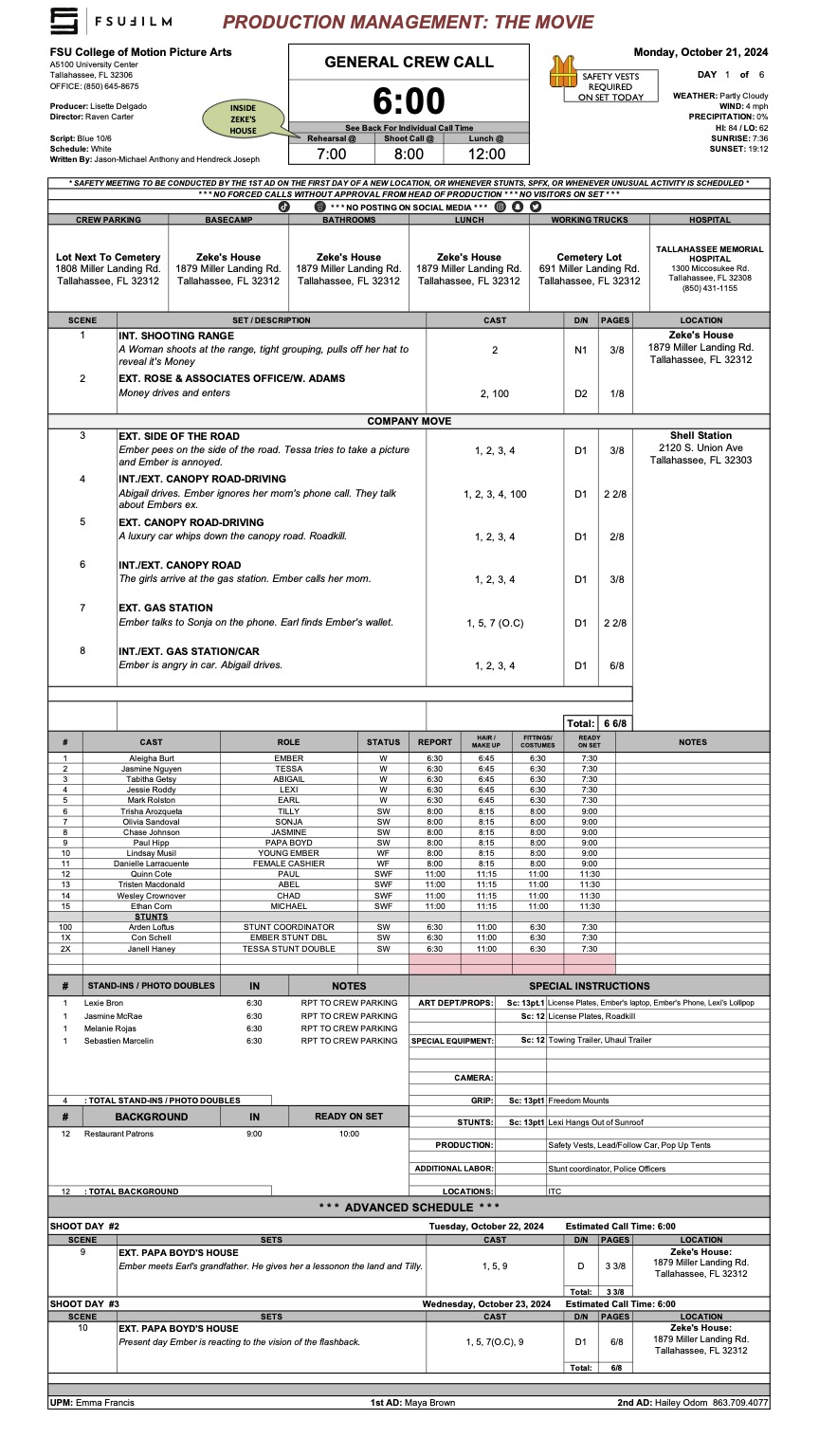
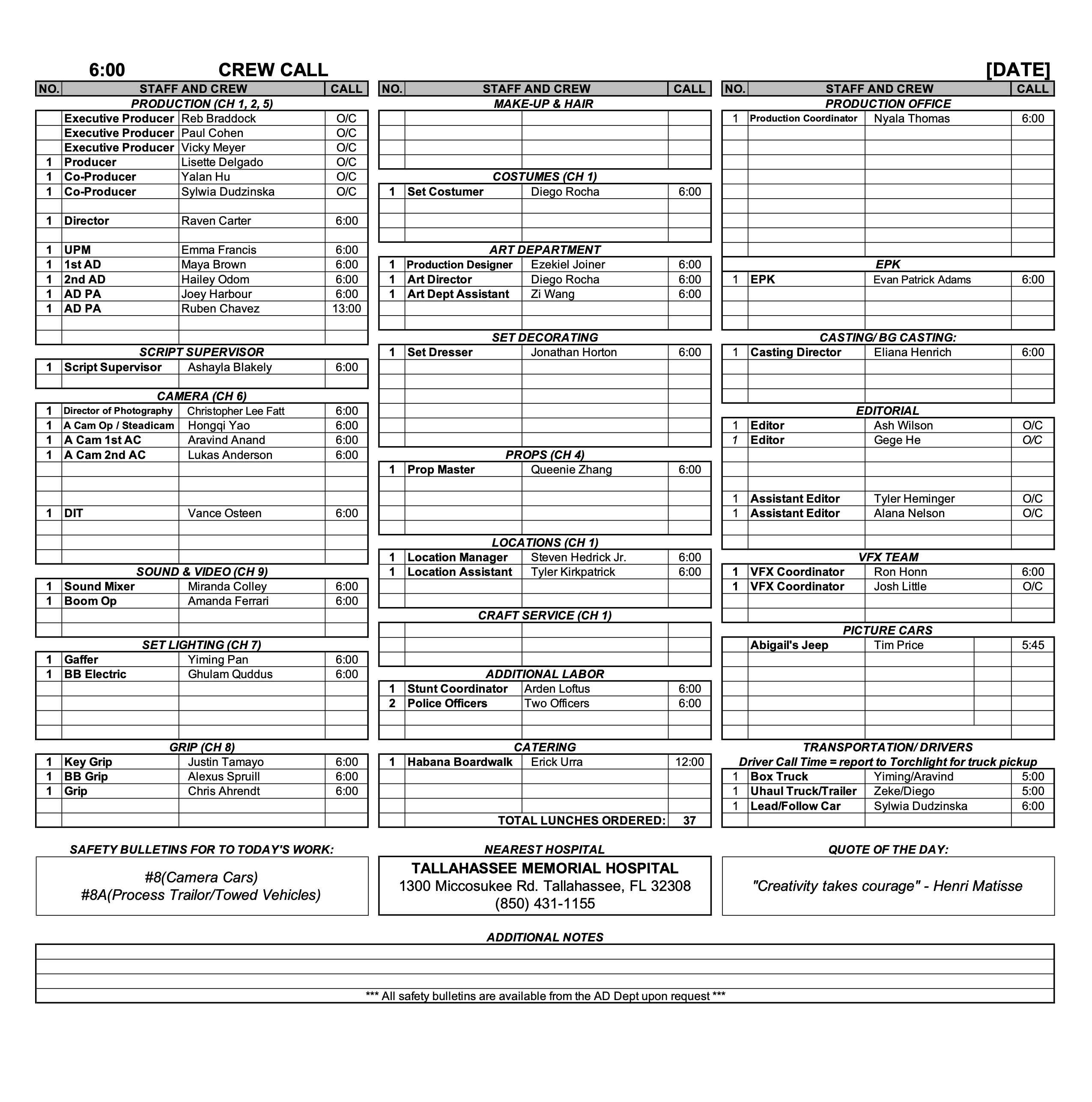
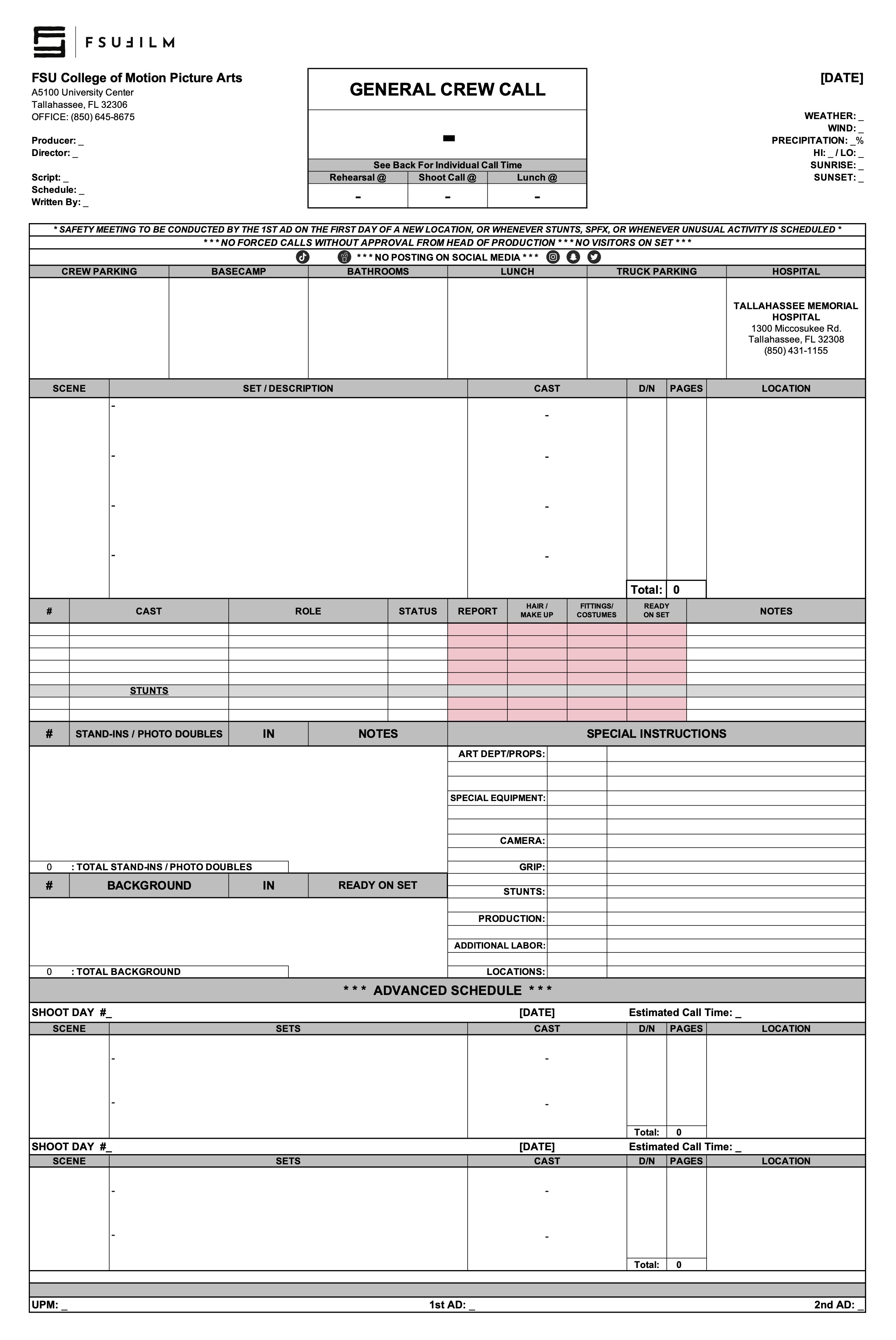
A call sheet is the primary daily production document used to communicate the schedule, locations, crew call times, cast information, scenes to be filmed, logistical details, safety notes, and other operational information for an upcoming shoot day.

Clear and accurate call sheets are essential because they serve as the central communication tool that keeps productions organized and aligned from day to day. Well-prepared call sheets help reduce confusion, improve coordination between departments, support safer production operations, and allow cast and crew to arrive properly prepared for the work ahead.

INSTRUCTIONS

The purpose of the call sheet is to provide all the pertinent information about the next day’s production. The Second Assistant Director is responsible for distributing a PDF of each day’s call sheet to the cast, crew, faculty, and FSU police. If the production does not have a dedicated Second Assistant Director, the First Assistant Director or Producer shall assume the responsibility.

Call sheets, along with any relevant additional information such as maps or safety bulletins, must be distributed no later than 12 hours before call time on the first day of production and no later than the previous day’s company wrap for all subsequent days. It is important to thoroughly check — and double-check — and triple-check — that all the information in the call sheet is correct before it is sent out, because the distribution of revisions can create confusion.

MESSAGING

Call sheets should be distributed with a subject line that follows this naming convention: 01f3-Film Title - Call Sheet - Day 1

You may include a brief, executive summary of important information in the body of the message, but this should not be a substitute for providing all relevant information in the call sheet itself.

Call sheets must be distributed in two ways:

  1. Post call sheets (and any relevant maps and safety bulletins) to the “Call Sheets” channel in Teams. This is for your instructors and assigned crew.
  2. Email call sheets to your cast, POL-PDSupervisors@fsu.edu (FSU Police), and any other relevant parties who need the call sheet.

Sample Call Sheet

Update accordingly for subsequent days. For instance, you no longer need to introduce yourself after day 1.

_________________________________________

SUBJECT: 01f3-Film Title – Call Sheet – Day 1

Hello 01F3 Team!

We hope everyone is excited to get working on, (“Film Title”), directed by (First Last Name).

My name is (First Last) and I am the (Position) for this film. I will be sending out call sheets, location directions, and general information each day of the shoot. When you arrive on set you will sign in with me and you will check out with me at the end of your day.

Attached are the call sheet, location info and parking instructions for tomorrow. Note, the location is approximately ## minutes away from the film school. Depending on your departure location, please plan accordingly. If you are part of a carpool, please ensure you allow extra time for pick-ups and drop-offs.

*Please read the call sheet thoroughly for specific information.

*Please arrive at least 15 minutes prior to your call time to ensure you have time to park and check in with me on time.

CREW CALL: 7:00AM

CAST CALL: See Below

(First Last) your call time is 7:45 AM

(First Last) your call time is 8:15 AM

FILMING LOCATION

Address: #### Somewhere St, City, FL, Zip

*Insert Google Maps Link here.

CREW/CAST PARKING

Add VERY specific instructions for parking here.

TRUCK PARKING

Add VERY specific instructions for parking here.

LOCATION NOTES

(Sample) Please DO NOT WALK ON THE GRASS. This is a specific request from the location owner.

(Sample) Dogs on site (they will be contained)

(Sample) Please keep exterior noise to a minimum.

DOCUMENTS ATTACHED TO EMAIL

-Call Sheet

-Location Map

-Location Parking Diagram

-Safety Bulletins: #5, #10

If you have any issues getting to set, or any questions whatsoever, please do not hesitate to call my number below.

We look forward to working with you!

Best,

(First Last)

(Your Position)

Cell: (###) ###-####

@FSU Email

(First Last)

Producer

Cell: (###) ###-####

@FSU Email

Sample call sheet (page one)
Sample call sheet (page two)
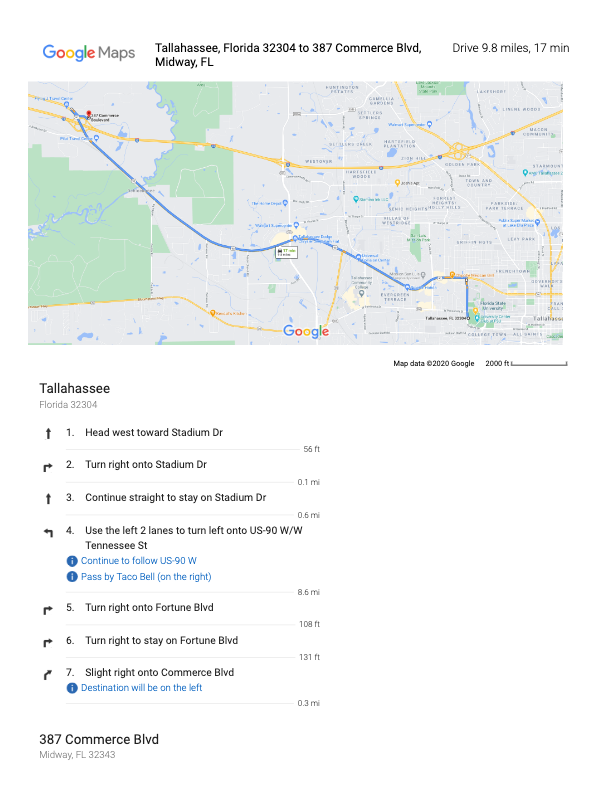
Sample map
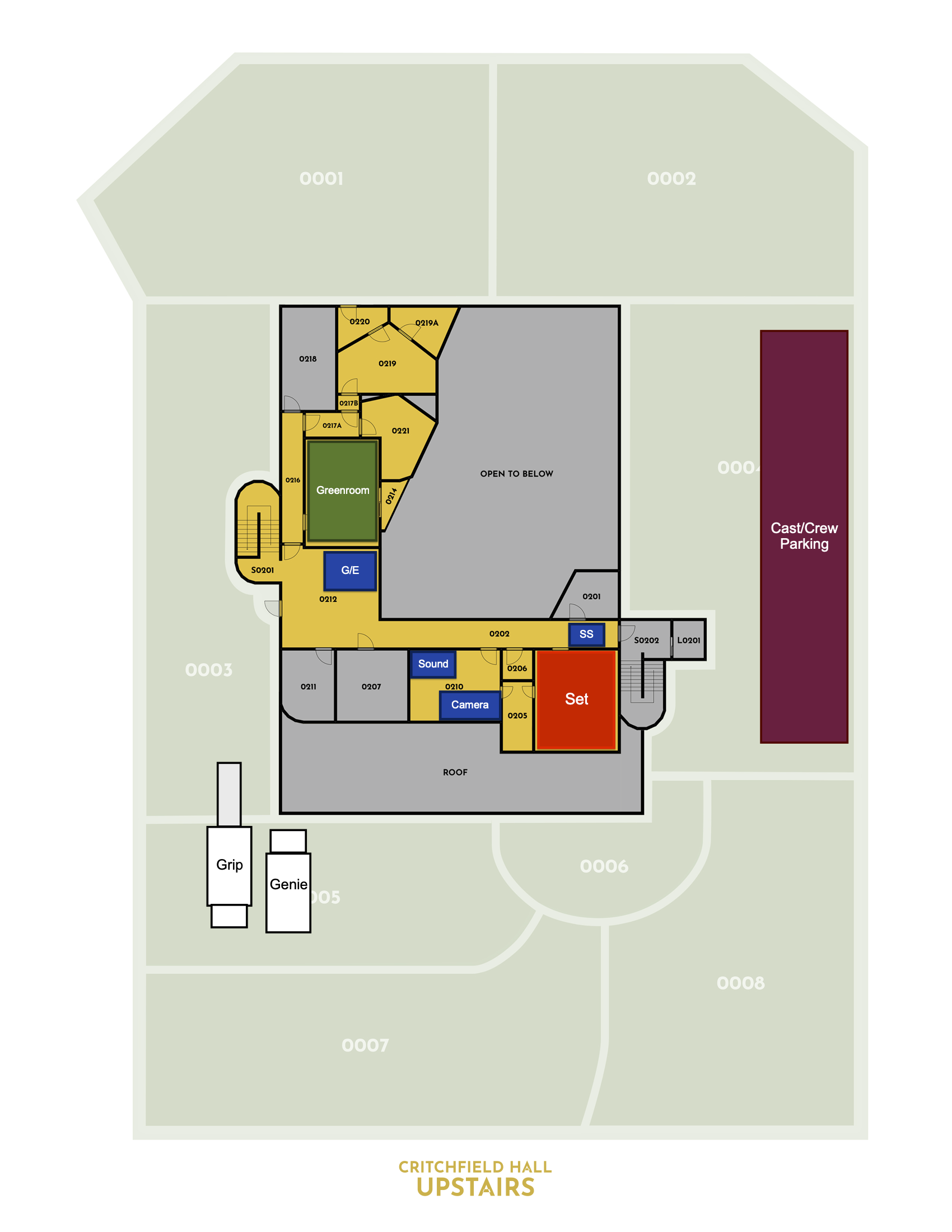
Sample location map

Set-up Schedule

Overview

The set-up schedule outlines the planned timing and workflow for preparing and shooting each set-up throughout a given production day.

Careful setup planning is important because productions rely on efficient coordination between departments before cameras begin rolling. Structured setup schedules help reduce delays, improve communication, support safer working conditions, and give crews a clearer understanding of how production operations are expected to unfold throughout the day.

INSTRUCTIONS

After the Director and DP have created a provisional shot list, the 1st AD will meet with the Director and DP to schedule the order of shots for each day. Using this Set-up Schedule, the shots should be listed in the order you intend to shoot them, including estimated times to set up and shoot each one.

Be sure to budget adequate time load-ins, load-outs, wraps, lunch, and any company moves.

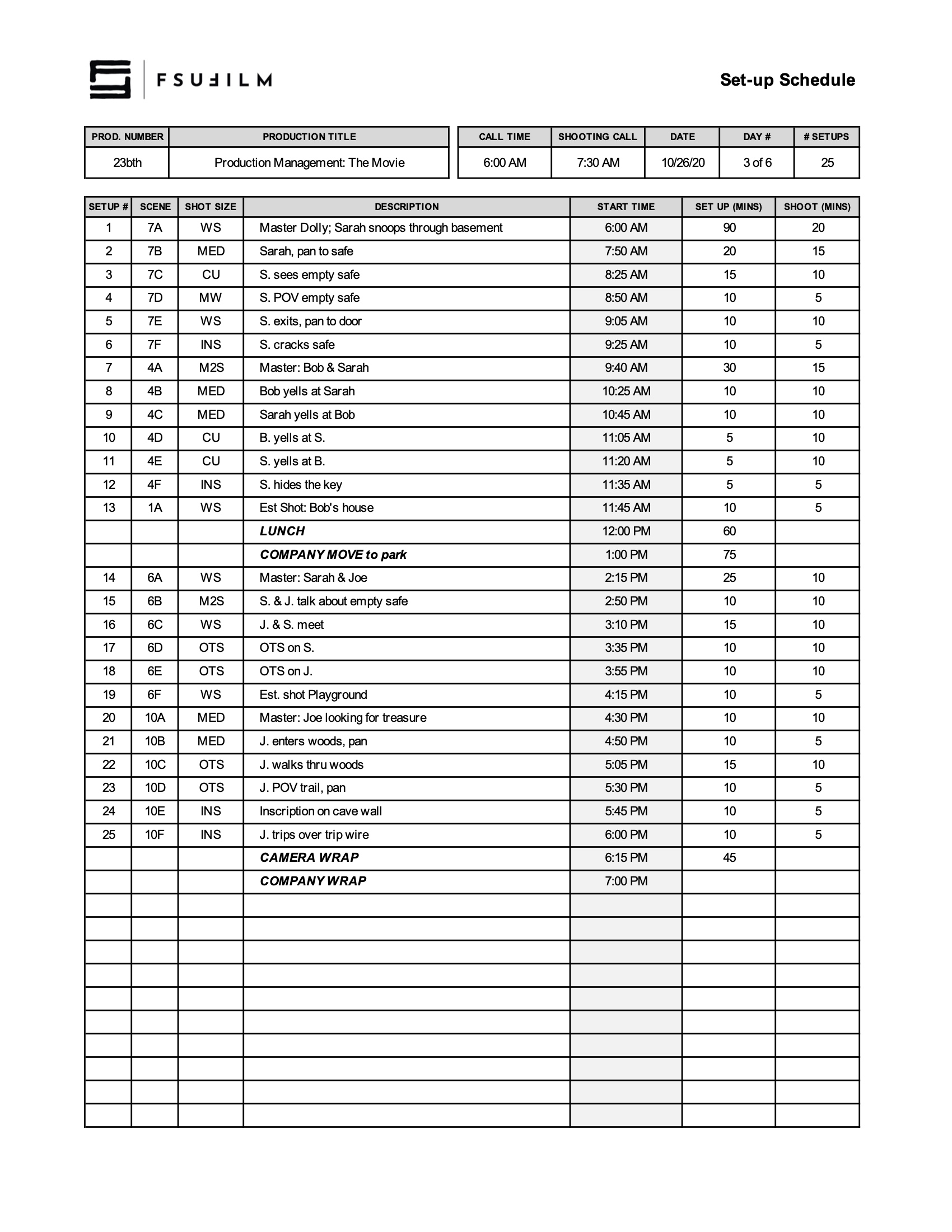
SAMPLE SET-UP SCHEDULE

Here’s a sample of what the completed set-up schedule should look like:

Sample of a completed form