Universal Production Music is a production music library available to students for approved use within film projects and related productions. This resource provides information about accessing the library, searching for music, and incorporating licensed tracks into student productions under the program’s agreement.
Using properly licensed production music is important because films intended for festival exhibition, online release, or public distribution must have clear rights documentation for all music used within the project. Access to a professional music library also helps students develop stronger practices related to music selection, licensing, and post-production workflow management.
How it Works
The College of Motion Picture Arts pays an annual fee to Universal Production Music (UPM)—the worlds largest music catalog—for the licenses to the library music they provide on their site.
All the music in UPM is pre-approved for use in any of our student productions. Each track should be credited in the end titles of the finished film, but no releases need to be signed for the use of this music, so long as you remain in accordance with the licensing agreement. Simply include a copy of the license in the final paperwork delivery for the project.
Contact the post-production staff if you need the login credentials.
Music rights refer to the legal permissions and ownership interests associated with the use of music within a film or media project. This includes rights connected to musical compositions, sound recordings, synchronization, master recordings, and other forms of music usage and licensing.
Understanding music rights is essential because productions cannot assume that music may be used simply because it is publicly available or easy to access online. Proper rights clearance helps productions avoid legal and distribution problems while reinforcing professional practices related to copyright, licensing, and responsible media usage.
Important Rules and Restrictions
Unfortunately, music rights are often neglected until the very end of post-production. This is a mistake that could come back to haunt you. Acquiring music rights is often a more difficult and time-consuming process than one might realize. It is therefore in your best interest to start thinking about the music in your film early—ideally during pre-production.
For this reason, all F1 and M1 projects are only permitted to use music from the Universal Production Music library, since the school has already licensed that music.
Producers on all other production cycles may use the other methods of acquiring music that are described below, but they should start the process of clearing rights as early as possible.
A show will not be permitted to mix with a piece of music if the music rights have not been 100% cleared.
An alternate track from the Universal Production Music library should always also be prepared as a back-up—in case unanticipated issues arise with the music rights and so that an alternate, screenable version of the film remains available after any music rights may have expired.
Working with a Composer
If you want your film scored, then you will want to contact several composers during pre-production. Explain to them what your story is about and ask them to send a demo reel. If you like their work, then ask them to produce a temp track based on the ideas expressed in the script. If you like the temp track, hire them to score the film. You should have them sign the School’s Composer Contract at the moment of hiring before they begin any work.
Provide them with copies of early cuts as well as the final cut of your film. The composer will then compose the score and submit it to you.
Licensed Music
If you want to use pre-existing music, then you will need to obtain the proper licenses in order to use the music in your film. You must get each license for at least:
Two-years
Film festival
Non-commercial
World rights
Getting the music rights could be as simple as sending letters to the publisher and record label, having them sign and return them. However, you may be required to complete their licensing agreements instead. If this is the case, make sure you have the Head of Production review the agreement before you sign it, to ensure we have the proper releases.
There are typically two different types of licenses that you will need to acquire:
This is the right to reproduce a specific musical composition in your film. It must be obtained from the copyright owner of the composition, which is usually the publisher. You can find out who the publisher is by searching by song title at either www.ascap.com or www.bmi.com.
Almost every song is represented by one of these two companies. Songs that are not represented by ASCAP or BMI might be found at the National Music Publishers’ Association “Songfile” website (www.nmpa.org). You will be provided with a contact at the publisher’s Business Affairs or Licensing Department.
Note that you will need to get a synchronization license from the publisher, even if you are making your own sound recording of that song. For example, if you have your actor sing or recite lyrics, whistle or hum the tune, play the song on a musical instrument, or in any way make your own sound recording of the song, you will need to get the synchronization license from the publisher.
This is the right to synchronize a sound recording with your visual image. You clear this right with the record label who owns the sound recording you would like to use. Check the liner notes of the recording to find out which company this is. Alternatively, you can get contact information for record labels by contacting either ASCAP or BMI (see above). You will be provided with a contact at the record label’s Business Affairs Department.
Library Music
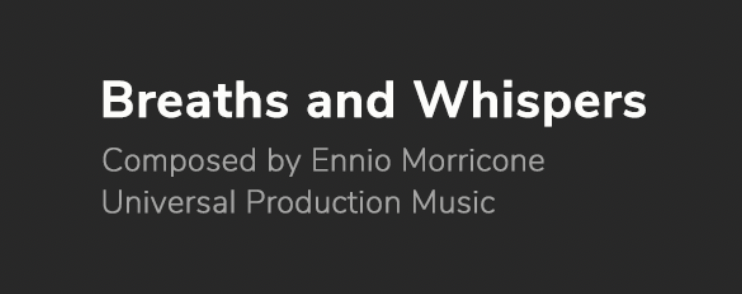
The school pays an annual fee to Universal Production Music for licenses to their library music. You are free to use any and all of the music in that library and no releases need to be signed. You will need to credit the song title and composer in the finished film for each piece of music that you use. Here’s an example:
[su_spacer size=”15″]
Public Domain Music
If you want to use a piece of music currently in the public domain, be careful. Know for sure that the piece of music is actually in the public domain. This can sometimes take a fair amount of research, as there is often unclear and unreliable information circulating about works that are supposedly in the public domain. All songs and musical works published in 1925 or earlier are in the public domain; anything published after 1925 should be assumed to be under copyright, unless otherwise stated. If the piece of music is in the public domain, then you can use it.
However, be aware that just because a musical composition may be in the public domain, that does not necessarily mean the sound recording of that composition is in the public domain. For example, the musical composition of Beethoven’s 9th Symphony is in the public domain, but the New York Symphony Orchestra’s recent recording of it is not. If you would like to use that particular recording in your film, you will need to get a license from the publishing company that holds the rights to that specific recording. You could, however, hire your own musicians to perform the 9th Symphony without needing to acquire a license to use the composition.
Creative Commons
Creative Commons is a community that offers an alternative copyright model for authors of creative works who would like others to be able to share, remix, sample, or build upon their work. Creative Commons provides a range of licenses that authors can attach to their creative works, giving other people greater or lesser degrees of permission to share or modify the work.
You may use Creative Commons work in your film if the original work has been licensed with one of the following license types, so long as you provide attribution in your film’s end credits:
Some of the Creative Commons licenses, however, do not play nicely with how we make movies. If you see licenses on works that include either of the following terms, you will most likely not be permitted to use those works:
NoDerivs. This license does not permit derivative works and requires that the original work is passed along unchanged and in whole, which is unlikely to happen in the context of our films.
ShareAlike. This license requires you to also license your work with a ShareAlike license. However, since the College owns the copyright on all student films, students are not permitted to license their films with a Creative Commons license, which makes it impossible for you to honor the original Creative Commons license.
Note, however, that many authors who’ve opted for a NoDerivs or ShareAlike license may be open to giving you permission to use their work if you contact them directly. If they are willing, you’ll need to follow the College’s usual process of acquiring a licensing agreement for a copyrighted work.
This page outlines the rules and professional standards governing the presentation of titles and credits in student films, including formatting expectations and appropriate content. Screen credits are intended to recognize individuals and entities who contributed directly to the production and are expected to follow established professional conventions.
Maintaining clear standards for titles and credits is important because credits function as an official production record and reflect the professionalism of both the film and its filmmakers. Accurate, properly formatted credits help ensure that contributors are recognized appropriately while reinforcing industry expectations surrounding presentation, attribution, and professional conduct.
Content vs. Credits
For FSUFILM productions, title and credits are limited to a maximum of 60 seconds. This can be divided between Lead Titles and End Credits but combined together their length is not to exceed 60 seconds. This allotted time includes the Logo card and the Copyright card at the end of the credits, each of which must run for two seconds each.
Titles and credits that run over picture or audio that is not “advancing the narrative” will count toward your 60 seconds for titles and credits. Titles and credits that run over picture or audio that is “advancing the narrative” will count toward your Content time.
Remember that the primary purpose of credits is to credit that people which contributed to the creation of the film. Content time is for story, credit time is for credit. Any questions will be left to the discretion of the directing and editing faculty.
Rules
At FSUFILM, we adhere to a professional standard for the presentation of credits and titles in all student films. Film credits serve the sole purpose of recognizing those who contributed directly to the production and are not a space for personal messages, jokes, or informal content. All credits must be accurate, appropriately formatted, and aligned with industry standards to maintain the integrity of the work and the professionalism of our filmmakers.
Every show must adhere to the following rules. No exceptions.
There can be no visual changes made to the FSUFILM leader.
There can be no possessive credits (“A Film by Me”) or production company credits. Only FSU makes these films.
Students must use their real names and are not permitted to take their name off a film.
Whenever possible, students who do more than one job should have their name listed once with all jobs in one place.
Only ATL crew, actors, and the title may have single cards. Everyone else should be in groups, listed efficiently to be legible but not lengthy.
There can be no dedicating the film to someone.
A “Special Thanks” section may be added to thank individuals or businesses that helped support the production, but aren’t credited elsewhere. A few rules:
The list should include only formal names and/or business names. No other language is permitted.
Use real names—not nicknames or terms like Mom & Dad.
If you wish to thank faculty or staff members, rather than singling out individuals, use the more inclusive: “College of Motion Picture Arts Faculty and Staff.”
For production cycles that ran a Spark fundraising campaign, include a general thank you to “Spark Donors” in every film. You may additionally thank individual donors, if you have a special relationship with them and would like for them to be able to see their name on screen.
Thanking a deity of any sort is not permitted. The State does not hold a religious affiliation, so FSU cannot thank any God or Gods.
This page outlines the university and college policies governing smoking, vaping, and tobacco-use during production activities and while using FSU facilities, locations, vehicles, or production spaces. These policies exist to support a safe, professional, and respectful working environment while ensuring compliance with university regulations and location requirements.
This protocol exists to provide provisions for crewmembers who smoke/vape, whilst also protecting locations and other people from cigarette smoke. The Producer on a show is responsible for making sure that these protocols are followed. In all cases, the production shall defer to any local or municipality laws regarding smoking, such as the Smoking Regulations for the State of Florida.
Sound Stage Shoots
Cigarette smoking and vaping is prohibited anywhere on campus. Therefore, for any production that shoots on the school’s sound stages, cigarette smoking and vaping is prohibited.
Location Shoots
During pre-production, the Producer is responsible for requesting permission from the location owner for crewmembers to smoke/vape during the production.
If the location owner agrees to smoking occurring at (or nearby) the location, the Producer and location owner will agree to a set of parameters about where smoking can and cannot occur. Under no circumstances can smoking occur within 150-feet of camera, craft services, video village, production vehicles, or any other work area.
During production:
The Producer is responsible for providing a cigarette can.
The Producer is also responsible for making sure that crewmembers are aware of, and are following, the smoking agreement at the location. This information should be included on the call sheet.
If a BTL crewmember would like to request a smoking break during the day, it must be approved by the department head. If a department head would like to request a smoking break, it must be approved by the 1st Assistant Director.
At the end of day, the Producer is responsible for making sure that there is no remaining cigarette waste at the location.
If a location owner does not agree to smoking occurring at or nearby the location, smoking is prohibited at that location.
This page outlines the circumstances under which students may be placed on probationary status or dismissed from the program. Because the program operates within both an academic and collaborative filmmaking environment, students are expected to consistently meet standards related to academic performance, professionalism, reliability, safety, and participation, including compliance with the University Academic Honor Policy, Student Conduct Code, Summons to Responsible Freedom, and the CMPA Foundations of Professionalism.
Clear probation and dismissal procedures help ensure fairness, transparency, accountability, and a shared understanding of the expectations required to remain in good standing within the program.
Academic probation
Once students are accepted into the major, they must maintain a minimum cumulative GPA of 3.0. This includes first-year liberal studies courses for undergraduate students. If a student’s cumulative GPA falls below 3.0, the student will be placed one semester of academic probation. Students will be reinstated in good standing if the cumulative GPA rises to 3.0 by the end of the probationary semester. Failure to raise the GPA to 3.0 will result in dismissal from the program.
Unprofessional conduct
Successful collaboration is of such importance to the College community and the artistic life of any filmmaker that failure to develop professional working skills can result in disciplinary action. This is based on the observed professional behaviors of the student, and not on the GPA or artistic strengths of the student, as it is not uncommon to have a very talented student who simply cannot work well with others. The College considers professionalism a key aspect to a filmmaker’s success and integrity and believes that talent without grace is not a quality the school wants from its graduates.
Throughout each semester, the faculty assesses how well each student performs in each area of the College’s Professional Code of Conduct: collaboration, proactivity, civility, reliability, punctuality, and safety. If a concern about student’s professional conduct emerges, a faculty member will meet with the student to present the concern and hear the student’s point-of-view. The faculty member will then provide a report from the meeting to the rest of the instructors who are working with the student that semester. That group of instructors will then make a determination about an appropriate course of action, which may include:
All Clear
Official Warning
Remediation Plan
Recommendation for Dismissal
All Clear
The faculty determines there are no significant professionalism concerns and the student remains in good standing.
Official Warning
The faculty determines that the student is falling below the College’s professional standards, but not to the degree of compromising the work of fellow students or the effectiveness of the faculty. The student will be issued an official warning in writing, with guidance on where to improve.
Remediation Plan
Behavior so negative, disruptive, or destructive as to compromise the work of fellow students or the effectiveness of the faculty and/or inability to work positively in a collaborative environment shall constitute a failure to meet the College’s standards of professionalism, as described in the Professional Code of Conduct. The student will be placed on professionalism probation for a defined period of time and the Assistant Dean will meet with the student to issue them a remediation plan that describes the areas of deficiency, the required actions to demonstrate improvement, and an end date for the remediation plan.
At the end date of the remediation plan, a student on probation will be reinstated in good standing if, in the judgment of the faculty and administration, the professionalism concerns have been corrected in accordance with the student’s remediation plan. Peer evaluations may be considered in this evaluation process. A student’s failure to comply with the remediation plan at any time during the probationary period may result in dismissal from the program. Should a relapse occur after a period of probation has ended, the student may be placed on another remediation plan or may be recommended for dismissal without probation.
Recommendation for Dismissal
Faculty or administration may recommend that a student be dismissed from the program for reasons other than GPA if: (a) the student has failed to comply with a remediation plan during a probationary period; (b) the student relapses egregiously in an area of professionalism that had previously resulted in a remediation plan; or (c) the student exhibits behavior so negative, disruptive, or destructive as to endanger fellow students, faculty, or members of the community. The student will be issued a dismissal letter that explains the reasons for the dismissal, the administrative steps that follow the dismissal, options that are available to the students, and a notification of the student’s right to an appeal.
Appeal process for students
A student placed on a remediation plan or dismissed from the College for reasons other than GPA may appeal the decision. The student’s appeal must be submitted in writing to the Associate Dean within 10 class days from the date on which the student was placed on a remediation plan or dismissed.
For students placed on a remediation plan, the Associate Dean will review all materials related to the faculty’s decision. If the faculty has followed University and College policies and there is no evidence that the faculty has acted in an arbitrary, capricious, or discriminatory manner, the Associate Dean will uphold the faculty’s decision to place a student on probation, and the student has no further recourse. If the Associate Dean determines that the faculty has not followed University and College policies or has acted in an arbitrary, capricious, or discriminatory manner, the Associate Dean will determine the final outcome for the student.
For students dismissed from the program, the Associate Dean will review all materials related to the faculty’s decision. If the faculty has followed University and College policies and there is no evidence that the faculty has acted in an arbitrary, capricious, or discriminatory manner, the Associate Dean will uphold the faculty’s decision, and will notify the student of their right to appeal to the Dean. If the Associate Dean determines that the faculty has not followed University and College policies or has acted in an arbitrary, capricious, or discriminatory manner, the Associate Dean will determine the final outcome for the student.
This page outlines the ownership structure and rights associated with student film productions created within the program, including how ownership applies to the completed films and related production materials. Because the College pays for each student’s production, the State of Florida retains the copyright to all student work, as defined by Florida State University Regulation 6C2R-6.0091.
Clear ownership policies are important because film productions involve contributions from many collaborators while also operating within university-supported production systems. Establishing consistent ownership guidelines helps students better understand their rights and responsibilities while reducing confusion surrounding usage, exhibition, archival access, and future distribution of student work.
Copyright and Chain of Title
Florida State University will maintain Chain of Title for all films and screenplays created by College students during their time in the College; this includes any work created while enrolled in any course at the College.
Original screenplays written for production – any screenplay, treatment, outline, or synopsis written to be produced at the College is owned by the College regardless of whether the story is produced or not. Stories developed for production, but not produced, become part of the College’s archive, and may or may not be produced at a future time at the discretion of the College. If these stories are ever produced, the original writer will receive a “story by” credit in the finished work.
Co-writers – in most cases the College requires that the student be the sole author of their work at the College. In some exceptions, the faculty will allow students to collaborate with other students as co-writers. Any co-writer must be approved by the administration (the appropriate faculty member and the Associate Dean) prior to any drafts being written. In some cases, the College may allow for collaboration with FSU students from other departments and in rare cases, with non-FSU students. Any approved co-writer that is not an FSU film student is considered work-for-hire and must sign an agreement giving the College all copyright in perpetuity. Failure to get approval or delivery of the necessary agreements can result in the student being dismissed for unethical conduct.
Adaptations –adaptations may be considered if the student is able to acquire the motion picture rights in all markets and in perpetuity, and to have those rights assigned to the College prior to the beginning of any writing class for which the screenplay is a requirement. Regardless, the proper clearance must be reviewed and approved by the Associate Dean.
The only exceptions to ownership by FSU are anything written by College students that were written as stand-alone works, not to be produced by the College. This can include stand-alone feature screenplays, teleplays, and stage plays, which are all owned by the writer.
FSU College of Motion Picture Arts Ownership Policy
As established by Florida State University Regulation 6C2R-6.0091 in the year of 1991, The Florida State University College of Motion Picture Arts owns all interests to which students may be entitled in any student production, including federal and state copyright interests. To wit:
6C2R-6.0091 – Ownership of Student-Produced Films
Purpose and Intent: This rule establishes policy governing:
The ultimate disposition of the student films;
Promotion of the collective work of the College of Motion Picture Arts (the “Film School”);
Protection of the reputation of the College. It is also intended to recognize the equity and interest of the individual students involved in their use of these films as portfolio pieces in the advancement of their careers; and
Graduate and Undergraduate programs.
Ownership of student productions:
Upon admission to the College or prior to the commencement of workshop exercises and filming, the University shall require all students to sign an acknowledgement of university ownership of all student productions. Each student enrolling in the College, thereby agrees to be governed by this rule and accepts all terms and conditions set out herein.
The acknowledgement shall contain substantially the following wording: “In consideration of admission to the College of Motion Picture Arts and other good and valuable consideration, I hereby acknowledge that the College is the owner of all interests to which I may be entitled in any student production, including federal and state copyright interests. I hereby further agree to be governed by all terms and conditions of the College as contained in Rule 6C2-6.0091, F.A.C.”
Screenplays:
Screenplays that are generated as “stand alone” products by students are the student’s individual property. They may be copyrighted in the student’s name and exploited commercially in whatever way the student wishes. However, the student will be responsible for all costs and liability associated with whatever use he or she makes of any student production.
Screenplays that are submitted by the student for production either as exercises or as thesis films become the property of the university, if accepted, and if incorporated into such a film. The use of such a completed film, its screenplay and its other parts is governed by the policies set forth elsewhere in this rule.
General Film and Video Works:
This rule applies to student film and video products, regardless of state of completion.
The Florida State University’s College of Motion Picture Arts retains all rights to all student films and videos produced. In particular, the University is vested with exclusive rights and ownership to the copyright of all student works and with exclusive rights to exhibit, distribute and duplicate these films and videos and to enter into distribution or broadcast licensing arrangements, whether commercially or non-commercially.
Subject to the conditions contained herein, the College will allow students to purchase prints of particular film and video productions on which they worked, the use of which is restricted exclusively to their inclusion in the students’ career portfolios. These prints and tapes shall not be exhibited, broadcast, distributed or duplicated in any fashion without explicit written permission from the Office of the Dean of the FSU College of Motion Picture Arts.
The availability of such portfolio prints for purchase is always subject to approval by the College. If, for example, the College’s faculty considers a particular student film too elementary or too poorly executed to represent properly in public the typical level of student achievement at the College, it may decline to make it available to the student filmmakers involved. In this regard, the College attempts to protect the reputation of both current and future students.
Students who are allowed to purchase prints of their films and videos will agree to assume full responsibility and all liability for any screening of those films for potential employers and others outside Florida State property.
In the event any net revenues are derived from the commercial or non-commercial exhibition, distribution, broadcast or duplication of any particular student film or video, the principal student film or video makers involved in its production shall receive a royalty, the nature of which will be determined by the Dean or his designee or designees in consultation with the Office of the University Attorney. The payment of royalty to any student shall reflect general university royalty policies, as set out in the BOR/UFF Collective Bargaining Agreement, 1988- 1991, Article 18; The Florida State University Faculty Handbook, Section 7; and Rule 6C2- 6.009, F.A.C., which are incorporated by reference.
The principal film or video makers involved in the production of a film or video are the writer, the director (or writer/director), the producer/production manager, the cinematographer, the editor and the audio supervisor. Should a student musical director/composer and/or art director function on the production, they also will be considered part of the team of principal film and video makers.
Any student films that are not completed within the deadlines that are set are also the permanent and exclusive property of the College.
Licenses, Contracts, Clearances, Waivers and Other Legal Agreements:
The incorporation of certain elements into a student film, especially music, but also animation, art work, derivative story properties, and the use of certain types of real public or private property, may involve property that is protected by a variety of laws, including statutory copyright and common law. Students are responsible for securing appropriate legal releases for the use of such property and films; recognizing that releases may contain or be subject to constraints by law regarding their use. The faculty of the Film School will take such matters into consideration in deciding whether or not to make student film exercises and thesis films available for exhibition outside the university.
The College will totally restrict the distribution of a student product when the appropriate releases have not been obtained for all materials used in the work.
Film Festivals and Competitions:
The College reserves the exclusive right to enter its student films and tapes in festivals and competitions, whether regional, national or international. If students request, the College may also agree to enter student “stand alone” scripts in competitions. Alternatively, students may enter their own scripts.
Any financial prizes for “stand alone” scripts done by students will go directly to the individual student(s) who wrote the script.
Any financial prizes won by student films or tapes made at the College will be placed in a student development fund, the revenues of which will be used to support student productions, scholarships or other student benefits.
Any certificates or statuettes of award received by student films will be displayed at the appropriate facilities in Tallahassee.
General Procedures:
The College will retain the motion picture negatives and/or video master tapes of all student films made as part of its programs. These will be used as needed to make prints or printing masters for either students or the College.
Each of the College’s completed productions will bear a copyright notice in the name of The Florida State University. At the time of its release, broadcast, exhibition or duplication the copyright will be registered with the Copyright Office by the College.
Completed College student productions will bear full credit titles in the position and order prescribed by the College. Any College of Motion Picture Arts student productions that are released or exhibited will bear the FSU and College logo and name as the producing studio.
Specific Authority 240.227(1) FS. Law Implemented 240.229, 240.241 FS. History–New 5-27-91.
This page outlines the overall structure and pacing of the program schedule, including how production cycles, coursework, deadlines, and major milestones are organized throughout the curriculum.
The schedule is designed to create a structured and immersive production environment that balances creative development, technical training, collaboration, and project completion within a limited timeframe. Understanding the larger rhythm of the program helps students plan more effectively and recognize how individual courses and productions fit into the broader educational process.
How It Works
The College of Motion Picture Arts is a conservatory. Its unique educational structure is based on the comprehensive process of production. Each level of the student’s education has a development phase, a pre-production phase, a production phase, and a post-production phase. Classes are organized, scheduled and structured to compliment the natural process of making a film.
To accommodate the 200+ films produced in any given year, the College operates on a very structured schedule. This rigid structure exists to provide each student and each faculty member sufficient time and resources for their class and production needs. This is essential to our value of the level playing field.
This schedule, while complicated, is also very organic. It may change with little notice to accommodate any number of “X” factors that arise during the semester. Changes in the schedule range from class changes to accommodate a special workshop to mundane room changes.
Students are also required to complete a number of tasks that fall outside the realm of the published weekly College schedule, such as homework, small group meetings, location scouts, and production meetings, etc. These outside requirements are also organic and specific to the needs of each individual class and production, and quite often happen during the evening and on weekends. It is also not unusual for the administration to call impromptu meetings to discuss issues, schedule changes, or unexpected opportunities.
Students enrolling in the College, therefore, must be willing to make a 24/7 commitment to the program.
The weekly schedule
The weekly schedule is the key instrument for holding the classes and other schedules together. The weekly schedule is created by administration, approved by the faculty, and updated and distributed by the Assistant Dean for each program.
Weekly schedules are viewable in each cohort’s “Schedule” channel in Teams. Revisions to the schedule are then posted to Teams as needed. All efforts are made to ensure changes are made in a timely manner, but sometimes that isn’t possible. In those instances, the student is always responsible for being aware of any schedule revisions. For this reason, students are expected to turn on notifications for the Schedule channel in Teams, so that they are alerted of all schedule changes.
Tracks and specializations
Both BFA and MFA students are divided into smaller groups within their cohort. Classes meet either in separate tracks/specializations or in combined tracks/specializations, depending upon the needs of a given course. The administration will set the tracks at the beginning of each semester.
Crew grids
For each production cycle, crew grids are created by the administration, approved by faculty, and distributed by the Head of Production. The crew grids plot out crew positions and production dates for the cycle and are designed to provide equal access to time and resources for each student, in accordance with the College’s level playing field philosophy.
Due to evolving changes in curriculum, equipment, or the number of students in a given cohort, the crew grid for a specific production cycle is subject to change from year-to-year.
Emergencies
If a personal emergency arises, the College administration will work with the student to accommodate such events to the degree that is does not impact the student’s ability to recover or make up the missed work.
In these instances the student is required to contact the Assistant Dean of their program immediately to communicate the nature of the emergency and to ensure the College has the necessary information. During their absence, the student is required to stay in touch and work with the Assistant Dean on any necessary details that would affect the student’s required schoolwork. Maintaining a good line of communication during such emergencies is essential, and failing to do so may result in disciplinary action.
In some instances, due to the lockstep nature of the curriculum, a student may not be able to continue in the program if a personal situation results in the student being unable to adequately make up for missed work.
As a required part of the College curriculum, each student will perform a variety of on-set and off-set crew positions. This page explains how students are assigned to production crews and how crew structures operate within the program’s filmmaking environment.
Crew assignments are an essential part of the educational model because filmmaking depends heavily on collaboration, shared responsibility, and cross-department coordination. The crewing process is designed not only to support productions operationally, but also to ensure that students gain meaningful and equitable experience working in a variety of production roles and collaborative environments.
Rights and responsibilities
It is the primary mission of the College to provide a level playing field for all students, so that they have an opportunity to perform a variety of crew positions for the purpose of their education. Students performing these crew positions are doing so for the primary purpose of their education, with a secondary purpose to provide support for production.
Students have the right to perform assigned crew positions, regardless of their actual or perceived skill level.
Only students enrolled in the College of Motion Picture Arts may hold a faculty-assigned crew position. At no time may a non-member of the College perform, supervise, or take over any faculty-assigned crew position.
Any student who takes over another student’s job, who switches jobs without prior approval of the Head of Production, who refuses to work on assigned responsibilities, or who refuses another student the right to perform their assigned job will be in violation of FSU’s Academic Honor Policy and the College’s Foundations in Professionalism policy and may be placed on immediate probation or dismissed from the program without advance notice.
Evaluation of student performance for the purpose of grades or disciplinary action is the sole right of the College faculty and staff.
Crew grids
For each production cycle, crew grids are created by the administration, approved by the faculty, and updated and distributed by the Head of Production. The crew grids plot out crew positions and production dates for the cycle and are designed to provide equal access to time and resources for each student, in accordance with the College’s level playing field philosophy.
The crew grid for a specific production cycle is subject to change from year-to-year, due to changes that inevitably occur in curriculum, equipment, or the number of students in a given cohort.
Crewing process
The Head of Production will administer the crewing process for each of the production cycles. For some cycles, the Head of Production may randomly assign all crew positions, while on other cycles students may be permitted to submit crewing requests to the Head of Production.
Once the crew grid has been published, any crewing changes must be approved in advance by the Head of Production. If subsequent changes are then made to the grid, the Head of Production will publish colored revisions to students.
The level playing field policy outlines the program’s efforts to maintain fairness and consistency across student productions with regard to access to resources, opportunities, equipment, staffing, and production support.
Because productions operate within a shared educational environment, maintaining reasonable equity between projects is important to both the learning experience and the overall health of the program. The policy helps ensure that productions are evaluated and supported within comparable conditions rather than based primarily on outside advantages or unequal access to resources.
How It Works
In order to provide a level playing field with equal access to school resources, all major film projects are tightly scheduled. This allows each show within a particular level of production to have the same number of crew members and production days, as well as equal access to all of the equipment and production facilities needed to bring a film to completion.
Additionally, the school pays for all the baseline expenses needed to make a movie, including expendables (such as batteries, tape, gels, and fuel for trucks) and a catering budget for all major live-action productions (since each crew needs to be fed!). On advanced-level projects, the school also provides supplemental budgets to assist with additional expenses related to such things as production design, actor-travel, and music rights.
To maintain this level playing field, students may not alter the assigned parameters of any production. Each student must make their film within the pre-determined constraints of their production. Any student who violates this essential level playing field will be subject to review and possible probation or dismissal from the College without a prior period of probation, in addition to the termination of the project.
Use of outside resources
It is understood that under certain circumstances, a production may require further resources. When this is necessary, the student, under the Assistant Dean’s supervision, may supplement catering, production design, or actor-travel with additional funds. This is permitted so long as it does not exceed the project-level limits as determined by the College.
Students may seek donations of goods and services as a supplement to their budgets. To do so, any donations must be backed with a letter confirming the source of the donations and must be submitted to the production supervisor. Students may not seek donations of items, expendables or equipment provided by the College or any donations that compromise the level playing field concept within the College.
For BFA and MFA capstone projects, students are permitted to run a friends-and-family fundraising campaign as a supplement to their budgets. Each fundraising campaign is a collective enterprise and the money raised is divided equally among all students in the cohort, so as to maintain the level playing field concept. Individual fundraising campaigns are not permitted.
This page explains the broader educational philosophy guiding how classes operate within the program, including the relationship between classroom learning and production work.
The curriculum is designed around the idea that filmmaking is learned most effectively through a combination of hands-on practice, critical discussion, repetition, collaboration, and reflection. Understanding this approach helps students better navigate the expectations of the program and recognize how classroom experiences connect to larger production and professional workflows.
How It Works
The manifestation of our values is in our unique approach to classes.
In traditional schools, students enroll in lecture courses and/or attend labs in practical workshops. The pre-production, production, and post-production of the film is considered “homework” – something that is assigned in class and is then executed on the students’ own time. At the end of the semester, the student “turns in” the film and the instructor evaluates the finished work.
Our College operates the opposite way. Based on our values in craft, hands-on experience, peer learning, and industry practices, we structure our curriculum around the process of producing a film. To this end, we have two types of classes:
Lecture classes
These are what you would think of as traditional lecture or lab classes, which take place in a classroom with the entire class and an instructor. Our lecture classes differ from traditional lecture classes, however, in that they are designed to be integrated into the College’s larger mission.
Lecture classes do not always meet at the same time, same place every week, and often run as targeted modules for portions of a semester to better support student learning and the production of films.
Faculty members also often collaborate across different lecture classes to sync up the learning experience for students and show the connections between the different craft areas of filmmaking.
Practicum classes
These are classes that fall outside the traditional lecture/lab model, and extend specifically to the process of creating a film. These include tech scouting, production meetings, crew drills, camera/lighting tests, principal photography, dailies screenings, picture and sound editing, visual effects, animation, or any other production activity that is required to create a film.
In this approach, our film sets are our classrooms and they are equally as important as a traditional lecture class. The practicum classes are done in the field with students acting as crew and faculty supervising as mentors.