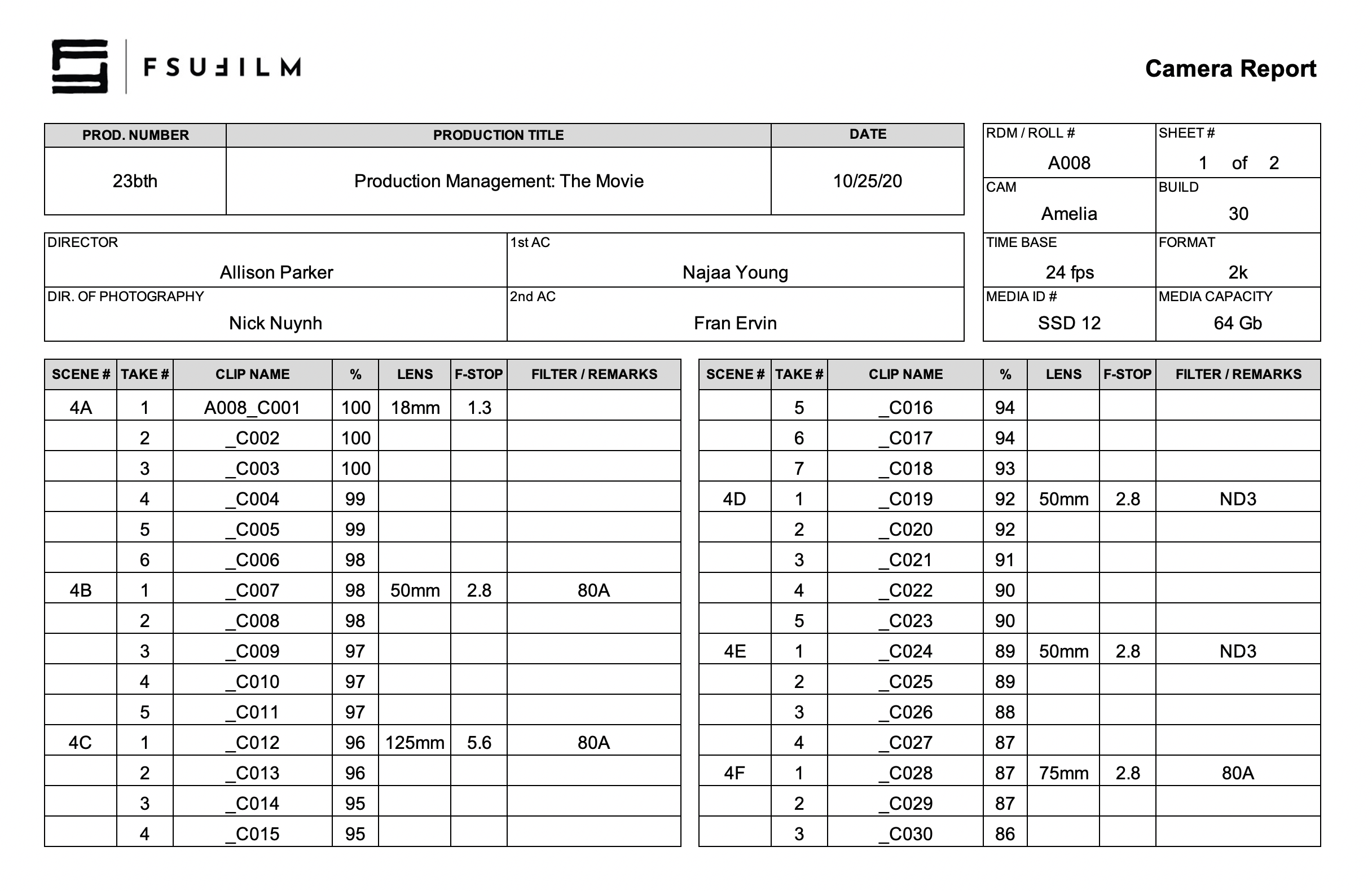
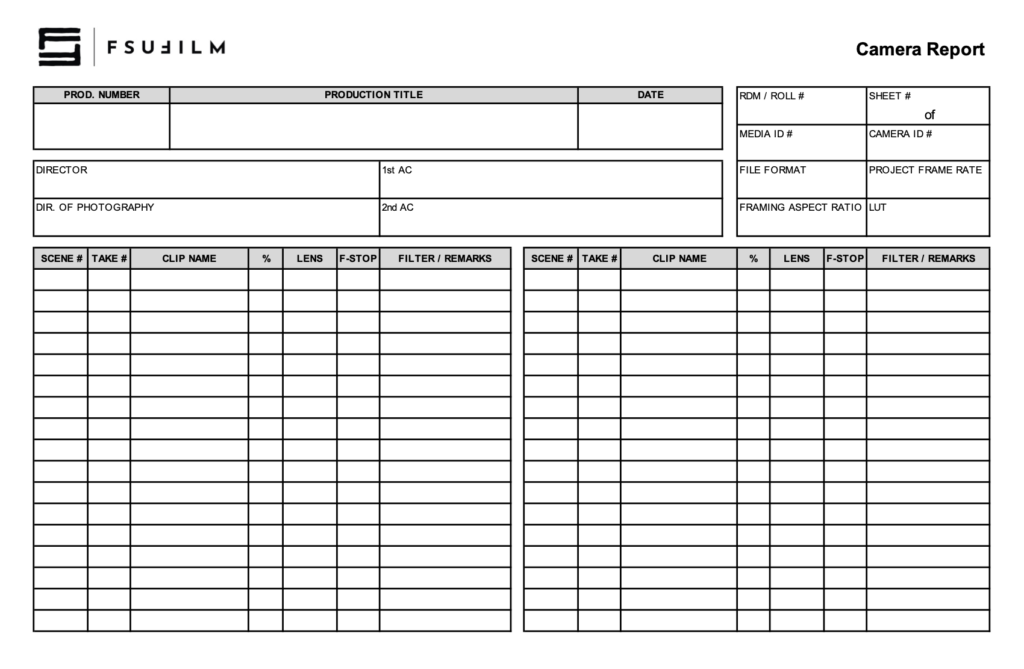
The Camera Report documents technical and organizational information related to footage recorded during production. This includes scene and take information, media card tracking, camera settings, lens and filter data, and other production details associated with camera operations.
Accurate camera reports are important because editorial and post-production workflows depend heavily on reliable production records when organizing and reviewing footage. Consistent reporting helps reduce confusion, improve media management, and support smoother communication between camera, script supervision, editorial, and post-production departments.
The 2nd AC completes the Camera Report. For the info in the top-right corner:
RDM/Roll #: A sequential numbering of each of the camera cards used. For example, the first camera card used on day 1 would be A001. The next camera card used, say on day 2, would be A002. And so on.
Sheet: A sequential numbering of Camera Reports for each camera card. For example, for camera card SSD 56, you start with Sheet 1. If you fill up Sheet 1, then you would continue on a new Camera Report, Sheet 2. And so on.
Media ID #: The ID number on the camera card.
Camera ID: The serial number that can be found on the bottom of the camera.
File Format: The file format that is set on the camera menu. Standard for Red Epic is 2K ProRes 444.
Project Frame Rate: The frame rate of the project edit timeline. Standard is 24fps.
Framing Aspect Ratio: The aspect ratio used for the camera framing guides.
LUT: The Look Up Table settings that were selected in the camera menu.
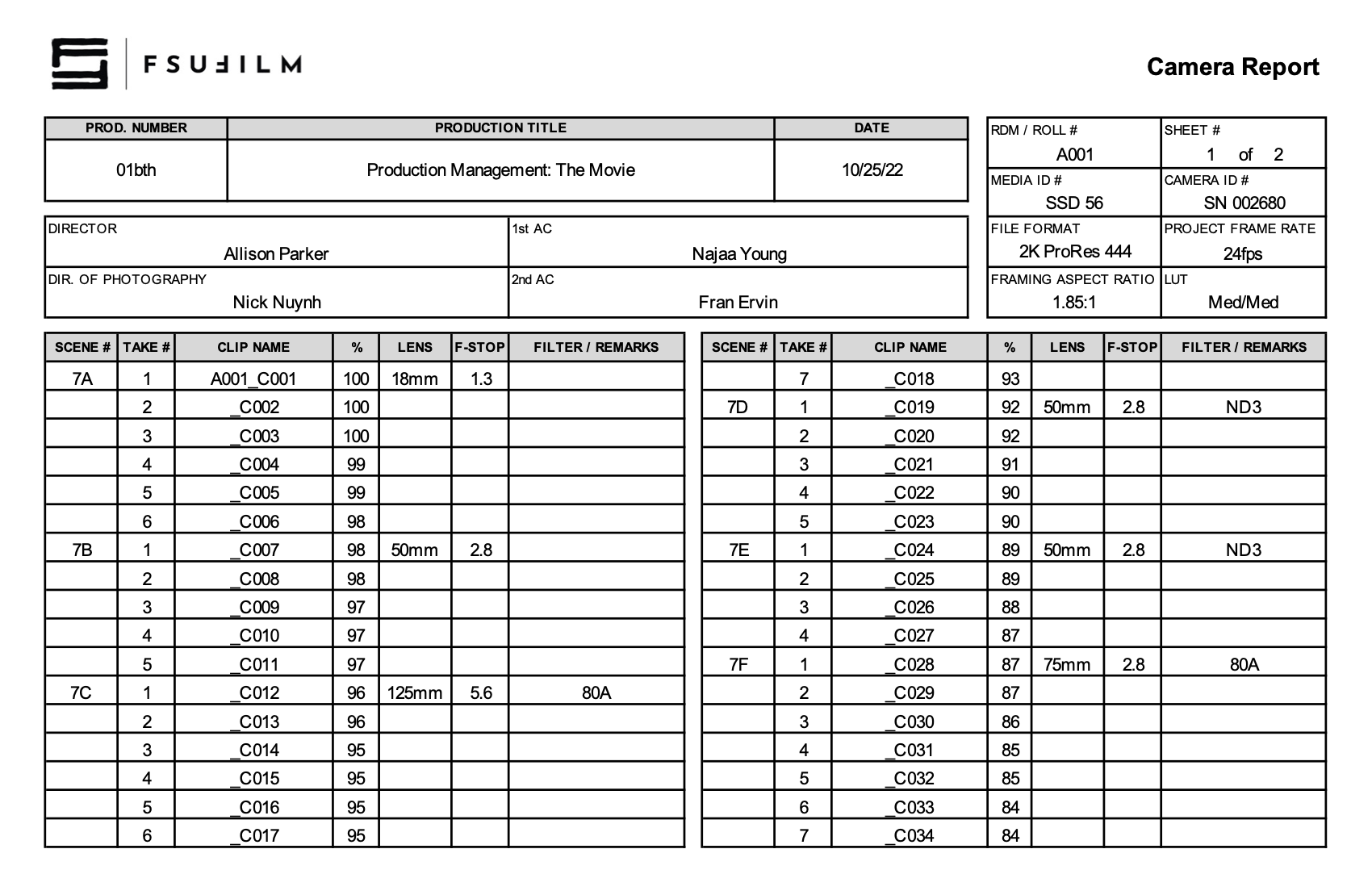
SAMPLE
Here’s a sample of what the completed form should look like:
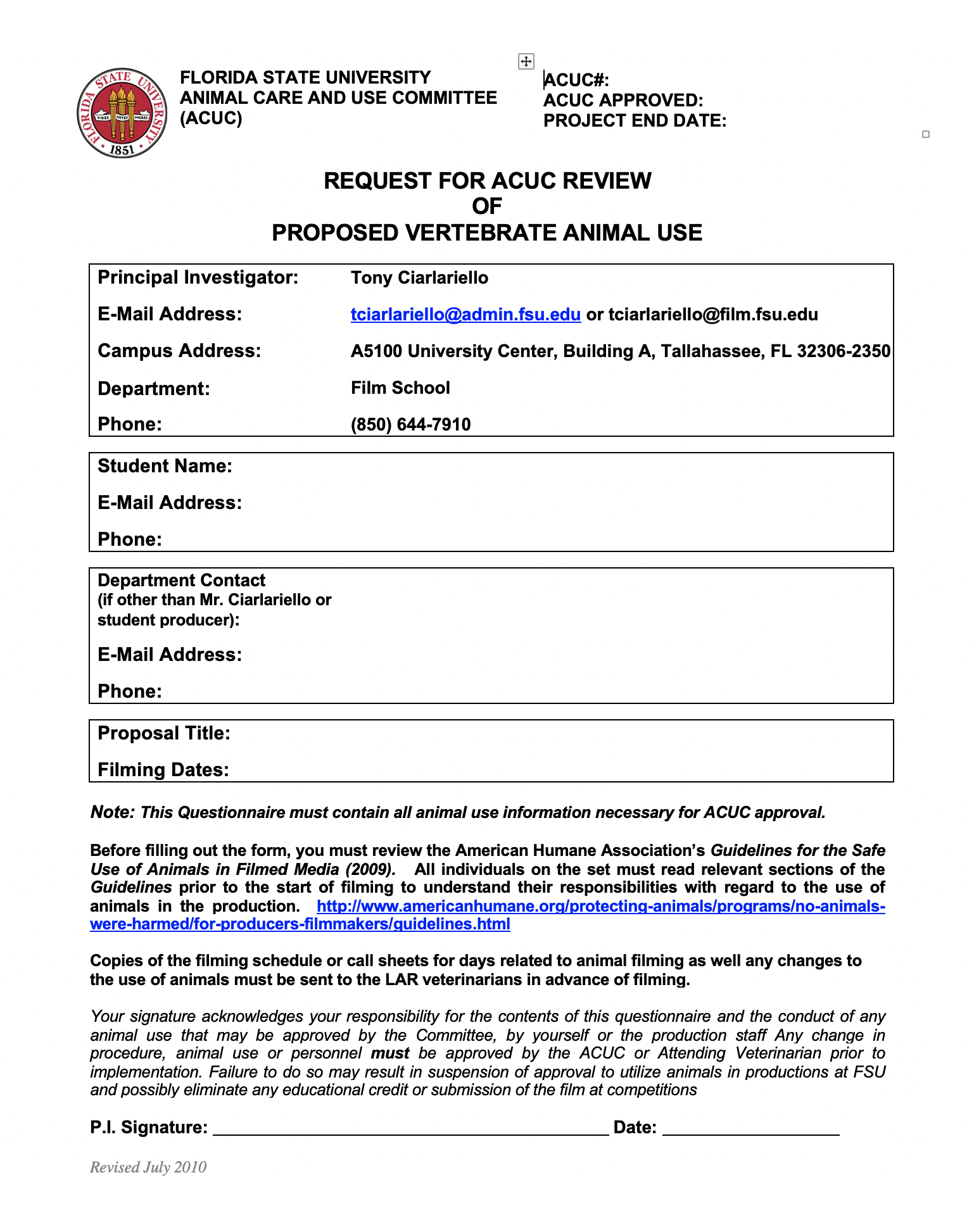
A Certificate of Insurance is a document issued by the university’s insurance provider verifying that approved production activities are covered under the institution’s insurance policies. Productions may need to provide this document to property owners, vendors, municipalities, or other outside parties before filming or conducting production-related activities.
Many locations and organizations require proof of insurance before granting permission for production activity to take place. The certificate helps demonstrate that the production has institutional coverage in place while supporting safer and more professionally managed relationships with outside partners and locations.
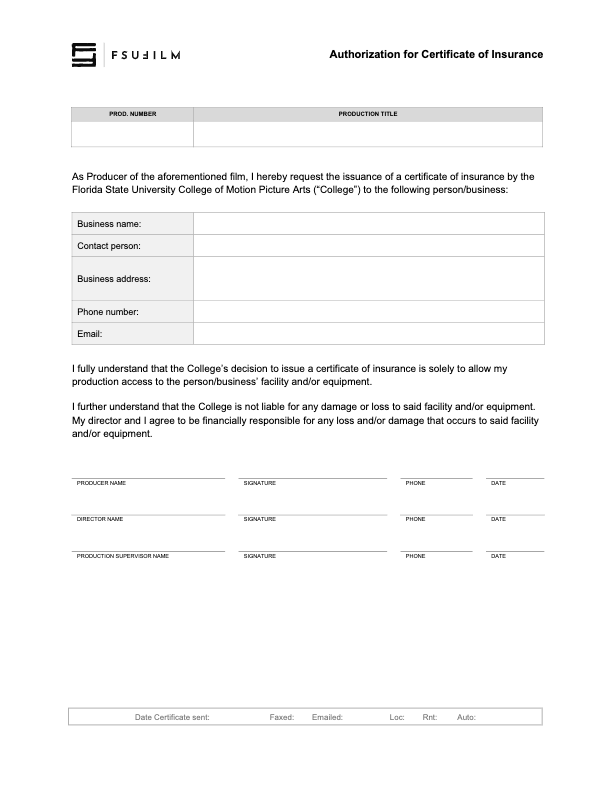
The Producer of a film should submit this form to the Head of Production to request the issuance of a Certificate of Insurance by the College of Motion Picture Arts to a business or individual that has requested one.
If the College issues a Certificate of Insurance, it is solely to allow access to the facility and/or equipment that the business or individual is offering the production. The College is not liable for any damage or loss to said facility and/or equipment. The Producer and Director will be financially responsible for any damage or loss to said facility and/or equipment.
Productions wishing to include animals in filming activities must complete an Animal Use Request describing the proposed use of the animal, the conditions under which filming will occur, and the safety and handling procedures that will be followed during production. Approval comes from the FSU Animal Care and Use Committee.
Animals introduce additional safety, liability, scheduling, and welfare considerations that require careful review before approval is granted. The request process helps ensure that productions are planning responsibly, protecting the well-being of both the animal and the crew, and complying with university expectations regarding safe production practices.
FSU Animal Care and Use Committee
Producers are required by Florida State University policies to file a request for review of animal use on the production by the FSU Animal Care and Use Committee (ACUC).
Approval is required by federal regulation, but it also enhances the relationship of FSU with the public, demonstrating to the public that the University is concerned with all use of animals by the University community.
This request must be submitted well in advance of the start of the production, as it will usually take a number of weeks for a request to be approved. If a production does not receive approval from the ACUC in time for production, the use of an animal is not permitted.
Should a production require ACUC approval, ACUC requires that the ACUC Film School Protocol Form and a PDF of the script (highlighting the parts that contain animals) be submitted at least two weeks prior to any animal use. This will permit the Committee to perform its federally mandated oversight function to ensure University compliance with Federal regulations. Students are strongly encouraged to allow for more than two-weeks of turnaround time, in case delays occur or revisions are needed. Again—if the request is not approved in time for production, the use of an animal is not permitted.
The application is submitted to the ACUC Coordinator in the Department of Laboratory Animal Resources (LAR) office. The ACUC Coordinator then forwards a copy of the protocol to the LAR veterinarians for a pre-review. These individuals conduct a preliminary review with an eye to helping eliminate any stumbling blocks to approval by the full Committee. Suggested modifications and questions are provided to the person that has filed the protocol. The LAR staff is available for consultation and is often able to assist with locating animals suitable for the productions.
If last minute modifications to the production are necessary following approval, students are required to contact one of the LAR Veterinarians for approval prior to making any changes. The LAR Veterinarian will then report on the modification at the next ACUC meeting.
On occasion projects request the use of animal tissue rather than live animals. These productions/projects also must be reviewed by the FSU Animal Care and Use Committee for reasons related both to public concern over source and health reasons related to the handling of animal parts. Individuals should follow the above instructions for protocol submission. Also, individuals should be aware that certain precautions are necessary when handling animal carcasses or tissue.
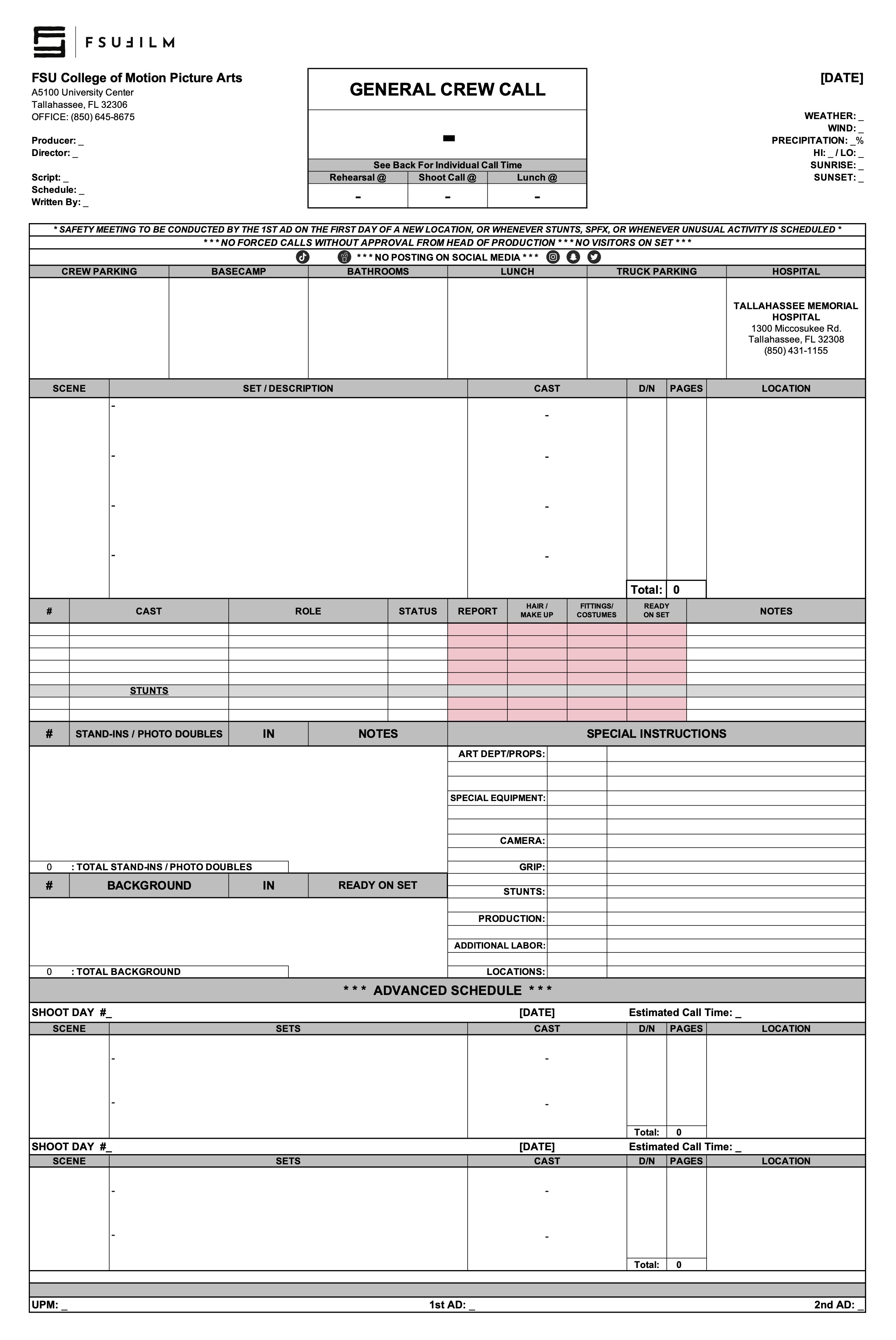
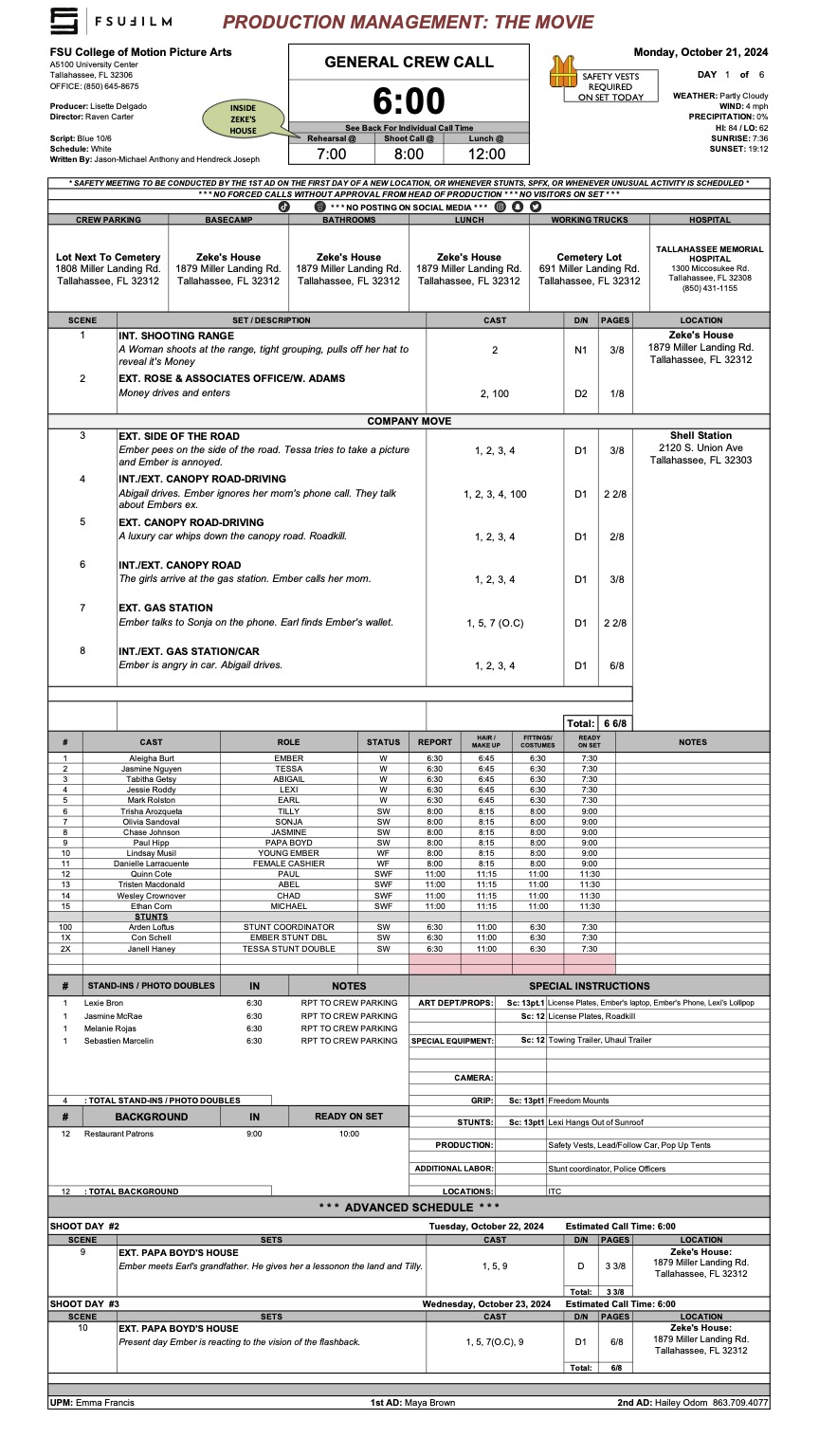
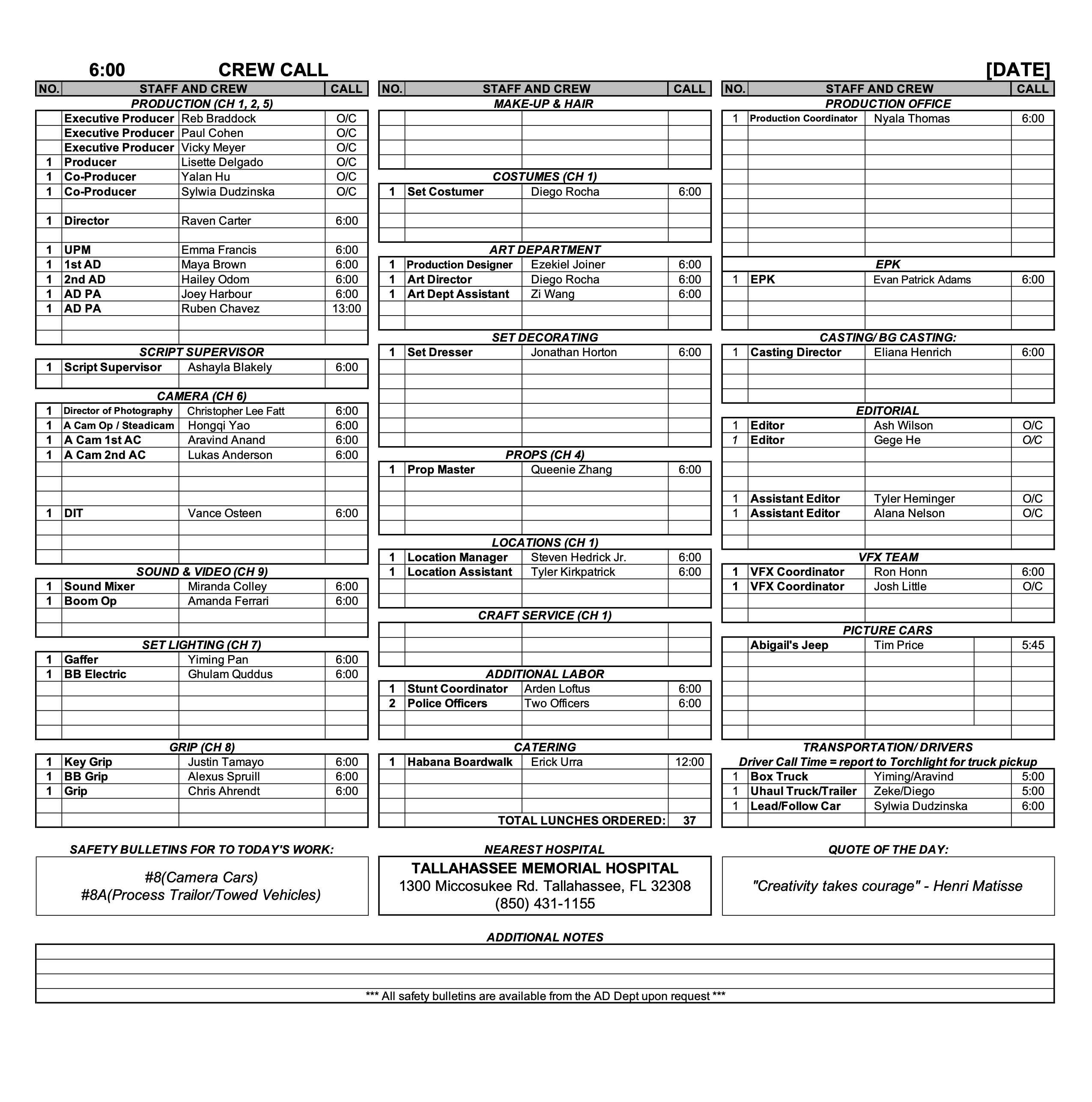
A call sheet is the primary daily production document used to communicate the schedule, locations, crew call times, cast information, scenes to be filmed, logistical details, safety notes, and other operational information for an upcoming shoot day.
Clear and accurate call sheets are essential because they serve as the central communication tool that keeps productions organized and aligned from day to day. Well-prepared call sheets help reduce confusion, improve coordination between departments, support safer production operations, and allow cast and crew to arrive properly prepared for the work ahead.
The purpose of the call sheet is to provide all the pertinent information about the next day’s production. The Second Assistant Director is responsible for distributing a PDF of each day’s call sheet to the cast, crew, faculty, and FSU police. If the production does not have a dedicated Second Assistant Director, the First Assistant Director or Producer shall assume the responsibility.
Call sheets, along with any relevant additional information such as maps or safety bulletins, must be distributed no later than 12 hours before call time on the first day of production and no later than the previous day’s company wrap for all subsequent days. It is important to thoroughly check — and double-check — and triple-check — that all the information in the call sheet is correct before it is sent out, because the distribution of revisions can create confusion.
MESSAGING
Call sheets should be distributed with a subject line that follows this naming convention: 01f3-Film Title - Call Sheet - Day 1
You may include a brief, executive summary of important information in the body of the message, but this should not be a substitute for providing all relevant information in the call sheet itself.
Call sheets must be distributed in two ways:
Post call sheets (and any relevant maps and safety bulletins) to the “Call Sheets” channel in Teams. This is for your instructors and assigned crew.
Email call sheets to your cast, POL-PDSupervisors@fsu.edu (FSU Police), and any other relevant parties who need the call sheet.
Sample Call Sheet
Update accordingly for subsequent days. For instance, you no longer need to introduce yourself after day 1.
_________________________________________
SUBJECT: 01f3-Film Title – Call Sheet – Day 1
Hello 01F3 Team!
We hope everyone is excited to get working on, (“Film Title”), directed by (First Last Name).
My name is (First Last) and I am the (Position) for this film. I will be sending out call sheets, location directions, and general information each day of the shoot. When you arrive on set you will sign in with me and you will check out with me at the end of your day.
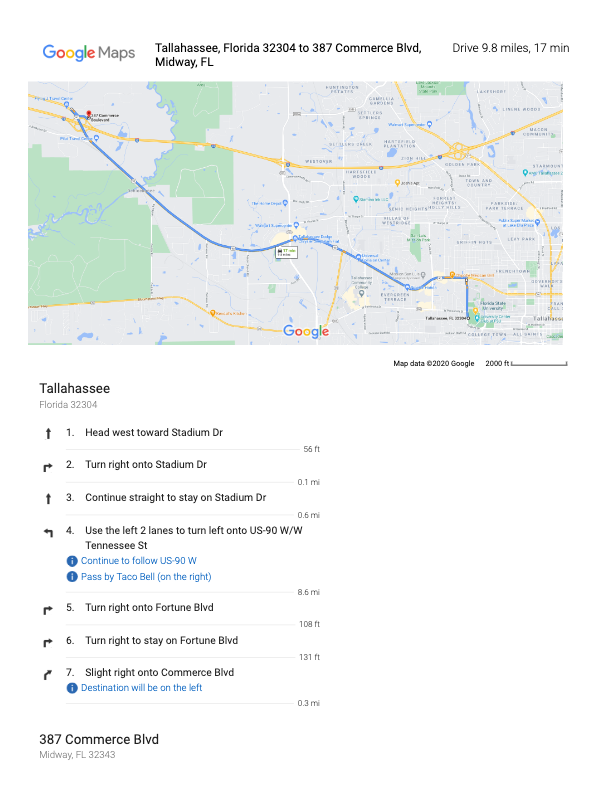
Attached are the call sheet, location info and parking instructions for tomorrow. Note, the location is approximately ## minutes away from the film school. Depending on your departure location, please plan accordingly. If you are part of a carpool, please ensure you allow extra time for pick-ups and drop-offs.
*Please read the call sheet thoroughly for specific information.
*Please arrive at least 15 minutes prior to your call time to ensure you have time to park and check in with me on time.
CREW CALL: 7:00AM
CAST CALL: See Below
(First Last) your call time is 7:45 AM
(First Last) your call time is 8:15 AM
FILMING LOCATION
Address: #### Somewhere St, City, FL, Zip
*Insert Google Maps Link here.
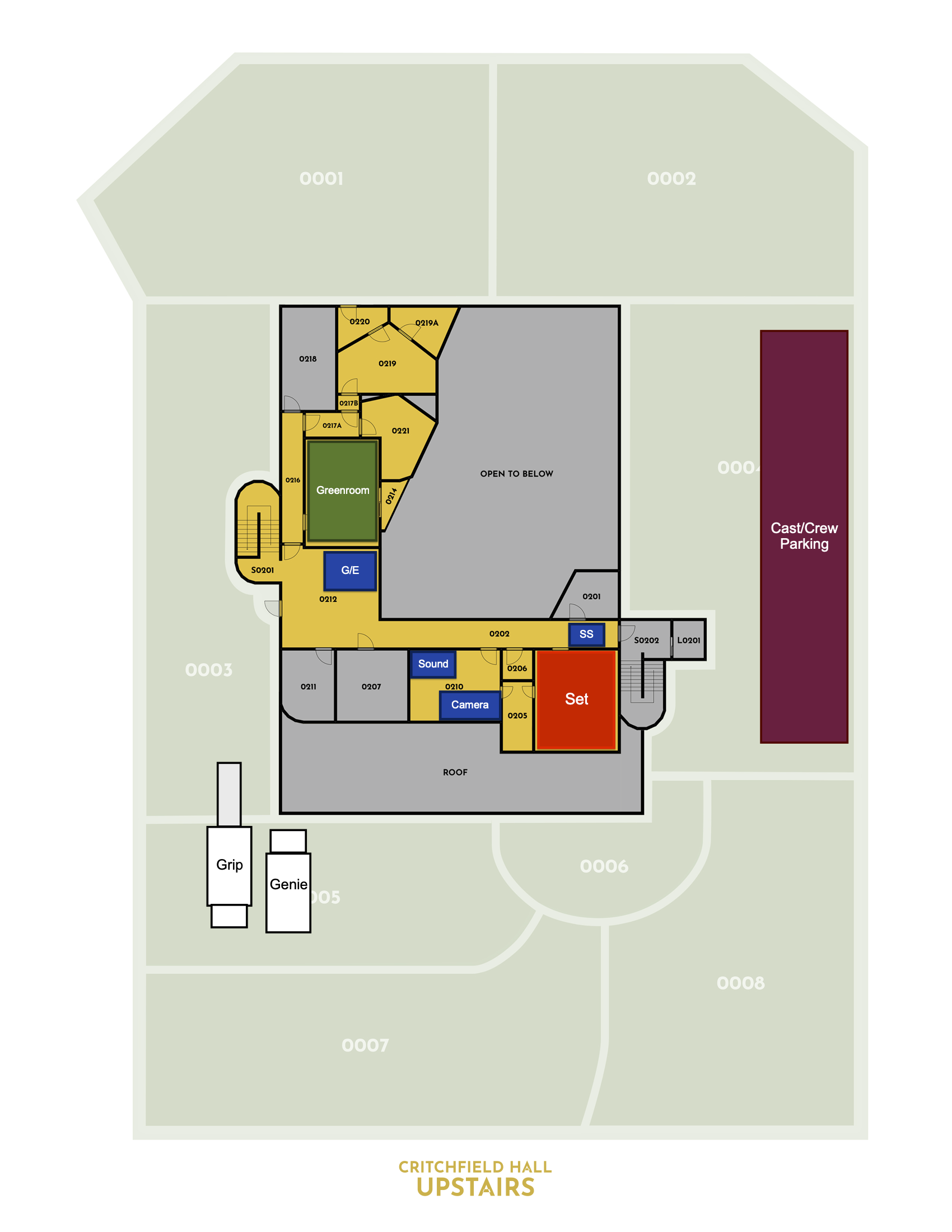
CREW/CAST PARKING
Add VERY specific instructions for parking here.
TRUCK PARKING
Add VERY specific instructions for parking here.
LOCATION NOTES
(Sample) Please DO NOT WALK ON THE GRASS. This is a specific request from the location owner.
(Sample) Dogs on site (they will be contained)
(Sample) Please keep exterior noise to a minimum.
DOCUMENTS ATTACHED TO EMAIL
-Call Sheet
-Location Map
-Location Parking Diagram
-Safety Bulletins: #5, #10
If you have any issues getting to set, or any questions whatsoever, please do not hesitate to call my number below.
This resource is intended for property owners and representatives considering allowing a student production to film at their location. It explains the general nature of the production process, what filming activity may involve, and how productions coordinate logistics, scheduling, insurance, and location agreements.
Thank you for considering allowing one of our students to use your property as a filming location. Each year, our students create nearly 200 films, and your generosity makes this possible. We value your time and support, and we are committed to maintaining the highest standards of professionalism, safety, and respect for your property.
WHAT TO EXPECT
How many people will be on site?
A typical student film crew includes 12-15 students, plus actors and possibly a few additional volunteers. Please feel free to ask the student for a specific headcount of crew, cast, and support personnel.
What will they bring?
Film productions require various equipment, including cameras, lights, sound gear, stands, cables, sandbags, rigging, dollies, and sometimes generators. Our students are trained to handle this equipment safely. They will confirm with you in advance where vehicles (trucks and cars) can be parked and where equipment can be staged.
How long will they be here?
A standard shoot day is up to 12 hours, plus a one-hour lunch break. Crews typically arrive about 30 minutes before the official start time and take an additional 30 minutes afterward for cleanup and packing. Students may also visit the location on separate days for planning, tech scouting, or set dressing. They will confirm with you in advance the start and end times for each prep and shoot day.
Location agreements
If you choose to allow the use of your property, here’s what to expect in terms of paperwork:
Script Review
The student will provide a copy of the script and answer any questions about the project, including sensitive content.
Location Shooting Plan Agreement
Together, you and the student will complete an agreement which outlines:
The specific spaces they will use.
Where vehicles may park.
Access times.
Any special conditions or restrictions you’d like to include.
Location Agreement
This legal document grants permission to use your property and waives your liability in the event of a student injury during production.
The set-up schedule outlines the planned timing and workflow for preparing and shooting each set-up throughout a given production day.
Careful setup planning is important because productions rely on efficient coordination between departments before cameras begin rolling. Structured setup schedules help reduce delays, improve communication, support safer working conditions, and give crews a clearer understanding of how production operations are expected to unfold throughout the day.
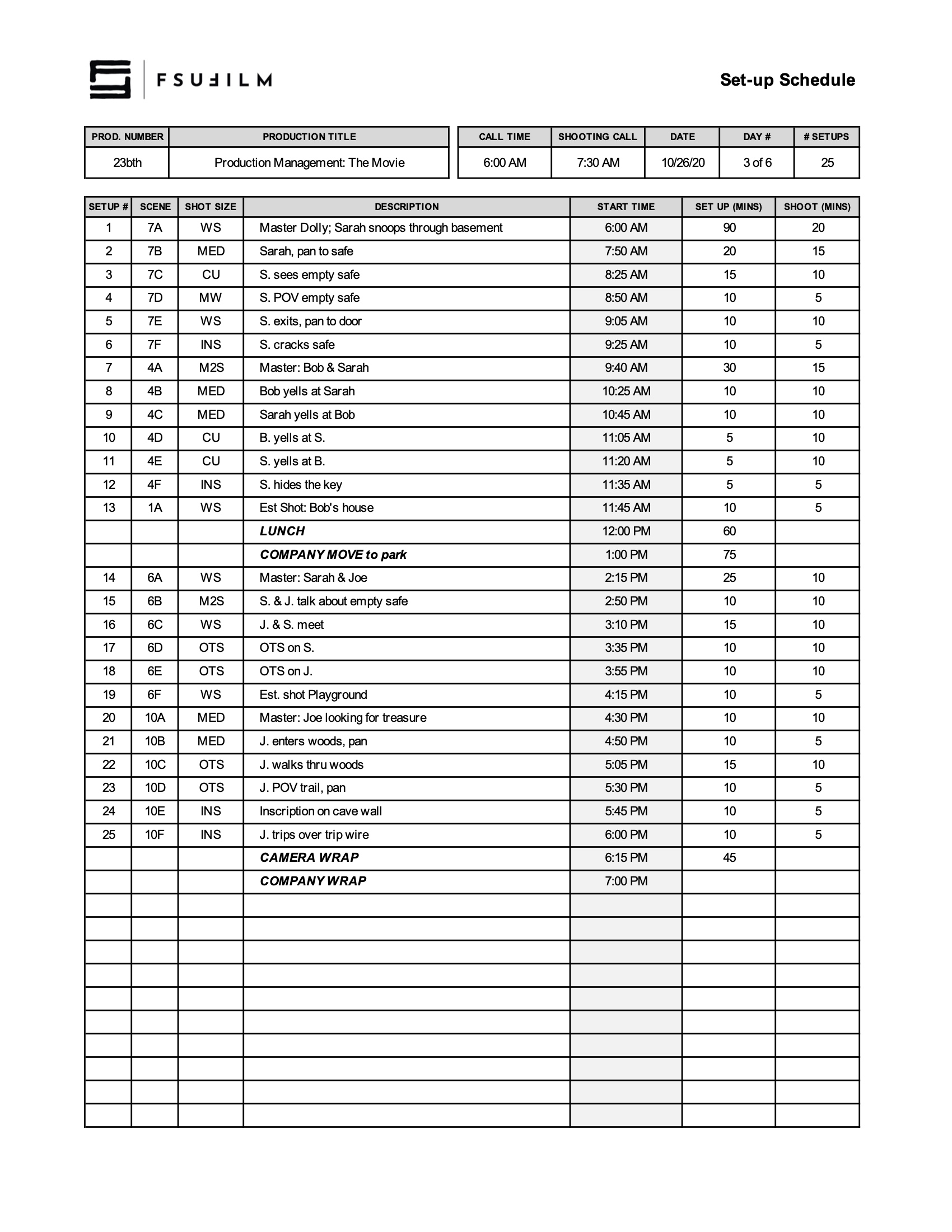
After the Director and DP have created a provisional shot list, the 1st AD will meet with the Director and DP to schedule the order of shots for each day. Using this Set-up Schedule, the shots should be listed in the order you intend to shoot them, including estimated times to set up and shoot each one.
Be sure to budget adequate time load-ins, load-outs, wraps, lunch, and any company moves.
SAMPLE SET-UP SCHEDULE
Here’s a sample of what the completed set-up schedule should look like:
This resource compiles public domain and Creative Commons materials that students may use when searching for music, images, footage, sound effects, or other media assets for productions and related projects.
Understanding public domain and Creative Commons licensing is important because productions must ensure that all third-party materials are being used legally and appropriately. Learning how to evaluate licensing terms, attribution requirements, and permitted usage helps students develop stronger professional practices related to copyright, rights clearance, and media sourcing within film production workflows.
Some Words of Caution
The Internet is a wonderful place for finding videos, images, motion graphics, clip art, music, and sound effects that can be used in your films.
Beware, however, that the Internet is also a terribly unreliable place and the burden of proof will fall on Producers to document that the production has the rights to use the materials, so that there’s a clear chain of title.
For works in the public domain, this can sometimes take a fair amount of research, as licensing information can be unclear, unreliable, or hard to track down. Any works published 95 years ago or earlier are now in the public domain. Any works published in the past 95 years should be assumed to be under copyright, unless otherwise confirmed. Be aware that new versions of works in the public domain — e.g., a New York Symphony Orchestra’s recent recording of Beethoven’s 9th Symphony — are copyrighted. In other words, while you could perform the composition yourself and be alright, you couldn’t use the New York Symphony Orchestra’s recording without clearing it first.
For Creative Commons work, some license types (such as “NoDerivs” and “ShareAlike”) are not compatible with the work we do. Productions are only permitted to use work licensed as “Attribution” or “Attribution-NonCommercial”.
Discover original artworks from a library of public domain books and chromolithographs. Art prints scanned and digitally enhanced into high resolution, available to download under the CC0 license.
Free vector images. Find the best royalty free vectors and illustrations for your design, with thousands of new images added every day. Download free backgrounds, graphics, clipart, drawings, icons, logos and more that are safe for commercial use.
Safety bulletins provide guidance, procedures, and recommended practices related to specific production hazards, equipment, environments, or activities that may arise during filmmaking—and they must be included alongside call sheets when relevant.
Because film production can involve physically demanding environments, technical equipment, transportation, electrical systems, weather exposure, stunts, weapons, animals, and other potential hazards, productions must approach safety proactively rather than reactively. Safety bulletins help crews identify risks earlier, develop safer working practices, and reinforce a culture of shared responsibility around production safety.
How They Work
The safety bulletins we utilize are researched, written, and distributed by the Industry-Wide Labor-Management Safety Committee for use by the motion picture industry. The committee is composed of guild, union, and management representatives active in industry safety and health programs.
Safety bulletins are recommended guidelines. They are not binding laws or regulations. State, federal, and/or local regulations override these guidelines. Modifications in these guidelines should be made, as circumstances warrant, to ensure the safety of the cast and crew.
A PDF of all relevant safety bulletins must be attached to call sheets. Be sure to download the most recent version of a safety bulletin before attaching one to a call sheet, as the Industry-Wide Labor-Management Safety Committee does update their bulletins periodically.
All crew are required to read distributed Safety Bulletins prior to commencing the work day. Failure to do so may result in disciplinary action, including immediate dismissal from the school.
Download Bulletins
To download the latest versions of the safety bulletins, click here:
A list of all the available Industry-Wide Labor-Management Safety Committee’s safety bulletins is outlined below.
Safety Bulletins
Recommendations For The Use Of Firearms, Blanks, And Dummy Rounds
Prohibitions And Special Restrictions On The Use Of Live Ammunition
Guidelines Regarding the Use of Helicopters in Motion Picture Productions
Addendum A – Helicopter External Loads
Stunts
Addendum A – Specialized Activities
Safety Awareness
Animal Handling Rules for the Motion Picture Industry
Recommendations For Diving Operations
Guidelines for Traditional Camera Cars
Addendum A – Process Trailer/Towed Vehicle
Addendum B – Camera Boom Vehicles
Addendum C – Power Line Distance Requirements
Recommended Guidelines for Working In and Around Base Camps
Addendum A – Base Camp Inspection Checklist
Guidelines Regarding the Use of Artificially Created Atmospheric Fog & Haze
Addendum A – Technical Awareness Sheet
Guidelines Regarding the Use of Fixed-Wing Aircraft in Motion Picture Productions
Addendum A – External Load Guidelines
Guidelines for the Use of Venomous Reptiles
Recommended Guidelines When Using Combustible & Flammable Fuels and Associated Equipment
Parachuting and Skydiving
Guidelines for Boating/Watercraft Safety for Film Crews
Recommended Guidelines for Safety with Pyrotechnic Special Effects
Water Hazards
Guidelines for Safe Use of Stunt Air Bags, Boxes or Other Freefall Catch Systems
Recommended Guidelines for the Use of Open Flame on Production
Guidelines for the Safe Use of Motorcycles
Guidelines for Appropriate Clothing and Personal Protective Equipment
Guidelines for the Use of Scissor Lifts (Elevating Work Platforms) and Aerial Boom Lifts (Extensible Boom Platforms)
Addendum A – Power Line Distance Requirements
Guidelines for Working with Portable Power Distribution Systems and Other Electrical Equipment
Addendum A – Power Line Distance Requirements
Addendum B – Basic Electrical Safety Precautions for Motion Picture and Television Off Studio Lot Location Productions
Addendum C – Working With 480 Volt Systems
Addendum D – Common Motion-Picture/Television Tasks and Associated Personal Protective Equipment
Addendum E – Guidelines for Meeting National Electrical Code (NEC) Grounding Requirements for Portable Generators Supplying Portable Equipment in the Motion Picture and Television Industry
California OSHA Safety Requirements for Handling of Blood and Other Potentially Infectious Materials
Camera Cranes
Addendum A – Power Line Distance Requirements
Preparing Urban Exterior Locations for Filming
Poisonous Plants
Guidelines for Railroad Safety
Guidelines for Safe Use of Hot Air Balloons
Addendum A – External Load Guidelines
Recommended Guidelines for Safely Working with Edged, Piercing, and Projectile Props
Safety Awareness When Working Around Indigenous Wildlife
Los Angeles County Approved Film Production Food Services
Addendum A – Los Angeles County Approved Film Production Food Services
Special Safety Considerations when Employing Infant Actors (15 days to Six Months Old)
Guidelines for Working in Extreme Cold Temperature Conditions
Addendum A – Wind Chill Chart
Safety Considerations for the Prevention of Outdoor Heat Illness
Recommended Guidelines for Safely Working Around Unmanned Aircraft Systems (UAS) a.k.a Drones
Appendix A – Federal Aviation Administration (FAA) Rules & Regulations
Vehicle Restraint Systems – Seat Belts & Harnesses
Guidelines For Inclement Or Severe Weather
Appendix A – Lightning Safety
Safety Guidelines for Using Foam(ed) Plastics in Set and Prop Construction
Guidelines for Non-Camera Utility Vehicles
Recommended Guidelines for Safely Working On and Around Gimbals
Guidelines for Alternative Driving Systems
Recommended Guidelines for Free Driving
Guidelines for Working Safely with Radiofrequency (RF) Transmitters
Guidelines For Long or Successive Takes
Procedural Guidelines
Special Procedures For Minors Performing Physical Activities
Informational Fact Sheets
General Code of Safe Practices for Production
Extended or Successive Takes
Guidelines for Handling Freshly Painted or Printed Backdrops and Other Graphic Arts
Photographic Dust Effects
Guidelines for Reducing the Spread of Influenza-Like Illness
The 1st Assistant Director is responsible for managing the shooting schedule and overseeing the day-to-day operation of the set during production. This includes coordinating the work of departments on set, maintaining production pace, monitoring safety concerns, communicating priorities to the crew, and helping ensure that the production remains on schedule throughout the shooting day.
The 1st AD serves as the primary operational leader on set, balancing the creative ambitions of the director and department heads against the practical realities of time, staffing, resources, and budget. While students sometimes misunderstand the position as simply enforcing the schedule or “watching the clock,” effective assistant directing requires constant collaboration, communication, and problem-solving in support of both the film’s creative goals and the producer’s responsibility to successfully complete the day’s work. Strong 1st AD leadership helps productions remain organized, safe, efficient, and creatively focused even under demanding production conditions.
Pre-Production
Break down the script and create the Production Schedule in Movie Magic Scheduling.
Organize and run the Tech Scout for each location. Establish where the restrooms, parking, staging, base camp and set will be.
The producer serves as the primary organizational and managerial lead of the production, overseeing the broader coordination of the project across development, pre-production, production, post-production, and delivery. Responsibilities may include managing schedules, coordinating communication between departments, overseeing logistics, monitoring production progress, helping resolve problems, and ensuring that the production remains aligned with the practical realities of time, staffing, safety, and available resources.
Within the collaborative structure of film production, the producer is ultimately responsible for helping guide the project to successful completion while balancing creative goals against operational limitations. Unlike roles focused primarily on on-set execution or departmental coordination, the producer maintains a wider view of the entire production process and helps ensure that all parts of the project continue moving forward cohesively. The role also helps students develop leadership, communication, organizational, and decision-making skills that are central to professional producing workflows.
Pre-Production
Do a script breakdown and production schedule using Movie Magic Scheduling. Update as needed.
Complete a budget for the film using Movie Magic Budgeting. Update as needed.
Make sure the show’s channel in Teams is kept up to date with the latest draft of the script, as well as updates on casting, locations, and other logistical elements.
Secure each filming location by completing a Location Agreement and Shooting Plan. Make sure the location owner is clear about the nature of the production.
Prepare all scheduling information and other material required for the Tech Scout.
Assist the Director with any and all logistical needs to prepare for principal photography.
Attend the Production Meeting. Discuss any logistics and answer crewmembers’ questions.
Check the weather periodically to monitor adverse conditions. Have a back-up plan.
Meet with the 1st AD to discuss the schedule.
Purchase Craft Services by the night before production.
Pre-order lunch and arrange for it to be picked up by a volunteer on the day of production.
Have a Greenlight Meeting with the Head of Production.
Double check every logistical piece of information and make sure nothing has been forgotten.
On Set
Start of day:
Arrive at set at least 30 minutes early.
Immediately establish contact with the location owner to make sure everything is still going as planned. Check back with them periodically throughout the day as needed.
Throughout the day:
Make sure everything is going as planned throughout the day, and troubleshoot logistics as needed.
Be another set of eyes at the tap monitor to make sure all is going as planned.
End of day:
With 2nd AD, clean and secure location. Be the LAST TO LEAVE (except perhaps Art Dept).
Whenever possible, do a walk-thru with the location owner to verify everything is in order.
Leave the location better than when you arrived.
Drop off the camera reports, camera cards & sound cards in the ER dropbox.
Turn in the hard copy originals of the Reimbursement Voucher, itemized receipts, and Meal Sign In Sheet to the Film School Accountant by 9am Thursday after production.