#agreement-paperwork

Minor Labor Policy Agreement

Overview

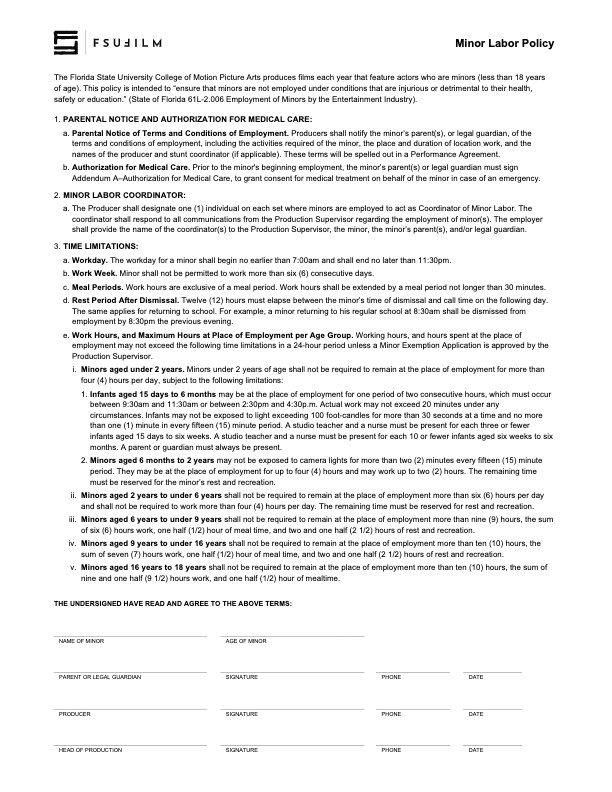
The Minor Labor Policy Agreement documents the expectations and conditions that apply when a production is approved to work with a minor. It establishes the responsibilities of the production, the student filmmakers, and the parent or guardian in relation to the minor’s participation.

This agreement is important because minors require additional safeguards around working hours, supervision, safety, transportation, and overall welfare. The form helps ensure that everyone involved understands the conditions of the minor’s participation before production begins.

Instructions

The Minor Labor policy is intended to safeguard children from being employed under conditions that are injurious or detrimental to their health, safety or education. This paperwork serves to ensure that parents (or legal guardians) are informed about the conditions of employment.

The Producer of a show that involves minor labor should complete both pages of this document with the parent or legal guardian. The first page outlines the terms of the labor agreement. The second page documents any medical conditions or dietary needs, and provides authorization for the school to seek medical treatment for the minor in cases of emergency.

Should any exemptions or modifications to this policy be needed, the Producer should complete a Minor Labor Policy Exemption Request with the parent or legal guardian.
Master Use License Request

Overview

A Master Use License Request is used when a production wants permission to use a specific existing sound recording in a film. This permission is cleared with the record label or other owner of the recording, and is separate from the synchronization license needed for the underlying musical composition.

This process is important because a recorded song usually involves multiple rights. Even if a production has permission to use the composition, it still needs permission to use a particular recording of that composition. Proper clearance helps ensure that the film can be exhibited and distributed without unresolved music rights issues.

INSTRUCTIONS

A master use license is the right to synchronize a sound recording with your visual image. You clear this right with the record label who owns the sound recording you would like to use.

Check the liner notes of the recording to find out which company this is. Alternatively, you can get contact information for record labels by contacting either ASCAP or BMI. You will be provided with a contact at the record label’s Business Affairs Department.

Getting the rights could be as simple as sending letters to the publisher and record label, having them sign and return them. However, you may be required to complete their licensing agreements instead. If this is the case, make sure you have the Head of Production review the agreement before you sign it, to ensure we have the proper releases.

You must get each license for at least:

  • Two-years
  • Film festival
  • Non-commercial
  • World rights

Note that if you do not plan to use the original sound recording, but rather plan to reproduce a specific musical composition in your film, you need to acquire a Synchronization License instead.

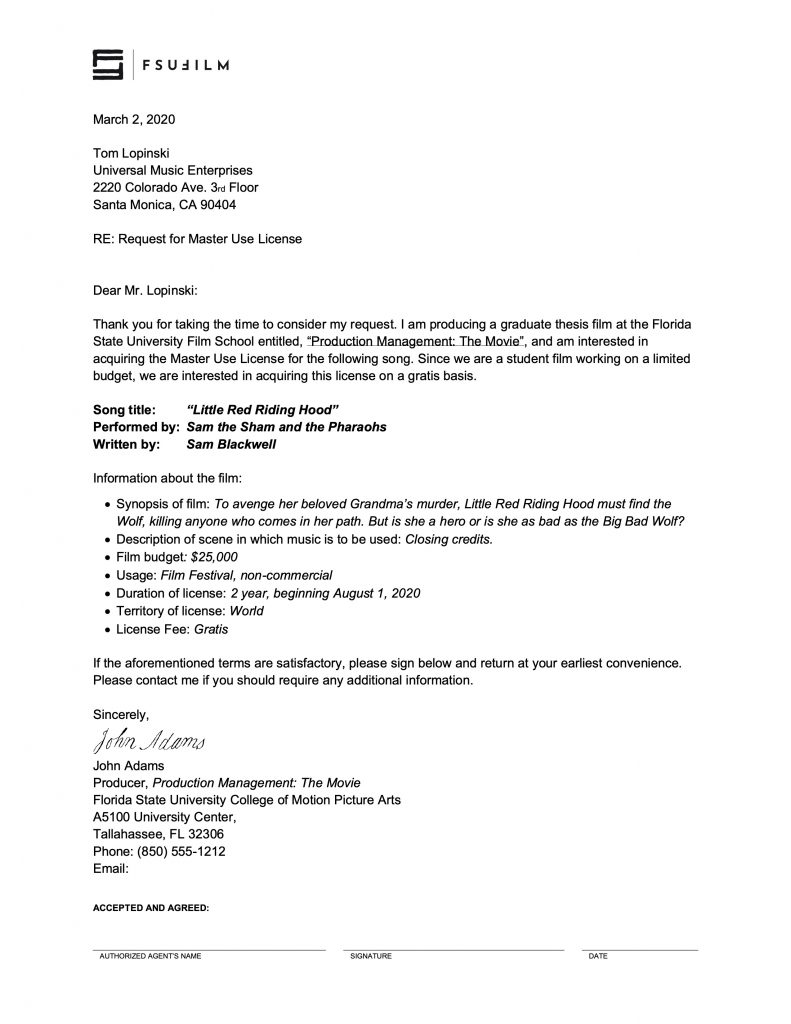
SAMPLE LETTER

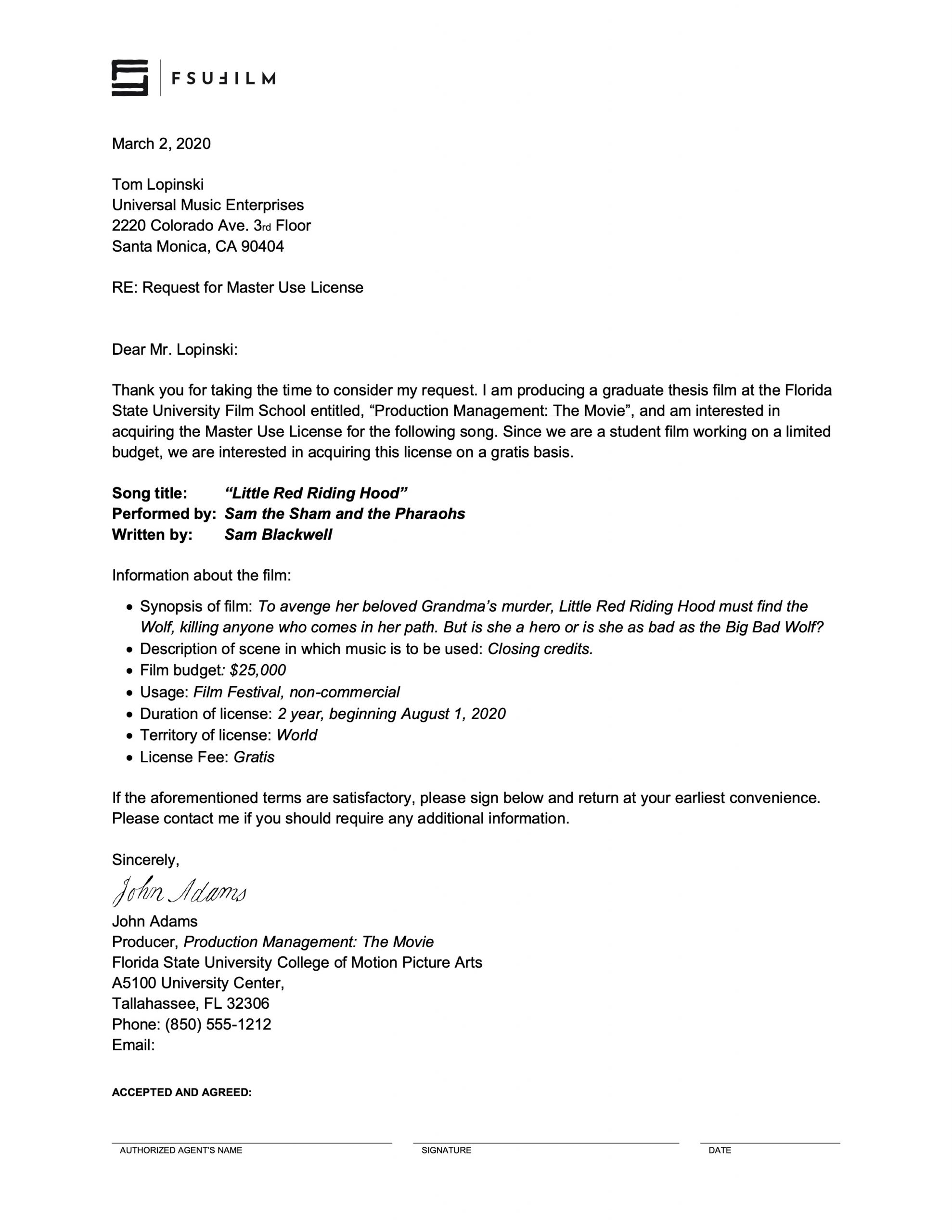
Here’s a sample of what the letter should look like:

Sample letter

Location Shooting Plan Agreement

Overview

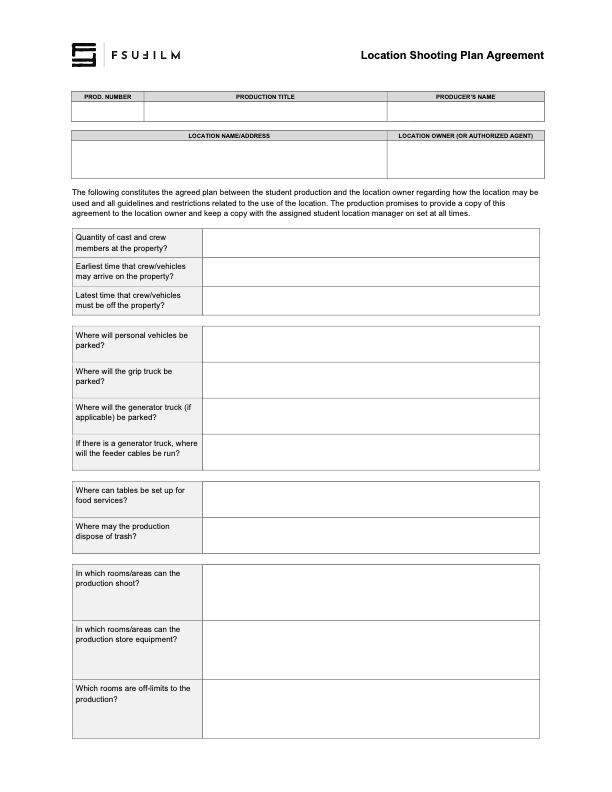
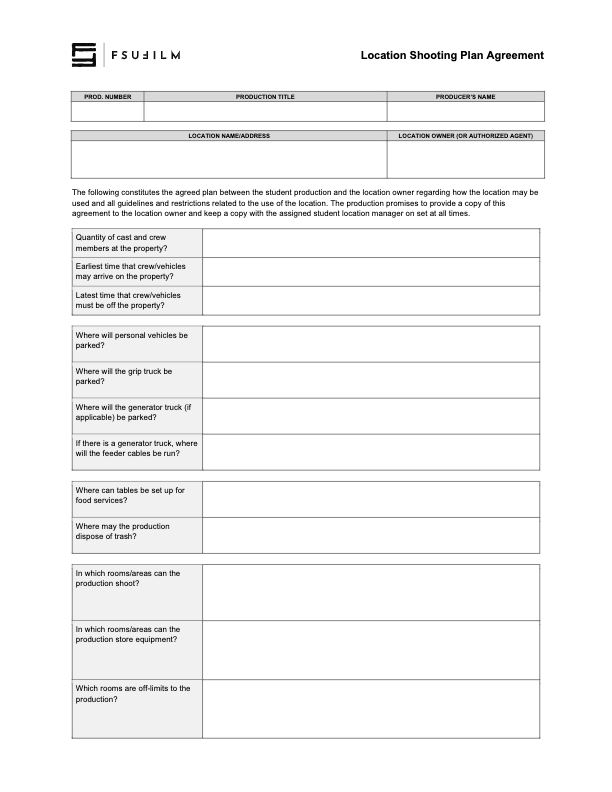
The Location Shooting Plan Agreement documents the specific guidelines, restrictions, and conditions governing how a production may use an approved location. It’s completed with input from the location owner and addresses the finer details of the shoot, including what activities may take place and what limitations the production must follow while on site.

This agreement helps protect the location owner, the production, and the school by making expectations clear before filming begins. Clear location rules reduce misunderstandings, support safer production planning, and help maintain positive relationships with property owners and community partners.

Instructions

In addition to completing a Location Agreement with the Location Owner (or authorized agent), the Producer must also complete a Location Shooting Plan Agreement. This agreement gets into the finer details of how the location may be used and all guidelines and restrictions related to the use of the location.

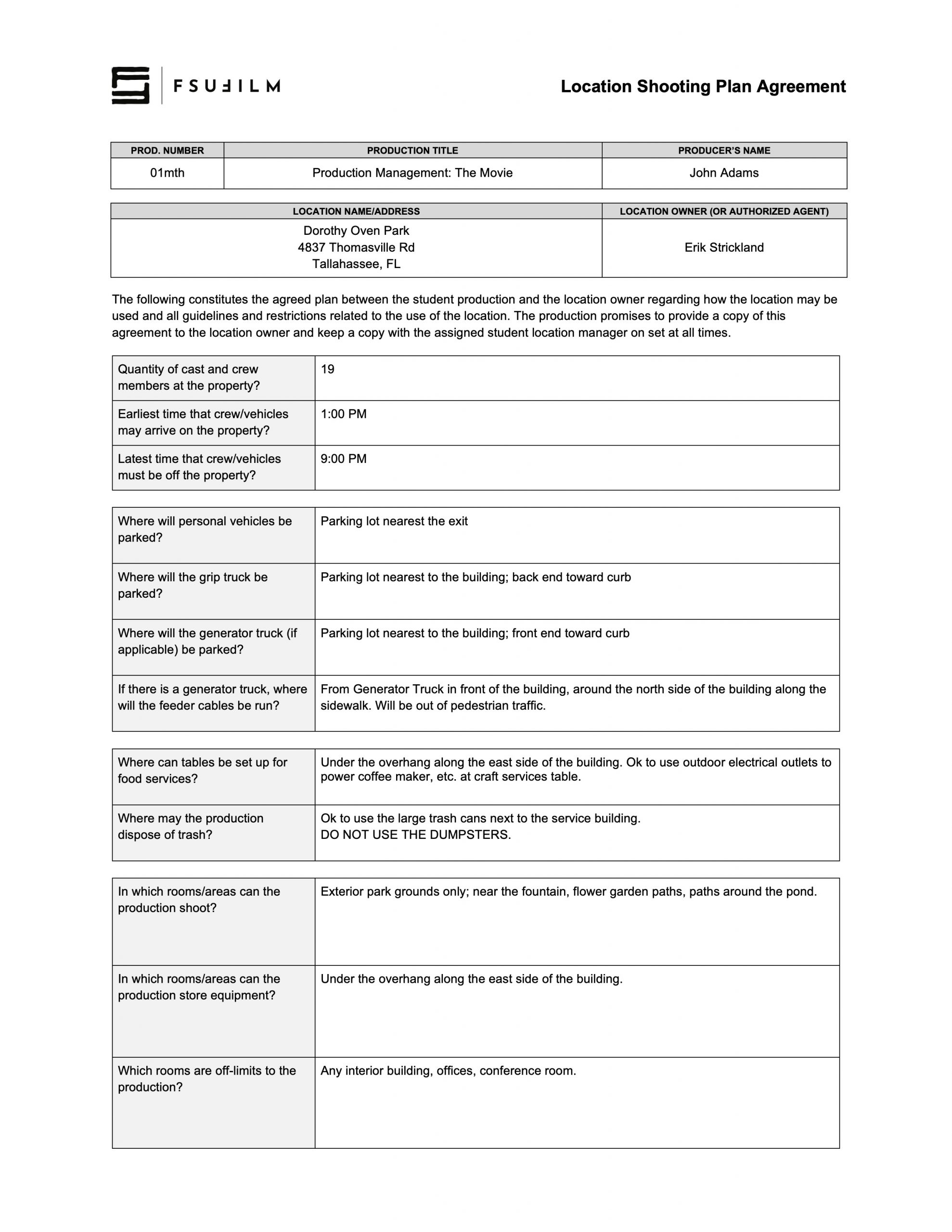
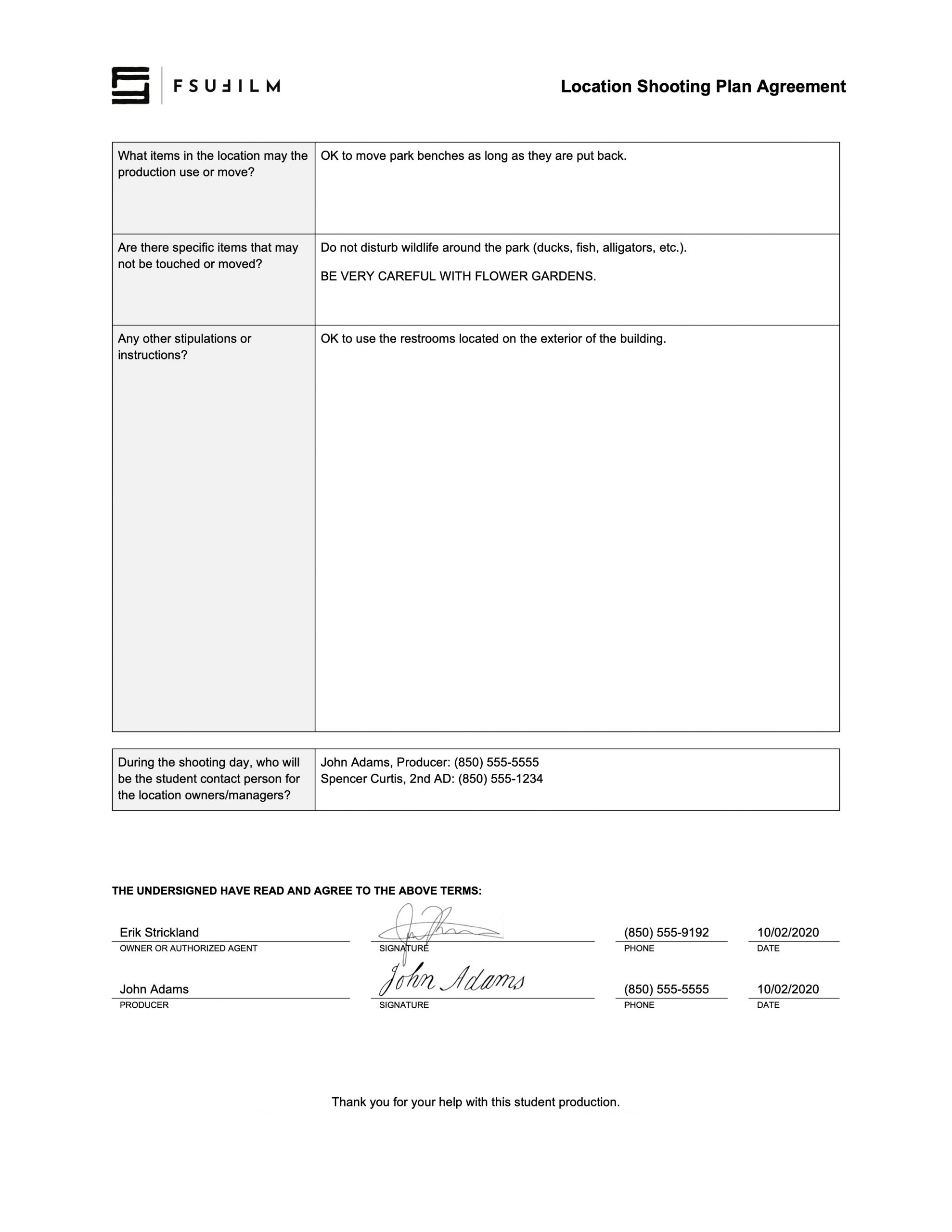
This includes information about: the quantity of crew members; arrival and departure times; parking; craft service; trash; which rooms can be used or not-used; which items can be moved or not-moved; any safety protocols the location may require; and the names/info of the students that location owners should contact during the shooting day.

Sample

Here’s a sample of what the completed form should look like:

Location Agreement

Overview

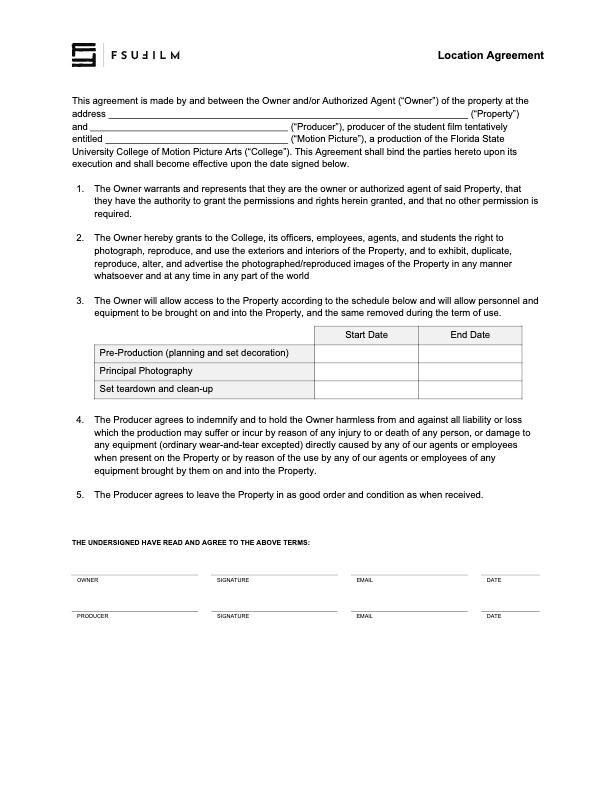
The Location Agreement is used with a location owner or authorized agent to secure permission for a production to use and photograph a property. It establishes the production’s right to film at the location and documents the basic terms of that access.

This agreement is essential because productions cannot assume permission to film on private or controlled property. Written approval protects the production, the school, and the property owner by clarifying access, usage rights, and the conditions under which the location may appear in the finished film.

Instructions

The Producer should use this contract agreement with the Location Owner (or authorized agent), in order to have the right to use and photograph the interiors and exteriors of the property.

The Producer is responsible for working with the Location Owner to determine the start and end dates for when the show will have access to the location. (The Producer is additionally responsible for drafting a Location Shooting Plan Agreement with the Location Owner.)

All other clauses in the agreement must remain unchanged, unless the Producer is authorized in advance by the Head of Production to make specific amendments to the contract.

Life Story Rights

Overview

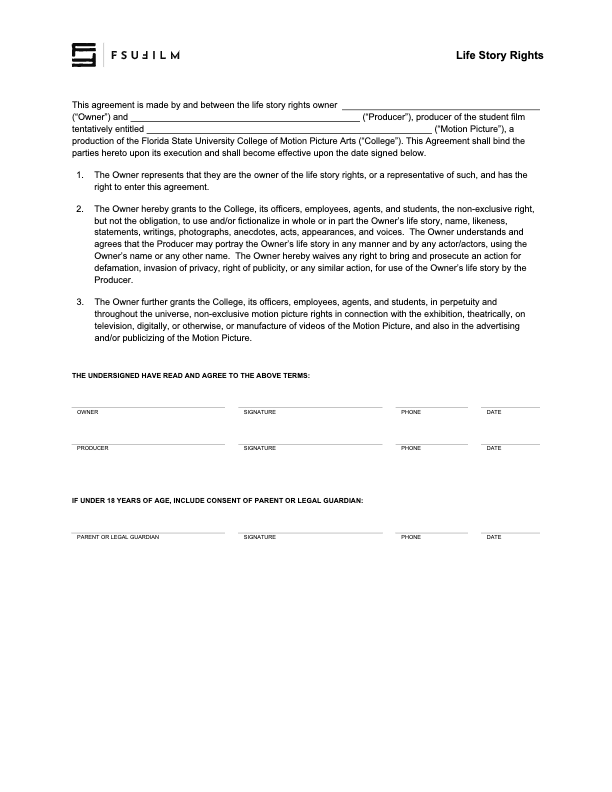
The Life Story Rights agreement is used when a production wants to use or fictionalize a person’s life story, name, likeness, statements, writings, photographs, anecdotes, acts, appearances, or voice. The Producer works with the owner of those rights to secure permission through the approved agreement.

This agreement is important because stories based on real people can involve significant personal, legal, and ethical considerations. Proper documentation helps ensure that the production has permission to use the material and that any changes to the agreement are approved in advance by the Head of Production.

Instructions

The Producer should use this contract agreement with the Owner of the life story rights, in order to use and/or fictionalize the Owner’s life story, name, likeness, statements, writings, photographs, anecdotes, acts, appearances, and voices.

All clauses in the agreement must remain unchanged, unless the Producer is authorized in advance by the Head of Production to make specific amendments to the contract.

Image Release

Overview

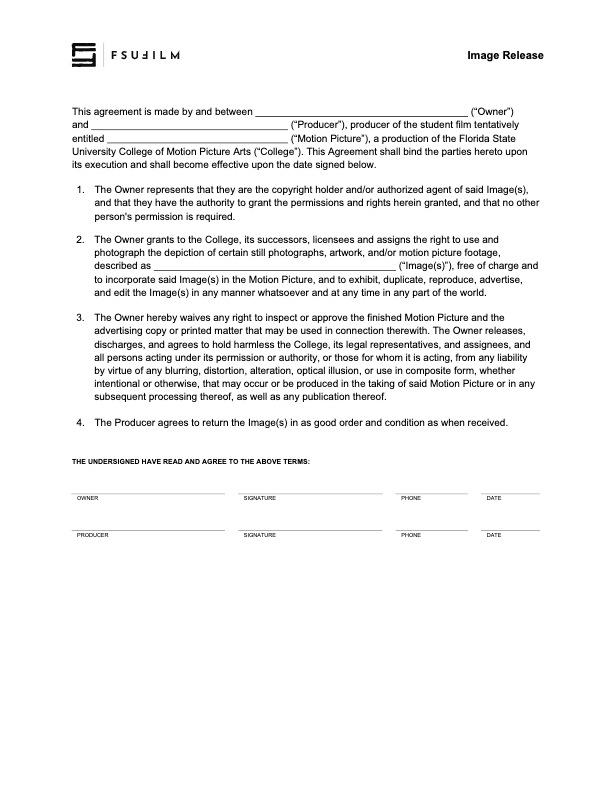
The Image Release is used when a production wants permission to use or photograph a still image, artwork, graphic, or other copyrighted visual material in a film. The Producer secures the release from the copyright holder or authorized agent.

This form is important because images found online, in books, in archives, or in personal collections are not automatically available for use in student films. Proper releases help productions avoid rights issues during delivery, festival submission, online exhibition, or future distribution.

Instructions

The Producer should use this contract agreement with the copyright holder (or authorized agent) for the right to use and photograph the depiction of still photographs, artwork, and/or motion picture footage.

All clauses in the agreement must remain unchanged, unless the Producer is authorized in advance by the Head of Production to make specific amendments to the contract.

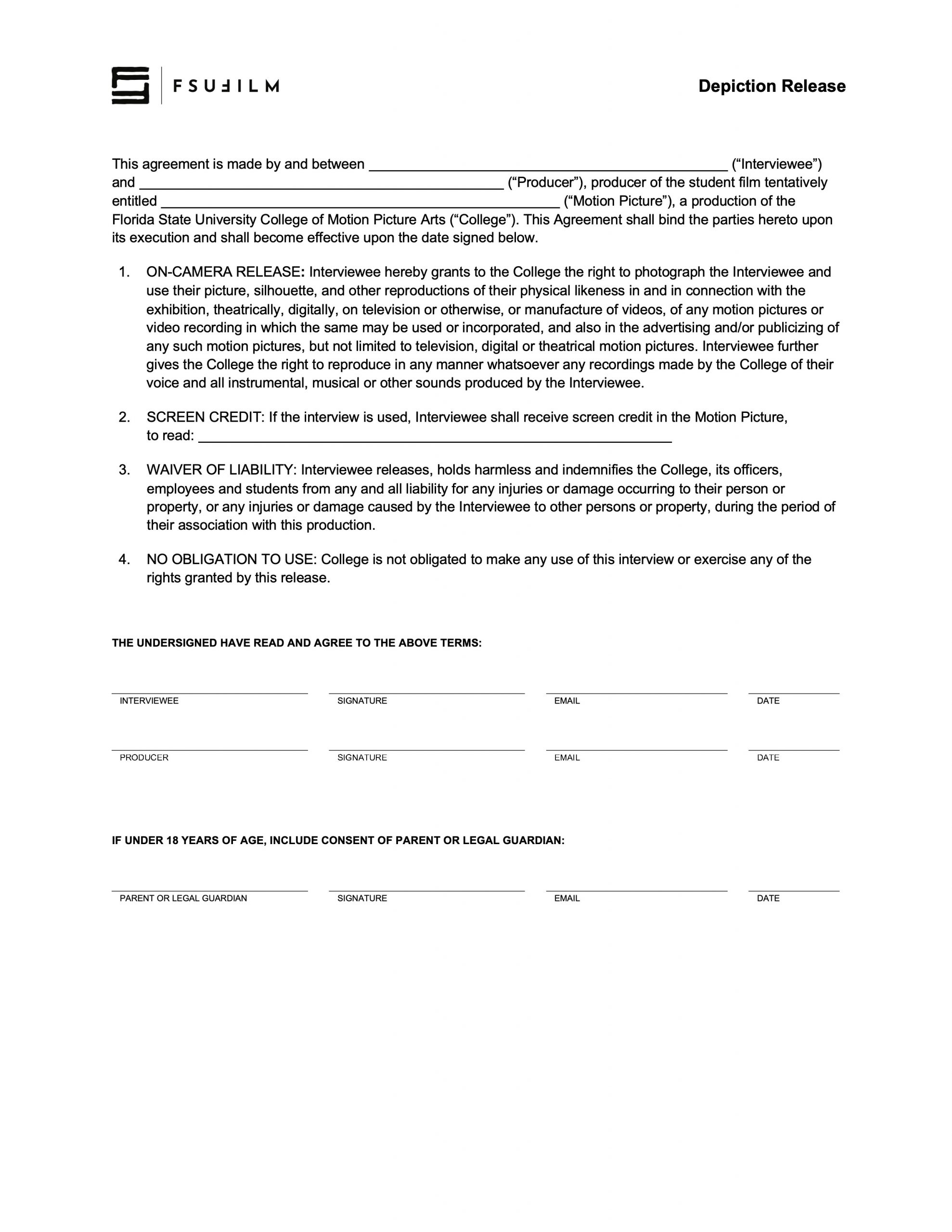
Depiction Release

Overview

The Depiction Release is used for documentary projects when an interviewee gives the production permission to record their voice and likeness and use that material in the film.

This agreement is important because documentary subjects must clearly understand and authorize how their recorded participation may be used. Proper releases protect both the production and the interviewee while supporting ethical, professional, and legally sound documentary practice.

Instructions

The Producer should use this contract agreement with an Interviewee for a documentary project, in order to have the right to record their voice and likeness and use it in the film.

The Producer is responsible for working with Interviewee to determine the screen credit in the finished film.

All other clauses in the agreement must remain unchanged, unless the Producer is authorized in advance by the Head of Production to make specific amendments to the contract.

Crowd Release

Overview

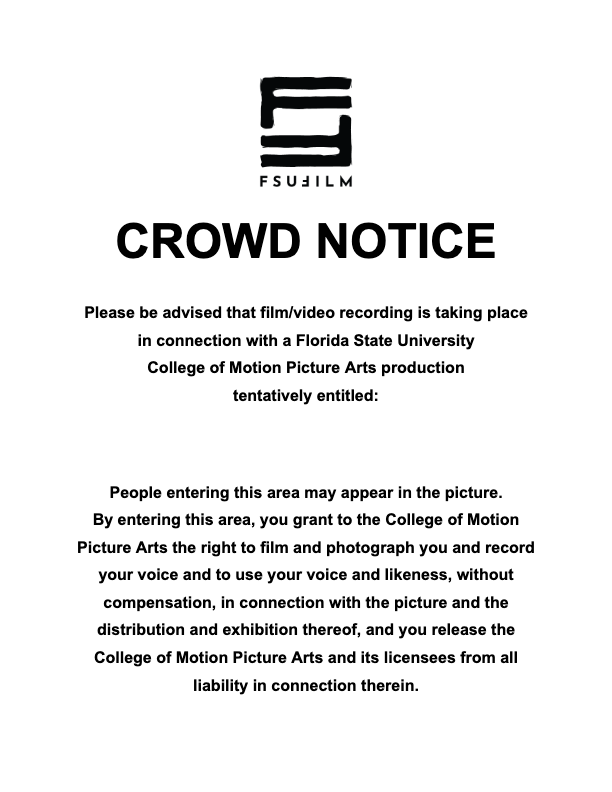
A Crowd Release grants the production permission to photograph and use the likenesses of individuals appearing as part of a crowd scene or public group within the film. It should be posted in highly visible places when a production cannot lock down a public space and get signed releases from all passersby.

This release is important because productions must secure permission to use identifiable individuals in footage intended for exhibition, festivals, online release, or distribution. Crowd releases help productions manage situations involving large groups more efficiently while still ensuring that participants have authorized the use of their image in the finished project.

Instructions

In some situations, especially in public spaces that the production cannot lock down, it is not always possible to get signed releases from every individual that appears in a shot. This Crowd Notice sign can be used in such situations to alert passersby that, by entering an area, their voice and likeness may be recorded and used in the film.

If a production plans to use this signage, the Producer should check in advance with the Location Owner to make sure they are okay with the signs being posted around the location.

When posting the signs, pay particular attention to the flow of passersby through the area. Identify strategic positions for placing the signs so that they are clearly visible to any passersby, but out of view of the camera.

Crew Deal Memo

Overview

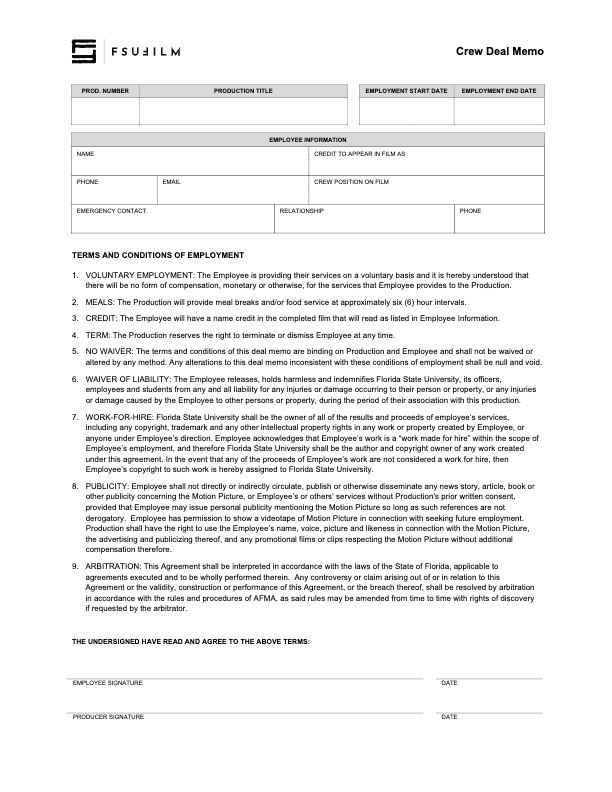
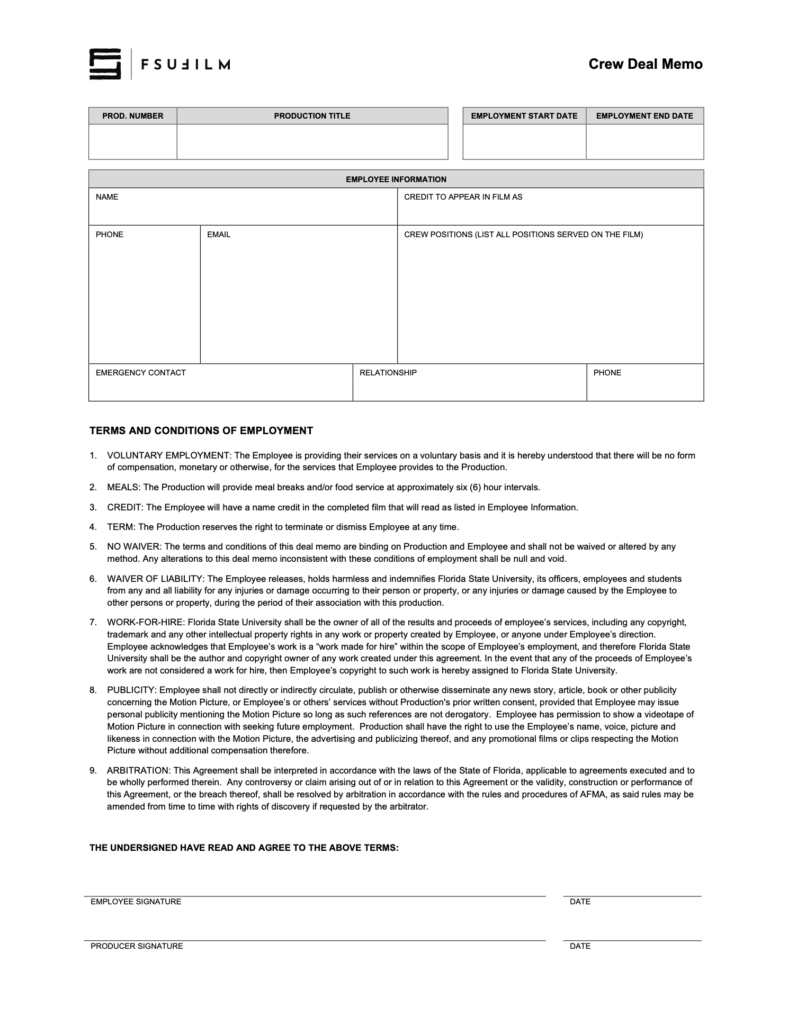
A Crew Deal Memo documents the basic terms and expectations associated with an individual’s participation as a crew member on a production. This includes information related to responsibilities, dates of participation, screen credits, emergency contacts, and other production expectations.

Clear crew documentation is important because productions depend on well-defined responsibilities and mutual understanding between collaborators. Maintaining formal agreements helps reduce confusion, supports accountability, and reinforces professional production practices related to staffing and crew organization.

Instructions

The Producer must ensure that all crew members complete a Crew Deal Memo at the start of the period of employment on the production. The deal memo outlines the terms and conditions of employment (which may not be modified) and defines the screen credit(s) in the finished film.

During final delivery of paperwork, a single form is used to collect all the deal memos for assigned crew positions. To prepare for this, it is recommended that producers either:

  1. Organize digital scans of all the crew deal memos before starting work on the form submission, then drag each PDF into the appropriate field in the form; or
  2. Organize paper copies of all the crew deal memos, then take a photo of each memo using the camera feature in the appropriate field in the form.

Composer Contract

Overview

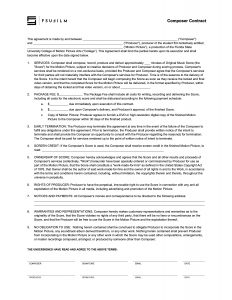
The Composer Contract establishes the agreement between the production and the composer creating original music for the film. The contract addresses the scope of the work, ownership and usage rights, delivery expectations, screen credits, and the production’s ability to use the music within the completed project.

Clear agreements with composers are important because original music involves both creative collaboration and intellectual property considerations. Proper documentation helps ensure that the production has the rights necessary to exhibit and distribute the film while also establishing clear expectations regarding deadlines, revisions, and ownership of the musical work.

INSTRUCTIONS

The Producer should use this contract agreement with a Composer who is writing the musical score for a production. It should be used regardless of whether or not the composer is being paid for their services.

The Producer is responsible for working with the Composer to determine the due date, the compensation structure, and the screen credit in the finished film.

It is advisable to make the delivery date of the score (in Section 1 of the contract) as early as is feasible, in order to provide some padding. It is not uncommon for composers on student films to miss their deadline, so it’s better to assume that that might happen than to hope for the best. Most ideal would be setting delivery of the score for a date during the sound editing phase, so that you have a better sense of how everything’s coming together. If that’s not viable, set delivery for as many days before the mix date as your composer’s schedule will allow.

All other clauses in the agreement must remain unchanged, unless the Producer is authorized in advance by the Head of Production to make specific amendments to the contract.