#safety-paperwork

Safety Meeting Report

Overview

The safety meeting report documents the safety discussions, procedures, identified risks, and production-specific concerns reviewed with cast and crew before filming activities take place.

Formal safety documentation is important because film productions often involve physical activity, equipment, environmental hazards, transportation, and other situations that require clear communication and shared awareness among the crew. Maintaining written safety records helps reinforce accountability, supports safer production practices, and encourages students to approach production planning with a stronger understanding of risk management and on-set responsibility.
INSTRUCTIONS

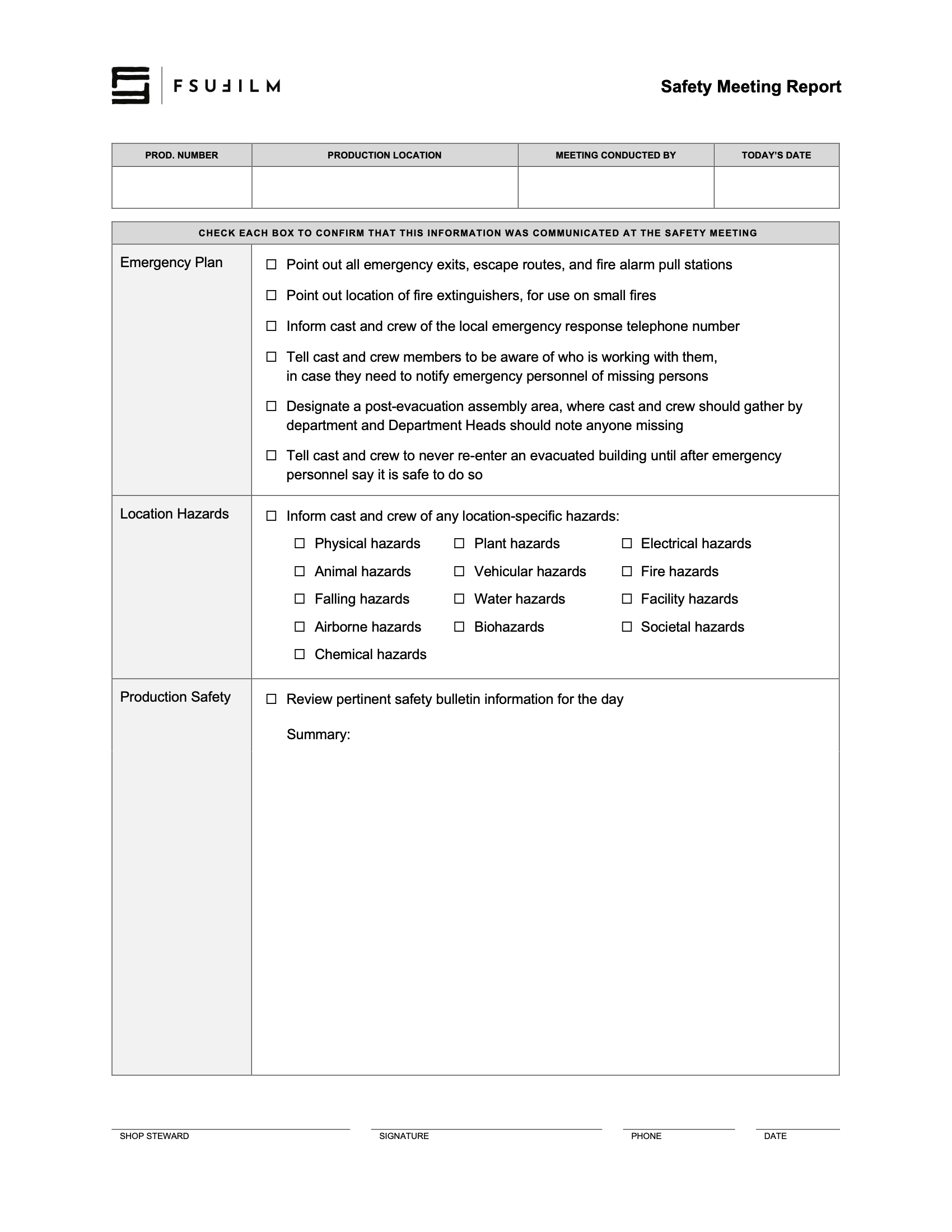
The Safety Meeting Report is to be completed by a Shop Steward to document what was covered in the morning safety meeting. It can also be used by the Assistant Director as a cheat sheet for what needs to be addressed in the meeting.

SAMPLE

Here’s a sample of what the completed report should look like:
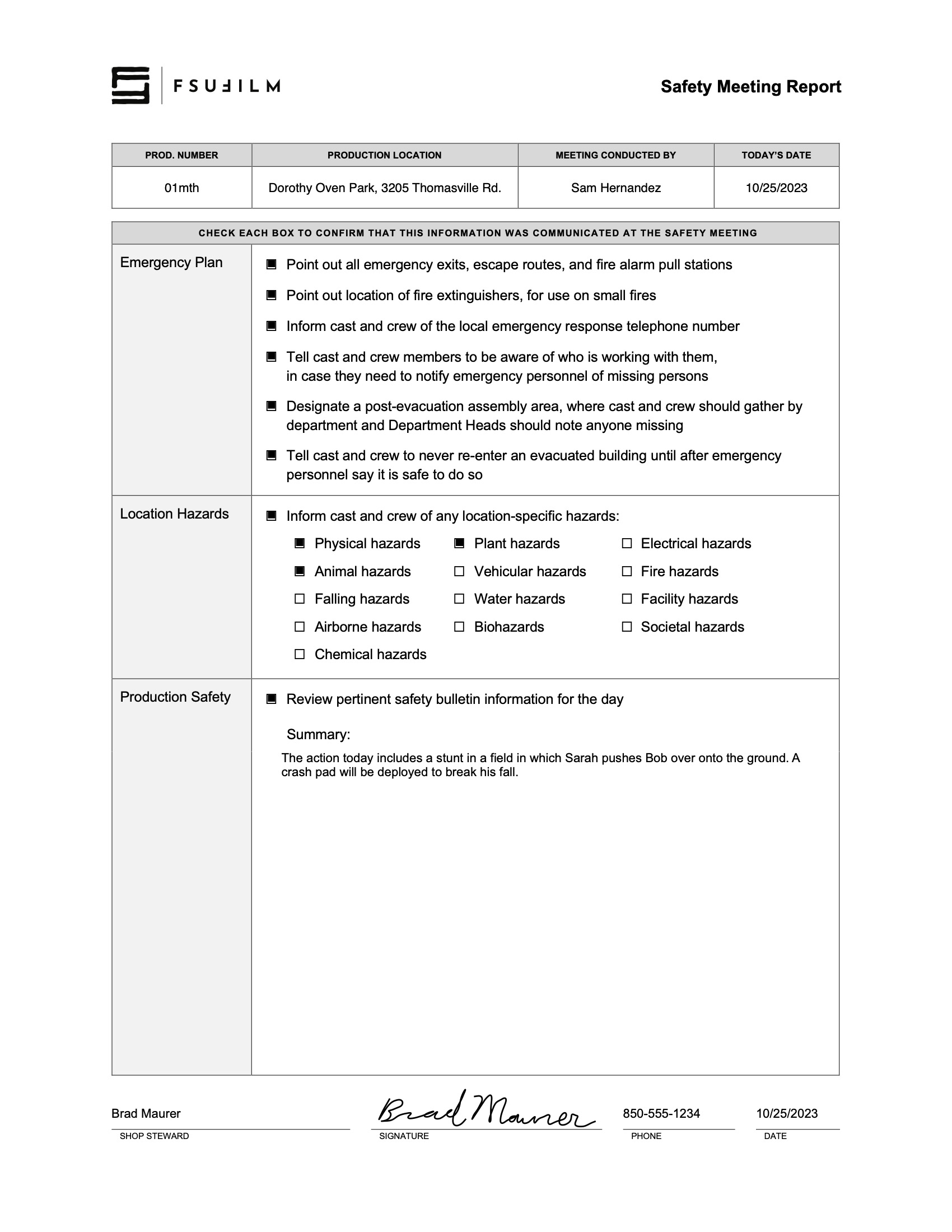
Sample of a completed form

Refusal of Medical Aid

Overview

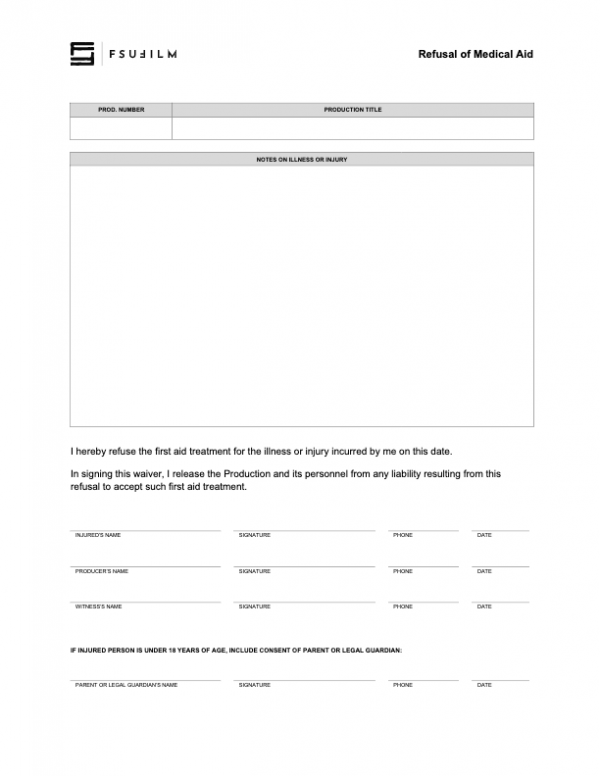
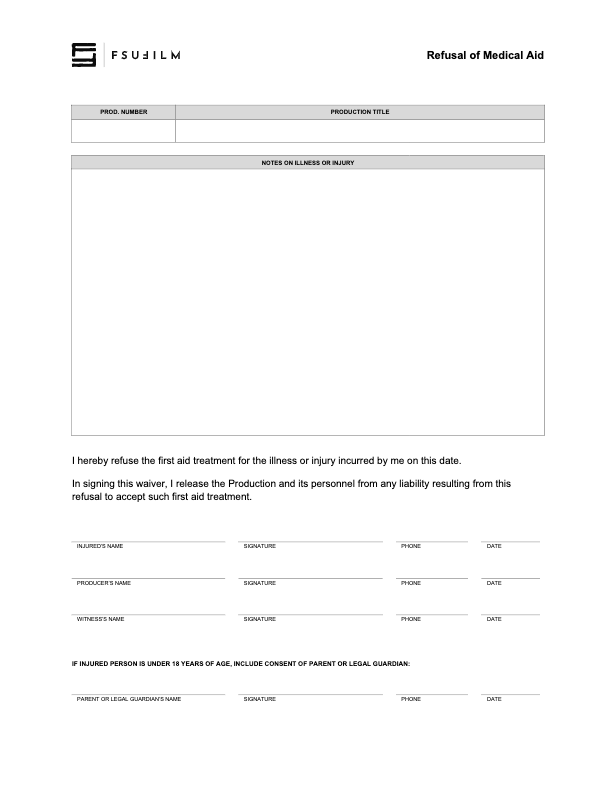
The Refusal of Medical Aid form documents situations in which an individual involved in a production declines medical assistance after an incident, injury, or safety-related event occurring during production activity.

Proper documentation of medical incidents is important because productions have a responsibility to maintain clear records related to on-set safety, injuries, and incident response. Recording a refusal of medical aid helps establish accurate documentation of the situation while reinforcing the importance of communication, accountability, and safety procedures within production environments.

Instructions

If a person is injured or experiences a medical emergency during the workday, the standard procedure to prioritize getting the person medical attention. There are circumstances, however, where an individual may choose to not get medical aid.

This form should only be used after an injury, illness, or medical incident in which an individual declines first aid, medical treatment, or transport after assistance has been offered. The form exists to document that the individual voluntarily refused care and understood the risks associated with that decision.

The form should be completed as soon as possible following the incident. Producers or set safety personnel should ensure that all sections are filled out clearly and accurately, including:

  • the date and location of the incident;
  • the nature of the illness or injury;
  • the medical aid or treatment that was offered;
  • the reason the individual declined assistance, if provided.

The injured or ill individual should personally complete and sign the form whenever feasible. A witness should also sign the form.

Signing the form documents that care was declined at the time of the incident and that the individual has released the production from any liability resulting from the refusal of medical aid. Signing the form does not prevent the individual from later seeking medical care.

This form should be retained with the production’s safety paperwork and incident documentation. If the situation appears serious or life-threatening, students should immediately contact emergency services and notify faculty, even if the individual initially refuses assistance.

Location Hazard Assessment

Overview

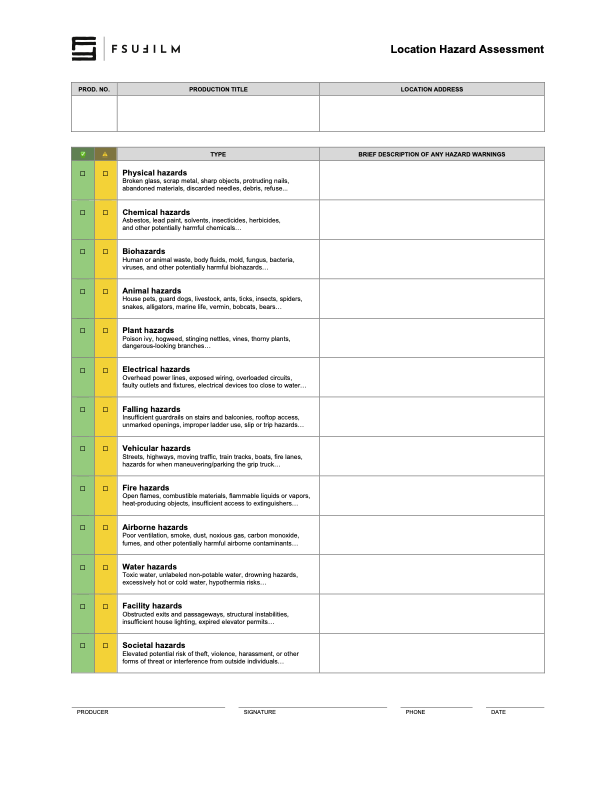
The Location Hazard Assessment checklist is used to identify potential risks at a filming location before production takes place. These may include physical hazards, chemical hazards, biohazards, animal or plant hazards, electrical hazards, fall risks, environmental concerns, or other conditions that could affect cast, crew, equipment, or the public.

This assessment is important because location risks are easiest to manage when they are identified early. Documenting hazards in advance allows the production and school to determine whether additional safety measures, approvals, adjustments, or alternate plans are needed before filming begins.

Instructions

The Producer is responsible for conducting a thorough inspection of every shooting location and completing a separate Location Hazard Assessment form for each site. This form should be completed before the project’s tech scout or director’s prep so that any identified risks can be reviewed with faculty in advance.

When completing the form, be specific and practical. The goal is not simply to identify hazards, but to document how the production might mitigate or manage them. If a hazard is present, clearly describe the precautions the production could take to reduce risk.

Hazards may include:

  • Physical hazards
  • Chemical hazards
  • Biohazards
  • Animal hazards
  • Plant hazards
  • Electrical hazards
  • Falling hazards
  • Vehicular hazards
  • Fire hazards
  • Airborne hazards
  • Water hazards
  • Facility hazards
  • Societal hazards

The assessment should reflect the actual conditions of the location at the time of scouting. Productions should revisit and update assessments if conditions significantly change prior to filming.

Sample

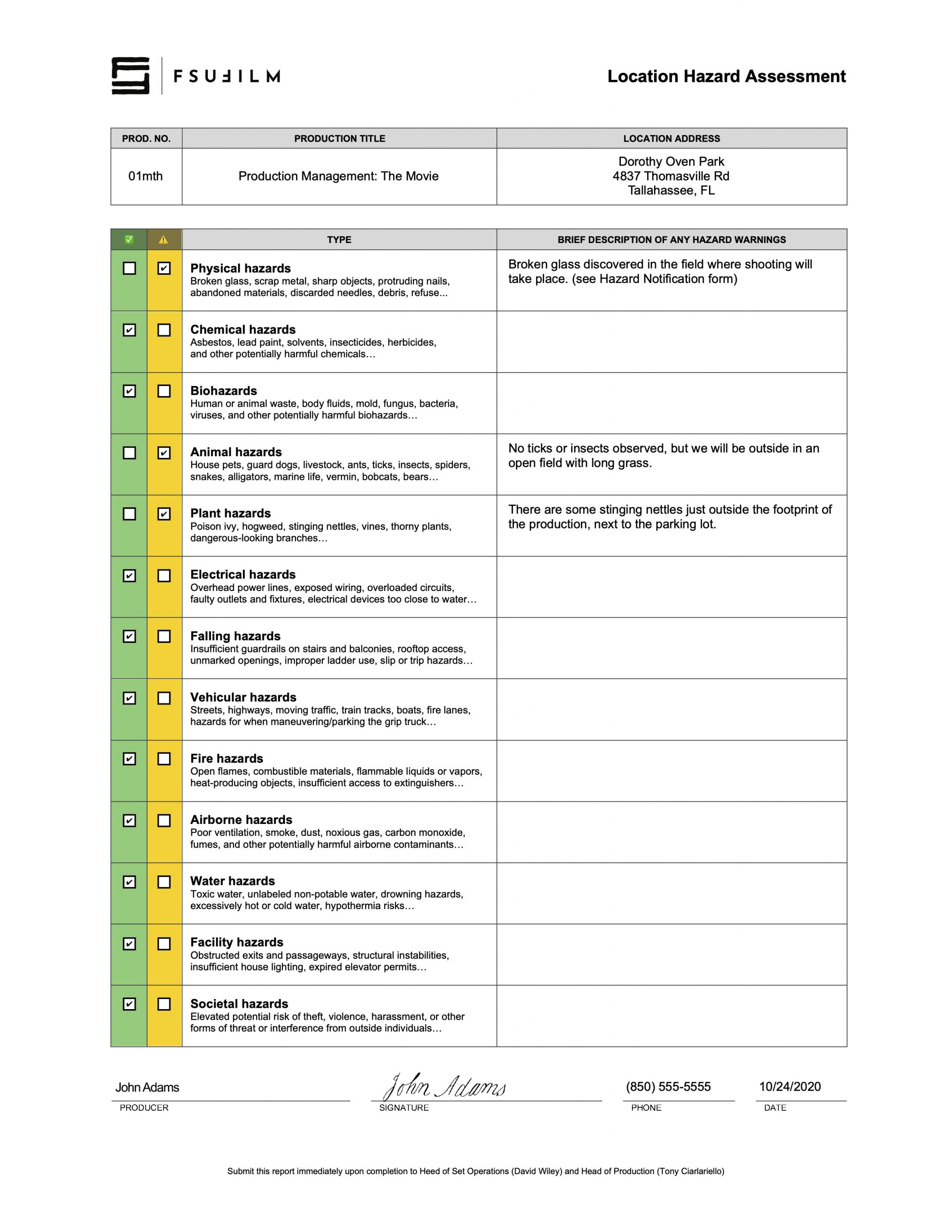
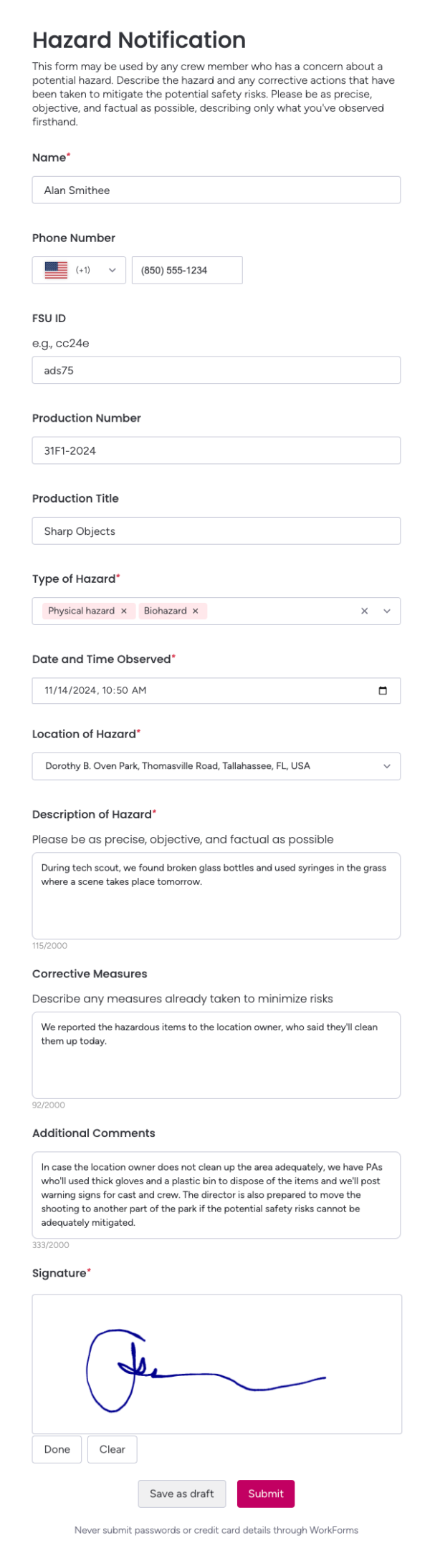
Here’s a sample version of what the completed form should look like:

Sample form

Hazard Notification

Overview

The Hazard Notification form may be used by any crew member who has a concern about a potential hazard during production. The form allows the crew member to describe the hazard and identify any steps they believe may be needed to address it.

This process is important because safety responsibility does not belong only to producers, department heads, and shop stewards. Giving any crew member a clear way to report hazards helps productions identify risks earlier, respond more responsibly, and reinforce a culture where safety concerns are taken seriously.

Instructions

The Hazard Notification form may be used by any crew member who has a concern about a potential hazard. Use the form to describe the hazard and to describe any corrective actions that have been taken (or could be taken). Please be as precise, objective, and factual as possible, describing only what you’ve observed first-hand.

Sample Form

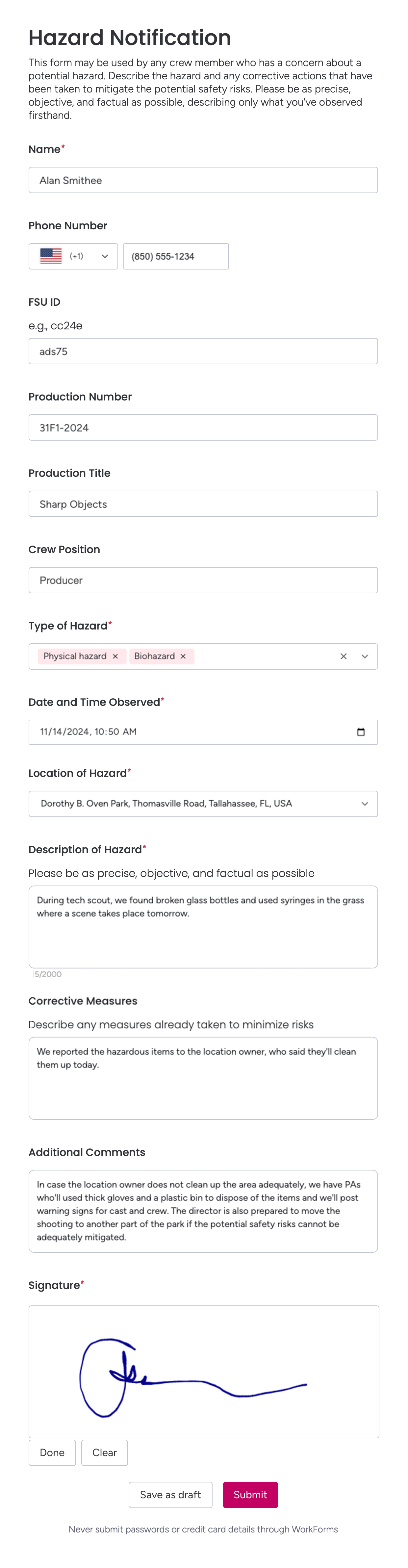
Here’s a sample of what the completed form should look like:

Sample form

Safety Bulletins

Overview

Safety bulletins provide guidance, procedures, and recommended practices related to specific production hazards, equipment, environments, or activities that may arise during filmmaking—and they must be included alongside call sheets when relevant.

Because film production can involve physically demanding environments, technical equipment, transportation, electrical systems, weather exposure, stunts, weapons, animals, and other potential hazards, productions must approach safety proactively rather than reactively. Safety bulletins help crews identify risks earlier, develop safer working practices, and reinforce a culture of shared responsibility around production safety.

How They Work

The safety bulletins we utilize are researched, written, and distributed by the Industry-Wide Labor-Management Safety Committee for use by the motion picture industry. The committee is composed of guild, union, and management representatives active in industry safety and health programs.

Safety bulletins are recommended guidelines. They are not binding laws or regulations. State, federal, and/or local regulations override these guidelines. Modifications in these guidelines should be made, as circumstances warrant, to ensure the safety of the cast and crew.

A PDF of all relevant safety bulletins must be attached to call sheets. Be sure to download the most recent version of a safety bulletin before attaching one to a call sheet, as the Industry-Wide Labor-Management Safety Committee does update their bulletins periodically.

All crew are required to read distributed Safety Bulletins prior to commencing the work day. Failure to do so may result in disciplinary action, including immediate dismissal from the school.

Download Bulletins

To download the latest versions of the safety bulletins, click here:

List of Bulletins

A list of all the available Industry-Wide Labor-Management Safety Committee’s safety bulletins is outlined below.

Safety Bulletins

  1. Recommendations For The Use Of Firearms, Blanks, And Dummy Rounds
  2. Prohibitions And Special Restrictions On The Use Of Live Ammunition
  3. Guidelines Regarding the Use of Helicopters in Motion Picture Productions
    • Addendum A – Helicopter External Loads
  4. Stunts
    • Addendum A – Specialized Activities
  5. Safety Awareness
  6. Animal Handling Rules for the Motion Picture Industry
  7. Recommendations For Diving Operations
  8. Guidelines for Traditional Camera Cars
    • Addendum A – Process Trailer/Towed Vehicle
    • Addendum B – Camera Boom Vehicles
    • Addendum C – Power Line Distance Requirements
  9. Recommended Guidelines for Working In and Around Base Camps
    • Addendum A – Base Camp Inspection Checklist
  10. Guidelines Regarding the Use of Artificially Created Atmospheric Fog & Haze
    • Addendum A – Technical Awareness Sheet
  11. Guidelines Regarding the Use of Fixed-Wing Aircraft in Motion Picture Productions
    • Addendum A – External Load Guidelines
  12. Guidelines for the Use of Venomous Reptiles
  13. Recommended Guidelines When Using Combustible & Flammable Fuels and Associated Equipment
  14. Parachuting and Skydiving
  15. Guidelines for Boating/Watercraft Safety for Film Crews
  16. Recommended Guidelines for Safety with Pyrotechnic Special Effects
  17. Water Hazards
  18. Guidelines for Safe Use of Stunt Air Bags, Boxes or Other Freefall Catch Systems
  19. Recommended Guidelines for the Use of Open Flame on Production
  20. Guidelines for the Safe Use of Motorcycles
  21. Guidelines for Appropriate Clothing and Personal Protective Equipment
  22. Guidelines for the Use of Scissor Lifts (Elevating Work Platforms) and Aerial Boom Lifts (Extensible Boom Platforms)
    • Addendum A – Power Line Distance Requirements
  23. Guidelines for Working with Portable Power Distribution Systems and Other Electrical Equipment
    • Addendum A – Power Line Distance Requirements
    • Addendum B – Basic Electrical Safety Precautions for Motion Picture and Television Off Studio Lot Location Productions
    • Addendum C – Working With 480 Volt Systems
    • Addendum D – Common Motion-Picture/Television Tasks and Associated Personal Protective Equipment
    • Addendum E – Guidelines for Meeting National Electrical Code (NEC) Grounding Requirements for Portable Generators Supplying Portable Equipment in the Motion Picture and Television Industry
  24. California OSHA Safety Requirements for Handling of Blood and Other Potentially Infectious Materials
  25. Camera Cranes
    • Addendum A – Power Line Distance Requirements
  26. Preparing Urban Exterior Locations for Filming
  27. Poisonous Plants
  28. Guidelines for Railroad Safety
  29. Guidelines for Safe Use of Hot Air Balloons
    • Addendum A – External Load Guidelines
  30. Recommended Guidelines for Safely Working with Edged, Piercing, and Projectile Props
  31. Safety Awareness When Working Around Indigenous Wildlife
  32. Los Angeles County Approved Film Production Food Services
    • Addendum A – Los Angeles County Approved Film Production Food Services
  33. Special Safety Considerations when Employing Infant Actors (15 days to Six Months Old)
  34. Guidelines for Working in Extreme Cold Temperature Conditions
    • Addendum A – Wind Chill Chart
  35. Safety Considerations for the Prevention of Outdoor Heat Illness
  36. Recommended Guidelines for Safely Working Around Unmanned Aircraft Systems (UAS) a.k.a Drones
    • Appendix A – Federal Aviation Administration (FAA) Rules & Regulations
  37. Vehicle Restraint Systems – Seat Belts & Harnesses
  38. Guidelines For Inclement Or Severe Weather
    • Appendix A – Lightning Safety
  39. Safety Guidelines for Using Foam(ed) Plastics in Set and Prop Construction
  40. Guidelines for Non-Camera Utility Vehicles
  41. Recommended Guidelines for Safely Working On and Around Gimbals
  42. Guidelines for Alternative Driving Systems
  43. Recommended Guidelines for Free Driving
  44. Guidelines for Working Safely with Radiofrequency (RF) Transmitters
  45. Guidelines For Long or Successive Takes

Procedural Guidelines

  1. Special Procedures For Minors Performing Physical Activities

Informational Fact Sheets

  1. General Code of Safe Practices for Production
  2. Extended or Successive Takes
  3. Guidelines for Handling Freshly Painted or Printed Backdrops and Other Graphic Arts
  4. Photographic Dust Effects
  5. Guidelines for Reducing the Spread of Influenza-Like Illness
  6. Protection from Wildfire Smoke
  7. Lithium-Ion Battery Safety
  8. Indoor Heat Illness Prevention: California