FC

Distant Location Request

Overview

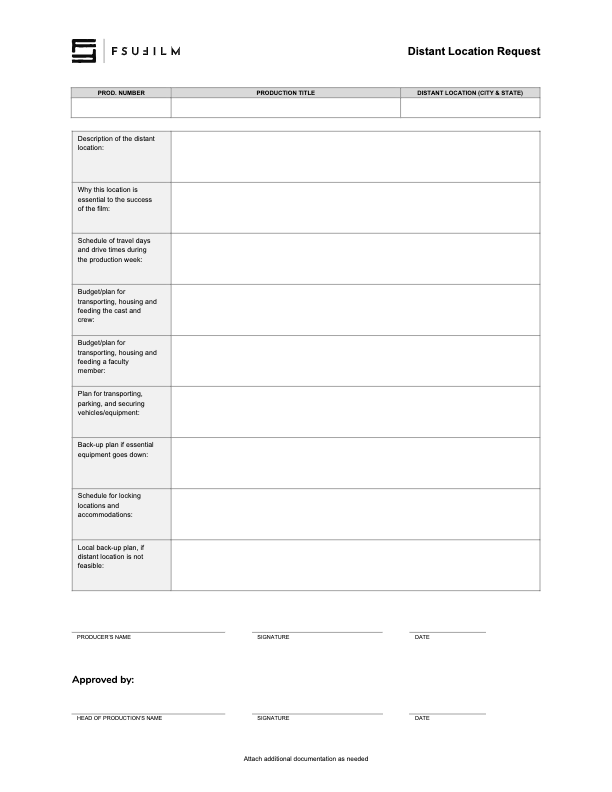
The Distant Location Request is used when a capstone production seeks permission to film outside the school’s studio zone. The Producer must present a detailed plan addressing the location’s importance, travel schedule, transportation, lodging, meals, equipment security, faculty support, contingency plans, deadlines, and a local backup option.

This process exists because distant locations add significant complexity, cost, wear on equipment, and stress on the crew. Approval is not automatic; productions must demonstrate that the location is essential, that the plan is realistic, and that the added demands can be managed responsibly within school expectations.
INSTRUCTIONS

BFA and MFA thesis films may request permission to shoot at a distant location outside of the studio zone. Please note however that — due to the added complexity of shooting films at distant locations, the added wear-and-tear on school equipment, and the added stress placed on the crew — shooting at a distant location is not approved automatically. It’s a privilege that needs to be earned.

The Producer will need to present a thorough plan to the Head of Production that addresses the following:

  1. A description of the distant location.
  2. Why this location is essential to the success of the film.
  3. The schedule of travel days and drive times during the production week.
  4. A budget/plan for transporting, housing, and feeding the cast and crew for the duration of the distant shoot.
  5. A budget/plan for transporting, housing, and feeding a faculty member for the duration of the distant shoot.
  6. A plan for transporting, parking, and securing school vehicles and equipment during the distant shoot.
  7. A back-up plan if the camera or other essential equipment goes down.
  8. A schedule showing key deadlines for locking locations, securing accommodations, and any other critical plans. Permission for shooting at a distant location will be revoked if these deadlines are not hit, and the production will need to shoot locally.
  9. A local back-up plan, in case permission is not granted and/or the distant location falls through.

The request to shoot at a distant location should be made to the Head of Production as early as possible in the development/pre-production process, and no later than two weeks before the first day of production on the show. The Head of Production’s decision on whether to approve or deny a distant location request is final.

Dialogue List

Overview

The Dialogue List is a delivery document that identifies and organizes all spoken dialogue and on-screen text appearing in the finished film. This is used for captions, subtitles, accessibility workflows, sound post-production reference, and final delivery documentation.

Accurate dialogue documentation is important because downstream workflows such as captioning, subtitling, localization, accessibility compliance, and archival delivery depend on having a reliable written record of the film’s spoken content. Maintaining a clean and organized dialogue list also helps productions avoid inconsistencies or omissions during final delivery.

Instructions

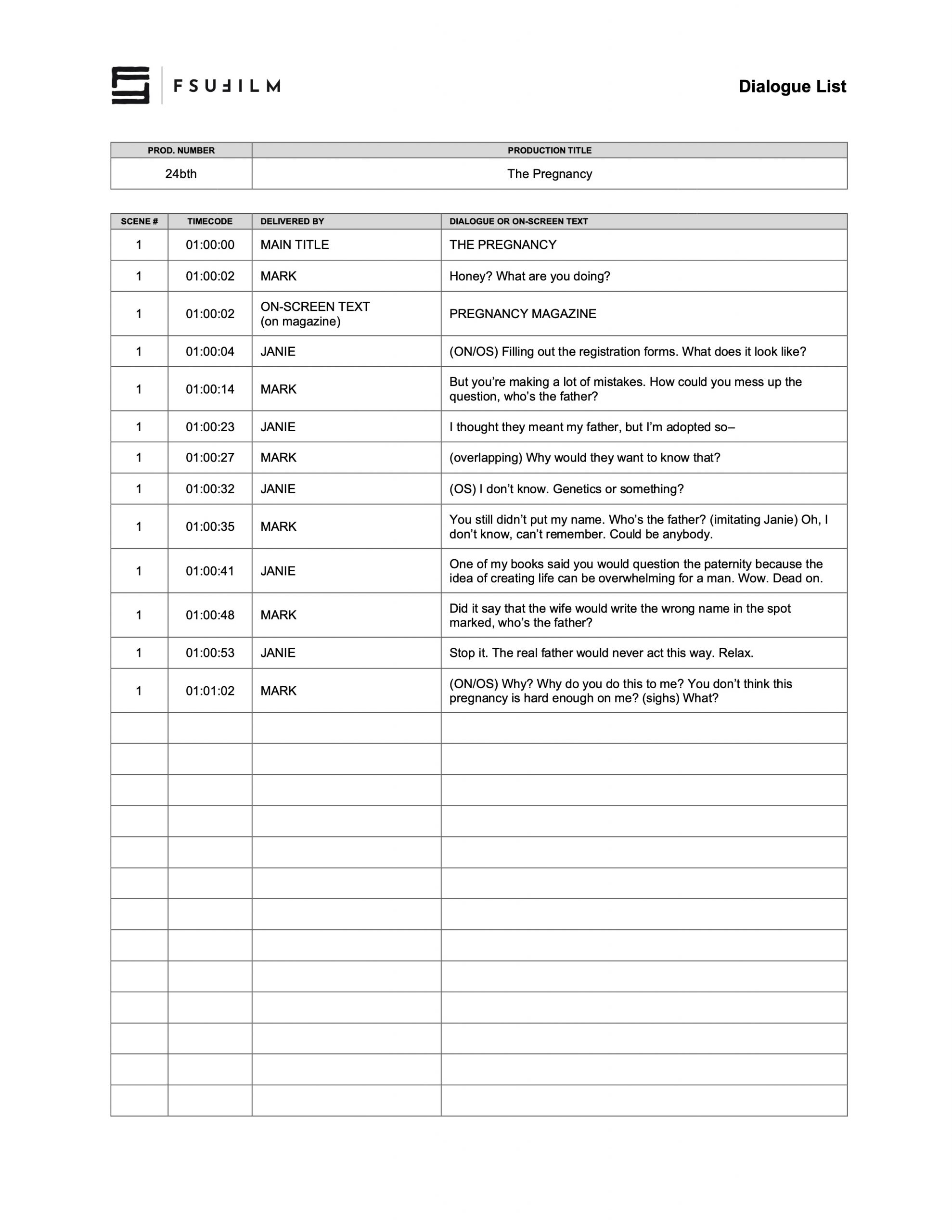
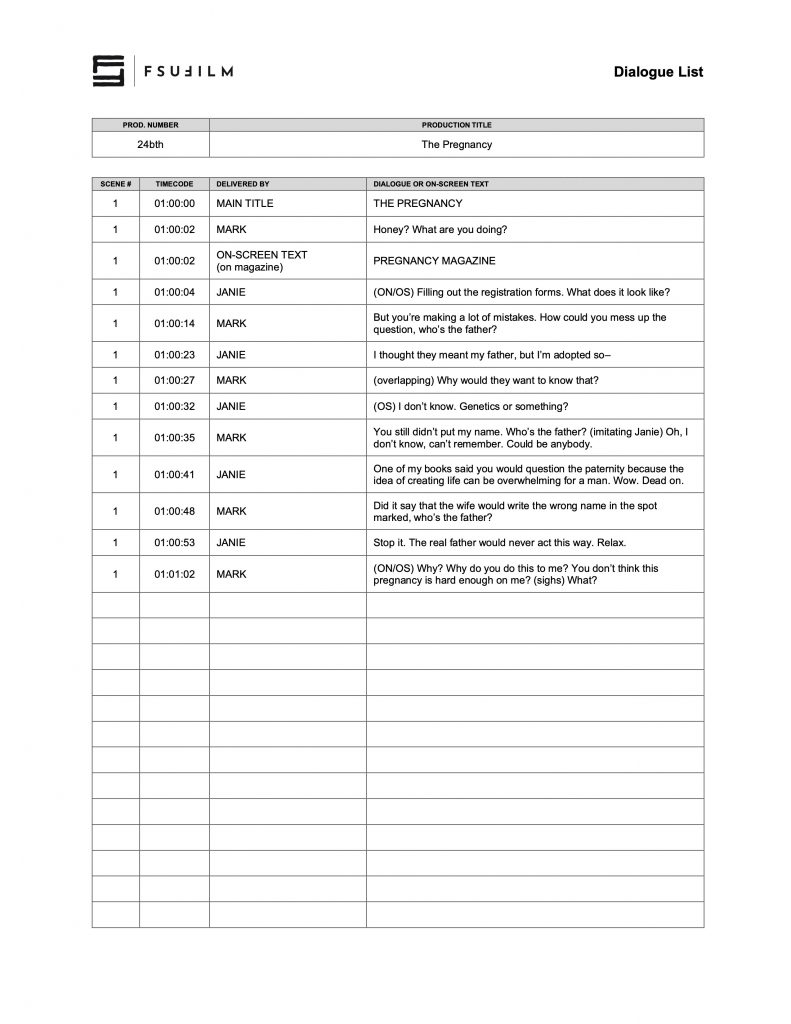
When a film is sent to a foreign language film festival, the festival will add subtitles in the local language based on this Dialogue List. The form should include all spoken dialogue and on-screen text that is in the final film, including the timecode of when each occurs.

SAMPLE

Here’s a sample of what the completed form should look like:

Sample of a completed form

Daily Production Report

Overview

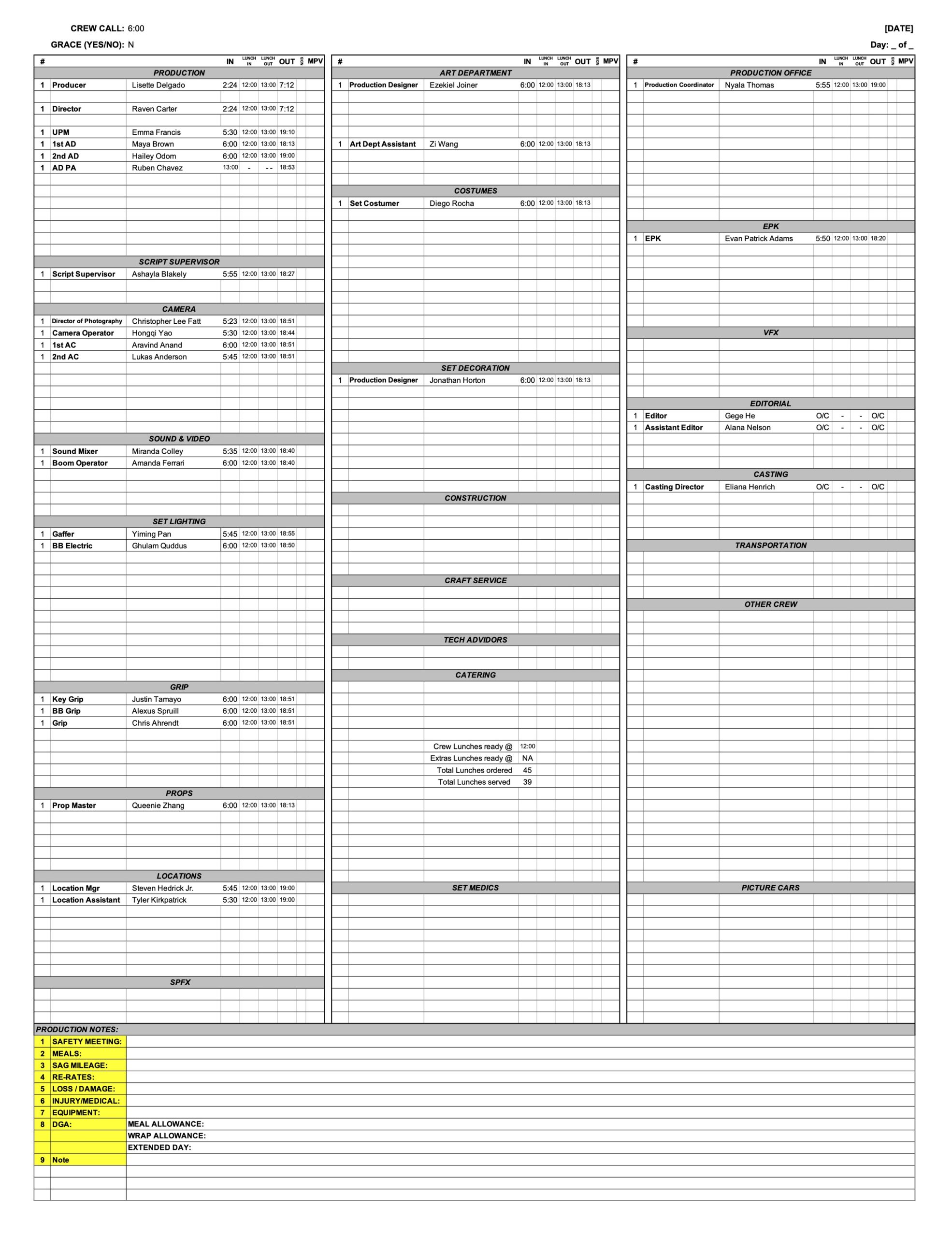
The Daily Production Report documents the major activities, progress, delays, incidents, scheduling information, and operational details associated with a production day. It serves as an official record of what occurred during filming and is completed at the end of each shoot day.

Daily reporting is important because productions rely on accurate records to track progress against the schedule, communicate between departments, identify emerging issues, and maintain accountability throughout the shoot. Consistent reporting also creates a valuable reference for post-production, faculty oversight, and future review of production operations.

INSTRUCTIONS

The Second Assistant Director is responsible for sending out a PDF of the Daily Production Report (DPR) at the end of every shooting day, no later than two hours after wrap. If the production does not have a dedicated Second Assistant Director, the First Assistant Director or Producer shall assume the responsibility.

The purpose of the DPR is to communicate important information from the day’s production, such as number of setups, start and end times, in and out times, reports on delays, and reports on equipment problems. If an urgent problem or situation arises on set, however, do not wait until the end of day to report it; contact the appropriate individuals immediately. (Make sure it is documented on the DPR at the end of the day as well, though.)

Post the completed DPR the “DPRs” channel on Teams. The PDF file should be formatted with production number and show title as follows: 

01f3-DPR-Day1.pdf

DPR Sample

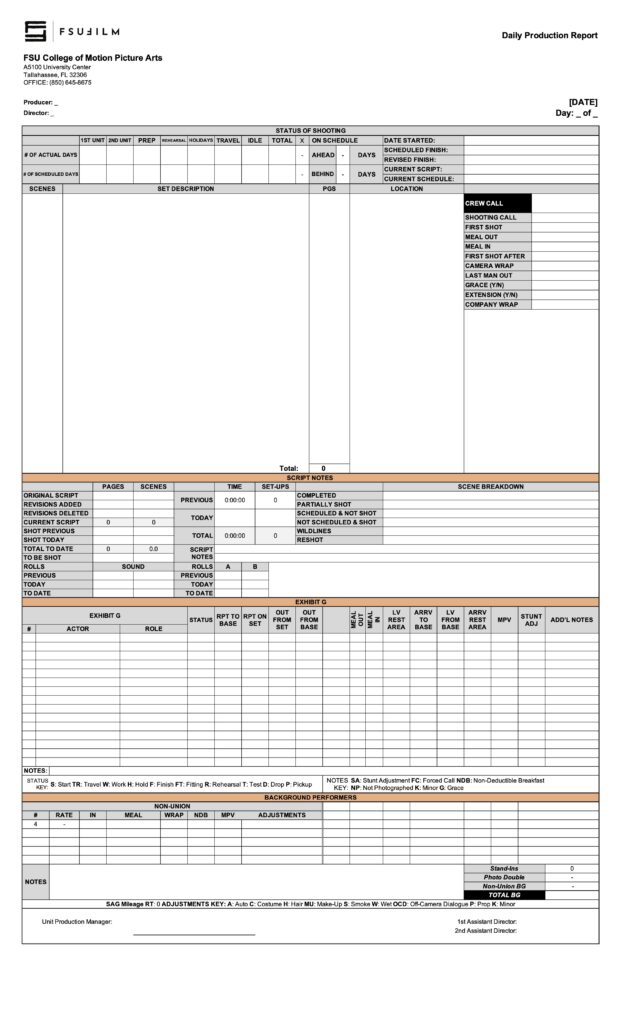
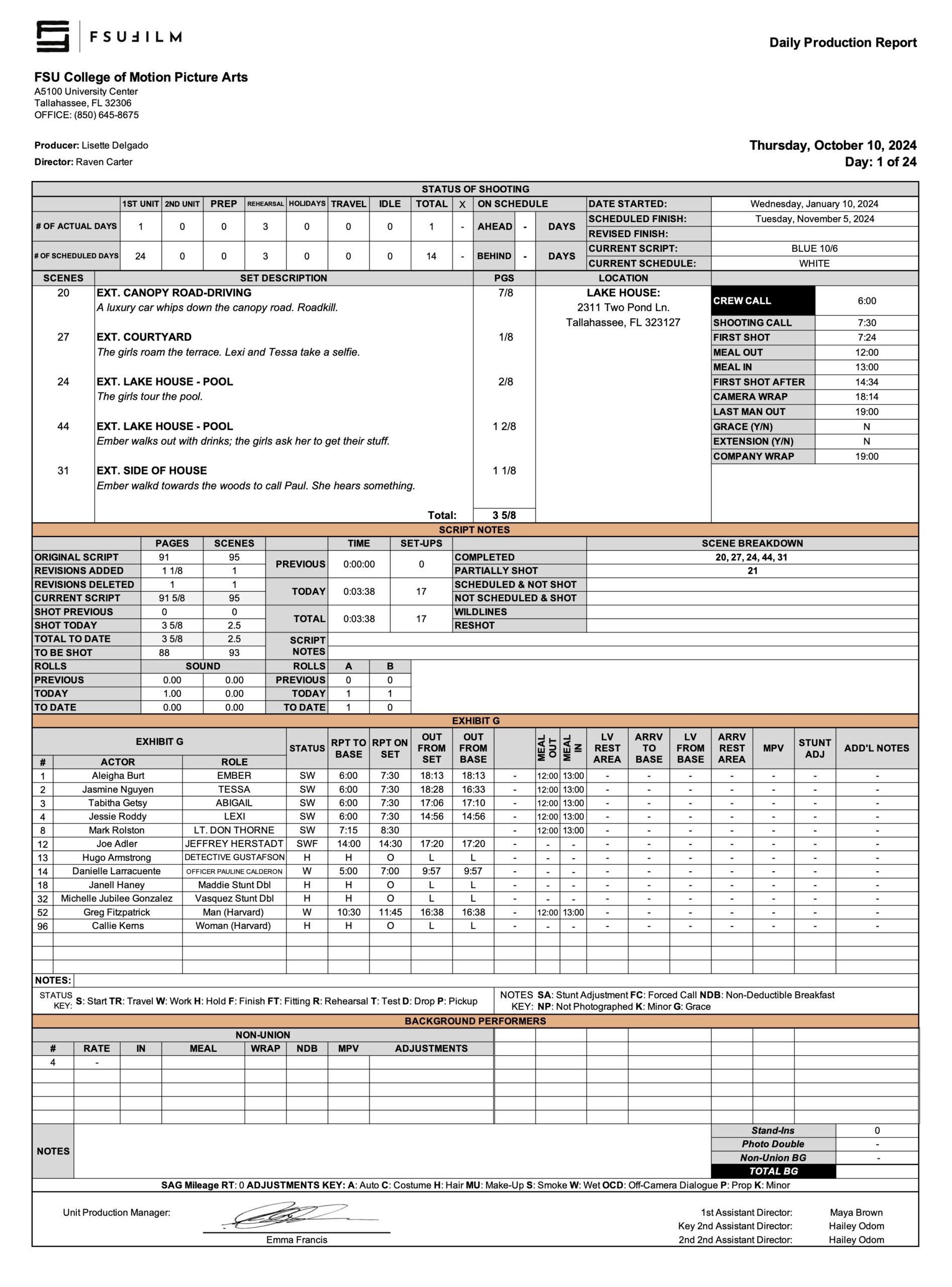
Here’s a sample of what the completed form should look like:

Sample DPR (page one)
Sample DPR (page two)

Crowd Release

Overview

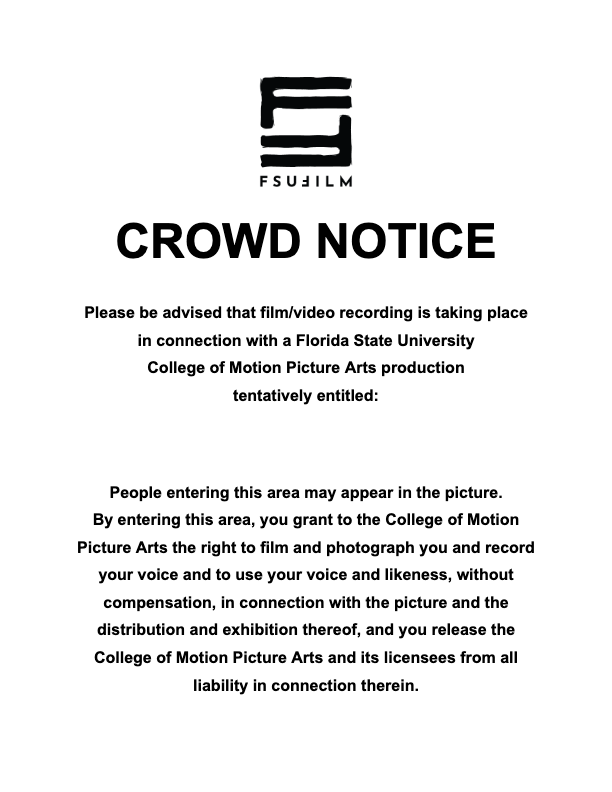
A Crowd Release grants the production permission to photograph and use the likenesses of individuals appearing as part of a crowd scene or public group within the film. It should be posted in highly visible places when a production cannot lock down a public space and get signed releases from all passersby.

This release is important because productions must secure permission to use identifiable individuals in footage intended for exhibition, festivals, online release, or distribution. Crowd releases help productions manage situations involving large groups more efficiently while still ensuring that participants have authorized the use of their image in the finished project.

Instructions

In some situations, especially in public spaces that the production cannot lock down, it is not always possible to get signed releases from every individual that appears in a shot. This Crowd Notice sign can be used in such situations to alert passersby that, by entering an area, their voice and likeness may be recorded and used in the film.

If a production plans to use this signage, the Producer should check in advance with the Location Owner to make sure they are okay with the signs being posted around the location.

When posting the signs, pay particular attention to the flow of passersby through the area. Identify strategic positions for placing the signs so that they are clearly visible to any passersby, but out of view of the camera.

Crew Sign In

Overview

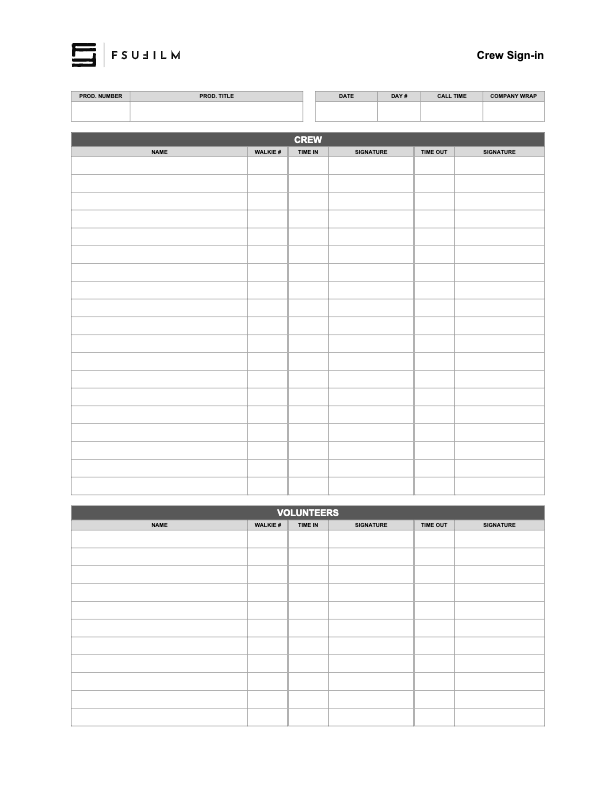
The Crew Sign In form is used to document crew attendance during production activities. It provides a record of which crew members were present on a given production day and is used to track arrival times, departure times, and walkie numbers.

Maintaining accurate attendance records helps productions stay organized and supports communication, scheduling, safety oversight, and administrative documentation throughout the shoot. Consistent sign-in procedures also help reinforce professional production practices related to accountability and crew coordination.

Crew Replacement Approval

Overview

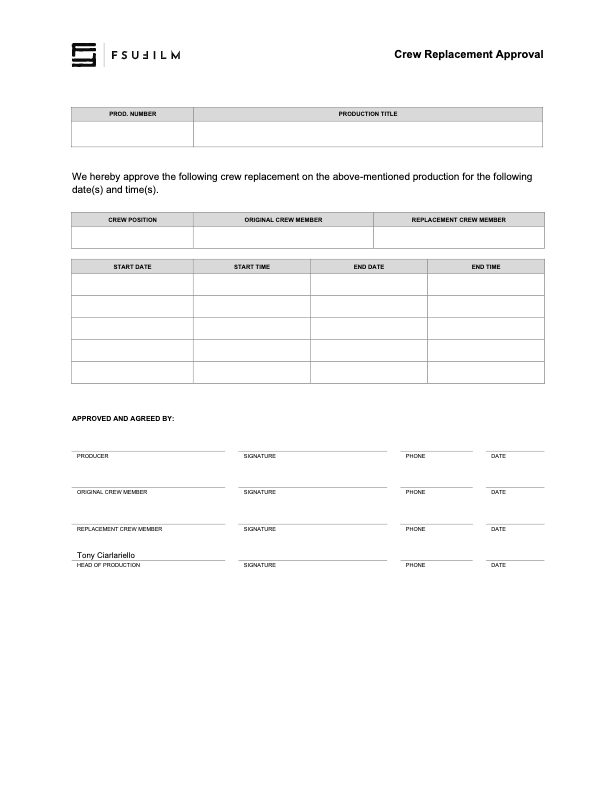
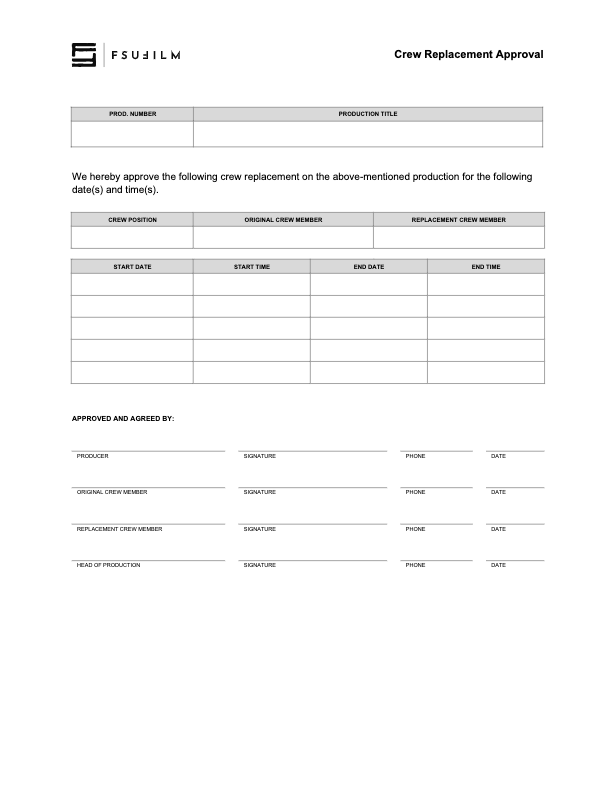
The Crew Replacement Approval process is used when a production seeks permission to replace a crew member after assignments have already been finalized.

Crew changes can affect scheduling, training, department continuity, collaboration, and the overall balance of the production structure. Requiring formal approval helps the school evaluate whether the proposed change is appropriate, manageable, and consistent with the educational and operational needs of the production.

Instructions

This paperwork should be submitted when requesting that a crew member be replaced by another student. It requires the signatures of both the original crew member and their replacement, as well as the Producer and the Head of Production.

If crew members are switching positions on a productions, a separate form should be submitted for each crew position.

Crew Deal Memo

Overview

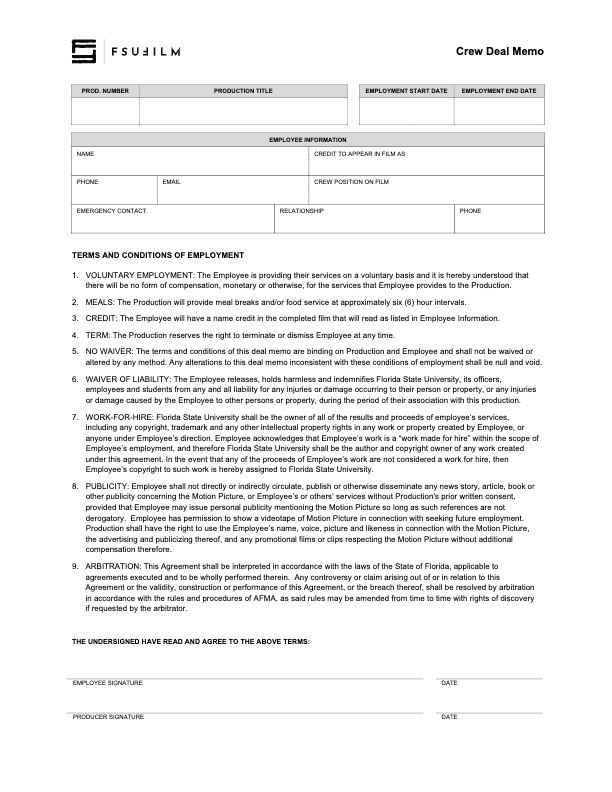
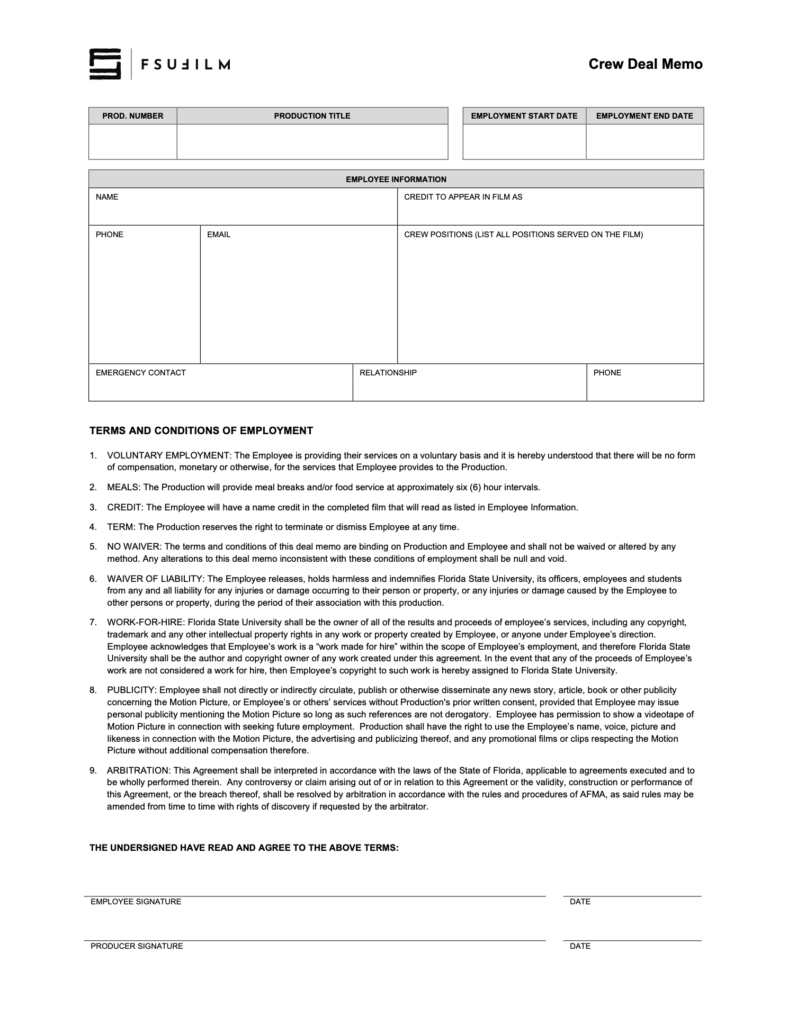
A Crew Deal Memo documents the basic terms and expectations associated with an individual’s participation as a crew member on a production. This includes information related to responsibilities, dates of participation, screen credits, emergency contacts, and other production expectations.

Clear crew documentation is important because productions depend on well-defined responsibilities and mutual understanding between collaborators. Maintaining formal agreements helps reduce confusion, supports accountability, and reinforces professional production practices related to staffing and crew organization.

Instructions

The Producer must ensure that all crew members complete a Crew Deal Memo at the start of the period of employment on the production. The deal memo outlines the terms and conditions of employment (which may not be modified) and defines the screen credit(s) in the finished film.

During final delivery of paperwork, a single form is used to collect all the deal memos for assigned crew positions. To prepare for this, it is recommended that producers either:

  1. Organize digital scans of all the crew deal memos before starting work on the form submission, then drag each PDF into the appropriate field in the form; or
  2. Organize paper copies of all the crew deal memos, then take a photo of each memo using the camera feature in the appropriate field in the form.

Composer Contract

Overview

The Composer Contract establishes the agreement between the production and the composer creating original music for the film. The contract addresses the scope of the work, ownership and usage rights, delivery expectations, screen credits, and the production’s ability to use the music within the completed project.

Clear agreements with composers are important because original music involves both creative collaboration and intellectual property considerations. Proper documentation helps ensure that the production has the rights necessary to exhibit and distribute the film while also establishing clear expectations regarding deadlines, revisions, and ownership of the musical work.

INSTRUCTIONS

The Producer should use this contract agreement with a Composer who is writing the musical score for a production. It should be used regardless of whether or not the composer is being paid for their services.

The Producer is responsible for working with the Composer to determine the due date, the compensation structure, and the screen credit in the finished film.

It is advisable to make the delivery date of the score (in Section 1 of the contract) as early as is feasible, in order to provide some padding. It is not uncommon for composers on student films to miss their deadline, so it’s better to assume that that might happen than to hope for the best. Most ideal would be setting delivery of the score for a date during the sound editing phase, so that you have a better sense of how everything’s coming together. If that’s not viable, set delivery for as many days before the mix date as your composer’s schedule will allow.

All other clauses in the agreement must remain unchanged, unless the Producer is authorized in advance by the Head of Production to make specific amendments to the contract.

Camera Report

Overview

The Camera Report documents technical and organizational information related to footage recorded during production. This includes scene and take information, media card tracking, camera settings, lens and filter data, and other production details associated with camera operations.

Accurate camera reports are important because editorial and post-production workflows depend heavily on reliable production records when organizing and reviewing footage. Consistent reporting helps reduce confusion, improve media management, and support smoother communication between camera, script supervision, editorial, and post-production departments.

INSTRUCTIONS

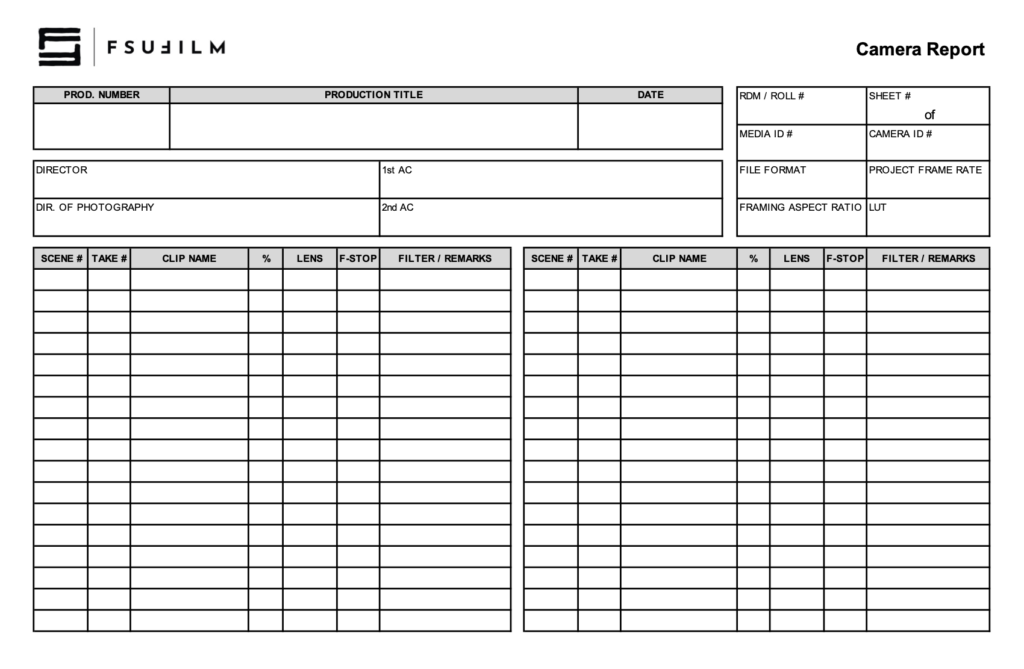
The 2nd AC completes the Camera Report. For the info in the top-right corner:

  • RDM/Roll #: A sequential numbering of each of the camera cards used. For example, the first camera card used on day 1 would be A001. The next camera card used, say on day 2, would be A002. And so on.
  • Sheet: A sequential numbering of Camera Reports for each camera card. For example, for camera card SSD 56, you start with Sheet 1. If you fill up Sheet 1, then you would continue on a new Camera Report, Sheet 2. And so on.
  • Media ID #: The ID number on the camera card.
  • Camera ID: The serial number that can be found on the bottom of the camera.
  • File Format: The file format that is set on the camera menu. Standard for Red Epic is 2K ProRes 444.
  • Project Frame Rate: The frame rate of the project edit timeline. Standard is 24fps.
  • Framing Aspect Ratio: The aspect ratio used for the camera framing guides.
  • LUT: The Look Up Table settings that were selected in the camera menu.

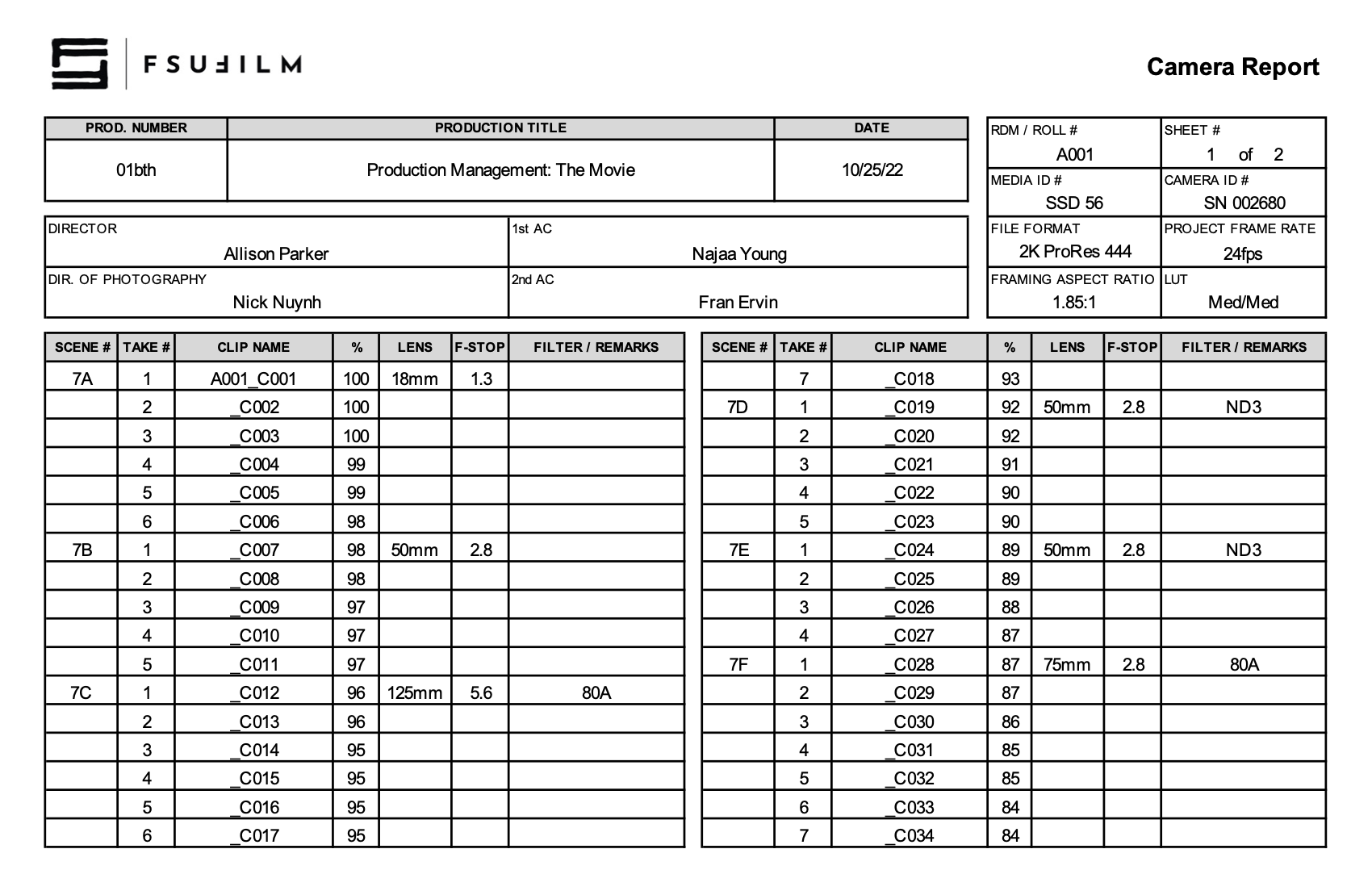
SAMPLE

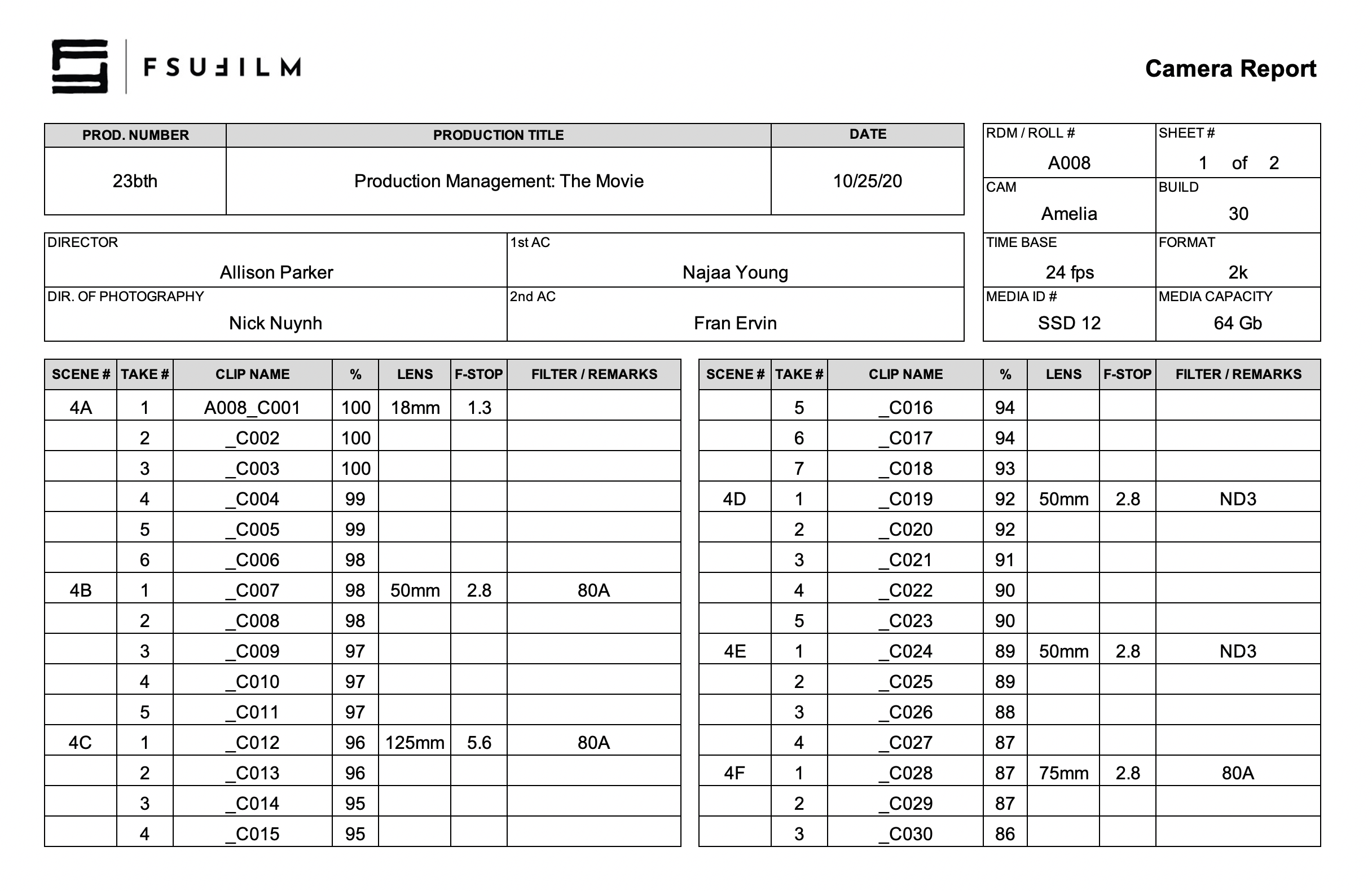
Here’s a sample of what the completed form should look like:

Sample of a completed form

Certificate of Insurance

Overview

A Certificate of Insurance is a document issued by the university’s insurance provider verifying that approved production activities are covered under the institution’s insurance policies. Productions may need to provide this document to property owners, vendors, municipalities, or other outside parties before filming or conducting production-related activities.

Many locations and organizations require proof of insurance before granting permission for production activity to take place. The certificate helps demonstrate that the production has institutional coverage in place while supporting safer and more professionally managed relationships with outside partners and locations.

Instructions

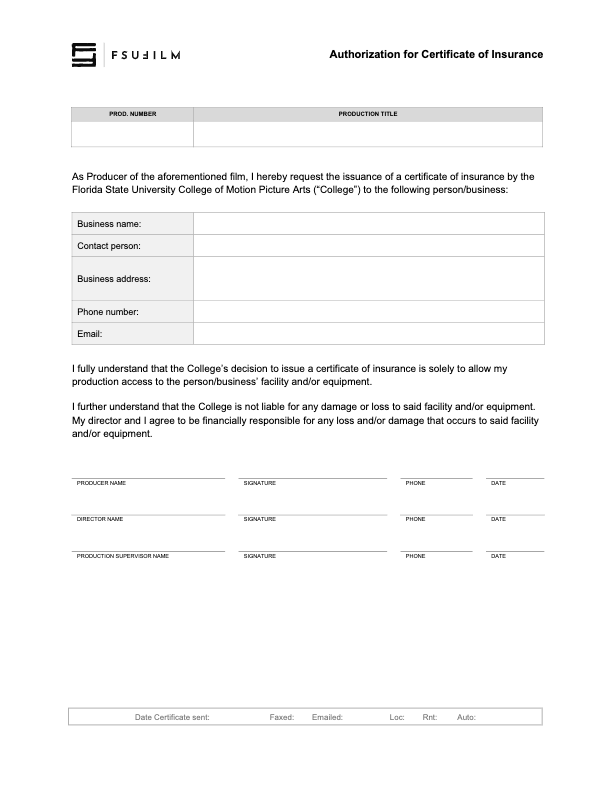
The Producer of a film should submit this form to the Head of Production to request the issuance of a Certificate of Insurance by the College of Motion Picture Arts to a business or individual that has requested one.

If the College issues a Certificate of Insurance, it is solely to allow access to the facility and/or equipment that the business or individual is offering the production. The College is not liable for any damage or loss to said facility and/or equipment. The Producer and Director will be financially responsible for any damage or loss to said facility and/or equipment.