M1 projects are expected to follow a defined set of production specifications and content parameters. These guidelines are designed to establish manageable limits for production scope, including factors such as page count, shoot days, cast size, locations, visual effects, stunts, intimacy, animals, weapons, and other complex production elements.
These specifications help ensure that projects can be completed successfully within the available schedule, crew size, resources, and experience level associated with the course. The goal is not to limit creativity, but to help students learn how filmmakers shape strong stories within the practical constraints of time, safety, logistics, staffing, and available resources.
Content specs
Page count
1 page (minimum) 2 pages (maximum)
Story runtime
1:30 (minimum) 2:30 (maximum)
Credits runtime
0:30 for credits + 0:10 for leader
Total runtime
2:10 (minimum) 3:10 (maximum)
Quantity of scenes
Set by faculty for each cycle
Quantity of locations
Set by faculty for each cycle
Quantity of characters
Set by faculty for each cycle
Children
No
Animals
No
Weapons
No
Stunts
Nothing that would typically call for a stunt coordinator
Intimacy
Nothing that would require a closed set or typically call for an intimacy coordinator
The producer serves as the primary organizational and managerial lead of the production, overseeing the broader coordination of the project across development, pre-production, production, post-production, and delivery. Responsibilities may include managing schedules, coordinating communication between departments, overseeing logistics, monitoring production progress, helping resolve problems, and ensuring that the production remains aligned with the practical realities of time, staffing, safety, and available resources.
Within the collaborative structure of film production, the producer is ultimately responsible for helping guide the project to successful completion while balancing creative goals against operational limitations. Unlike roles focused primarily on on-set execution or departmental coordination, the producer maintains a wider view of the entire production process and helps ensure that all parts of the project continue moving forward cohesively. The role also helps students develop leadership, communication, organizational, and decision-making skills that are central to professional producing workflows.
Pre-Production
Leadership & Production Oversight
Help maintain overall production momentum during prep
Identify potential risks or scheduling concerns early
Support collaboration between creative and logistical departments
Balance creative ambitions against practical production realities
Participate in prep meetings with department heads and faculty
Double check every logistical piece of information to make sure nothing has been forgotten
Production Planning & Scheduling
Break down the shooting script
Create a schedule in Movie Magic Scheduling
Oversee the overall pre-production timeline
Coordinate with the 1st AD on scheduling and prep progress
Track deadlines and departmental deliverables
Help ensure the production is realistically achievable within available resources and time
Communication & Coordination
Oversee the Teams channel for the show
Serve as a central communication hub between departments
Organize meetings to maintain production-wide information flow
Follow up on unresolved logistical or departmental issues
Help ensure that departments remain aligned throughout prep
Supervise the 2nd AD in the creation of the Call Sheet
Ensure that agreements and forms are completed properly
Maintain organized production records
Coordinate required delivery of production paperwork
Resource & Operations Management
Monitor production resources and operational needs
Purchase craft services by the night before production
Pre-order lunch and arrange for its pickup or delivery
Help departments identify logistical needs
Check the weather periodically to monitor adverse conditions
Have a back-up plan
Arrange for volunteer(s) if needed
Greenlight Meeting
Attend a greenlight meeting with the Head of Production, during which you will review/update the M1 scope breakdown and finalize all location documents
On Set
FIRST HALF OF THE DAY
The Pre-Pro crew (PR, DR, PD, DP, AR, 1D, 2D, SS) will have 2 hours at the start of the day to prepare for the day, including any remaining set decoration, shot designing, etc.
Deliver the craft services to the 2nd AD for them to set up the craft service table.
Give the 2nd AD all the paperwork you prepared ahead of time for them to have completed throughout the day.
Verify with volunteer or caterer that lunch will be brought to set in time to set it up prior to releasing for lunch.
LUNCH
Make sure 2nd AD has lunch set up and ready by the time lunch is to be served.
Make sure lunch does not exceed one hour.
SECOND HALF OF THE DAY
Make sure everything is going as planned. Help troubleshoot as needed.
END OF DAY
At Camera Wrap, make sure crew wraps safely and efficiently. Make sure to have Company Wrap on time.
Collect all the Daily Production Paperwork and Camera Card from the 2nd AD.
With 2nd AD, clean and secure location. Be the LAST TO LEAVE (except perhaps Art Dept).
Leave the location better than when you arrived.
Approve the Daily Production Report and have 2nd AD distribute copies at the end of the day.
Post-Production
Turn in Camera Reports and Camera Card and Sound Card to the drop box in the Equipment Room as soon as possible after wrap. Be sure to scan a copy of the Camera Report first for your delivery.
Send a Thank You Letter to the location owner/authorized agent.
Submit Reimbursement Voucher, along with original itemized receipts and Meal Sign-In sheet to the Film School Accountant by 6pm on the Tuesday after production.
Turn in Production Delivery Paperwork via the links in the handbook to the Head of Production by 6pm on the Friday after production.
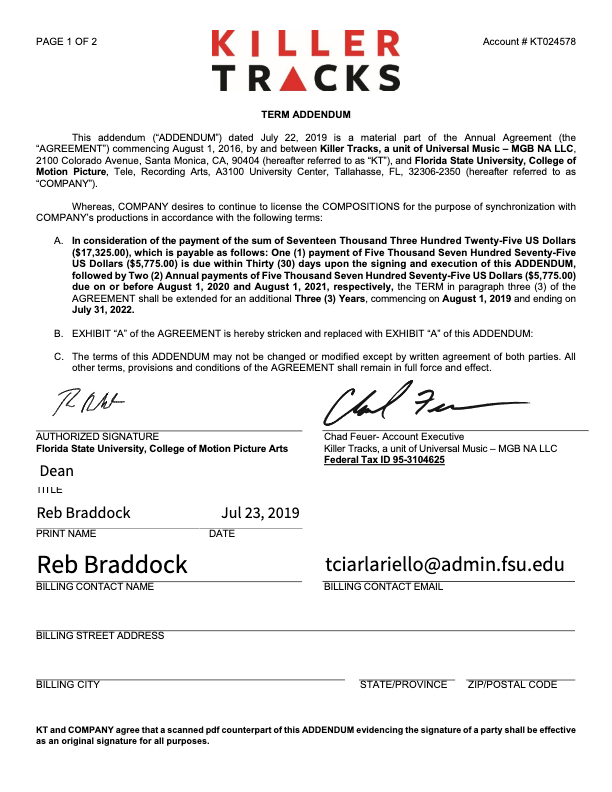
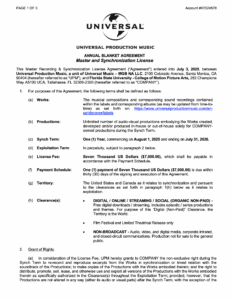
Universal Production Music provides licensed music resources that students may use within approved productions under the program’s educational licensing agreement. If a production features Universal Production Music on the soundtrack, the license below covers the work.
Music licensing is an important part of professional filmmaking because productions must ensure that all music used within a project is legally cleared for exhibition and distribution. Understanding how licensed production music libraries operate helps students develop stronger professional practices related to copyright, music supervision, rights management, and legal compliance within post-production and delivery workflows.
The College of Motion Picture Arts pays an annual fee to Universal Production Music for the licenses to the library music they provide on their site. No additional releases need to be signed for the use of this music, as long as you remain in accordance with this licensing agreement.
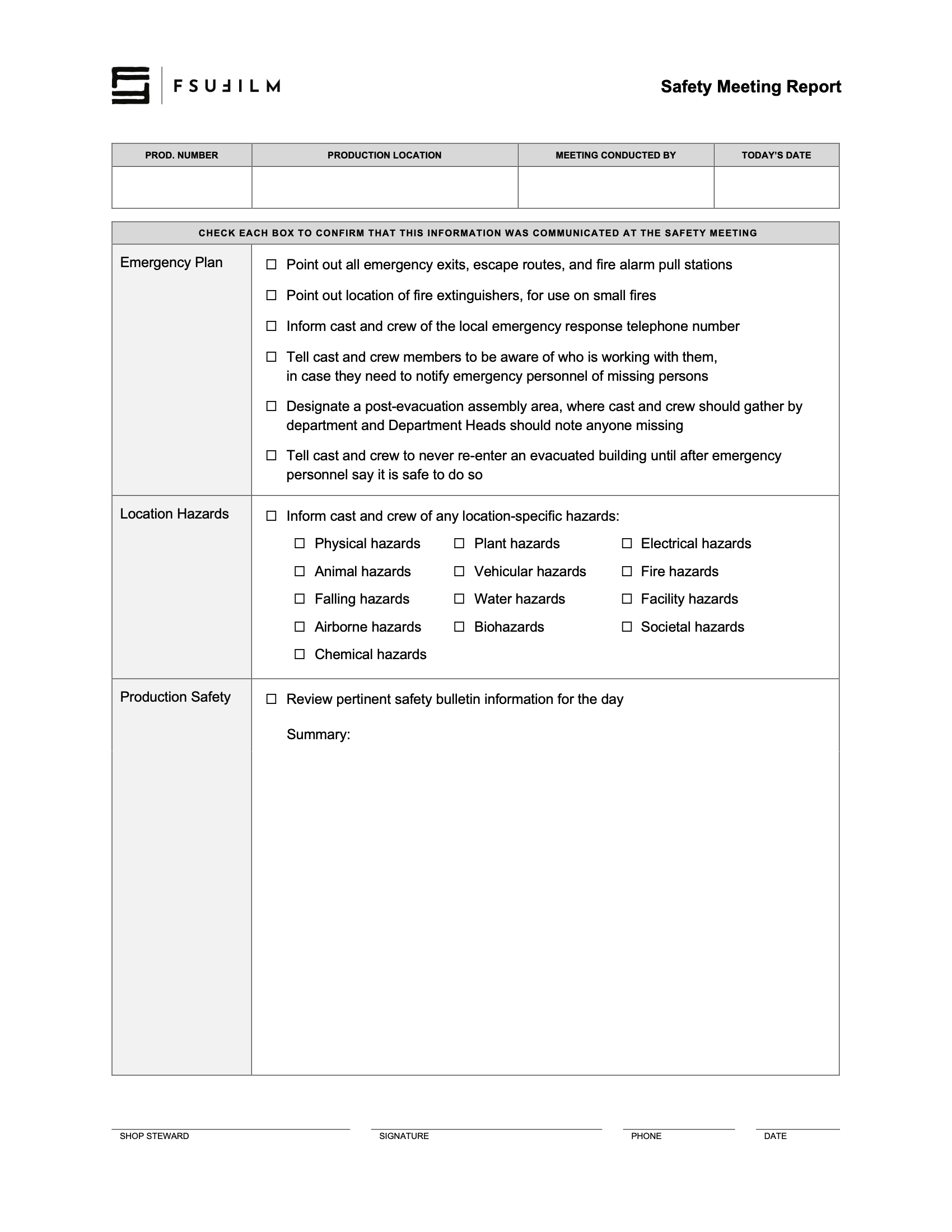
The safety meeting report documents the safety discussions, procedures, identified risks, and production-specific concerns reviewed with cast and crew before filming activities take place.
Formal safety documentation is important because film productions often involve physical activity, equipment, environmental hazards, transportation, and other situations that require clear communication and shared awareness among the crew. Maintaining written safety records helps reinforce accountability, supports safer production practices, and encourages students to approach production planning with a stronger understanding of risk management and on-set responsibility.
The Safety Meeting Report is to be completed by a Shop Steward to document what was covered in the morning safety meeting. It can also be used by the Assistant Director as a cheat sheet for what needs to be addressed in the meeting.
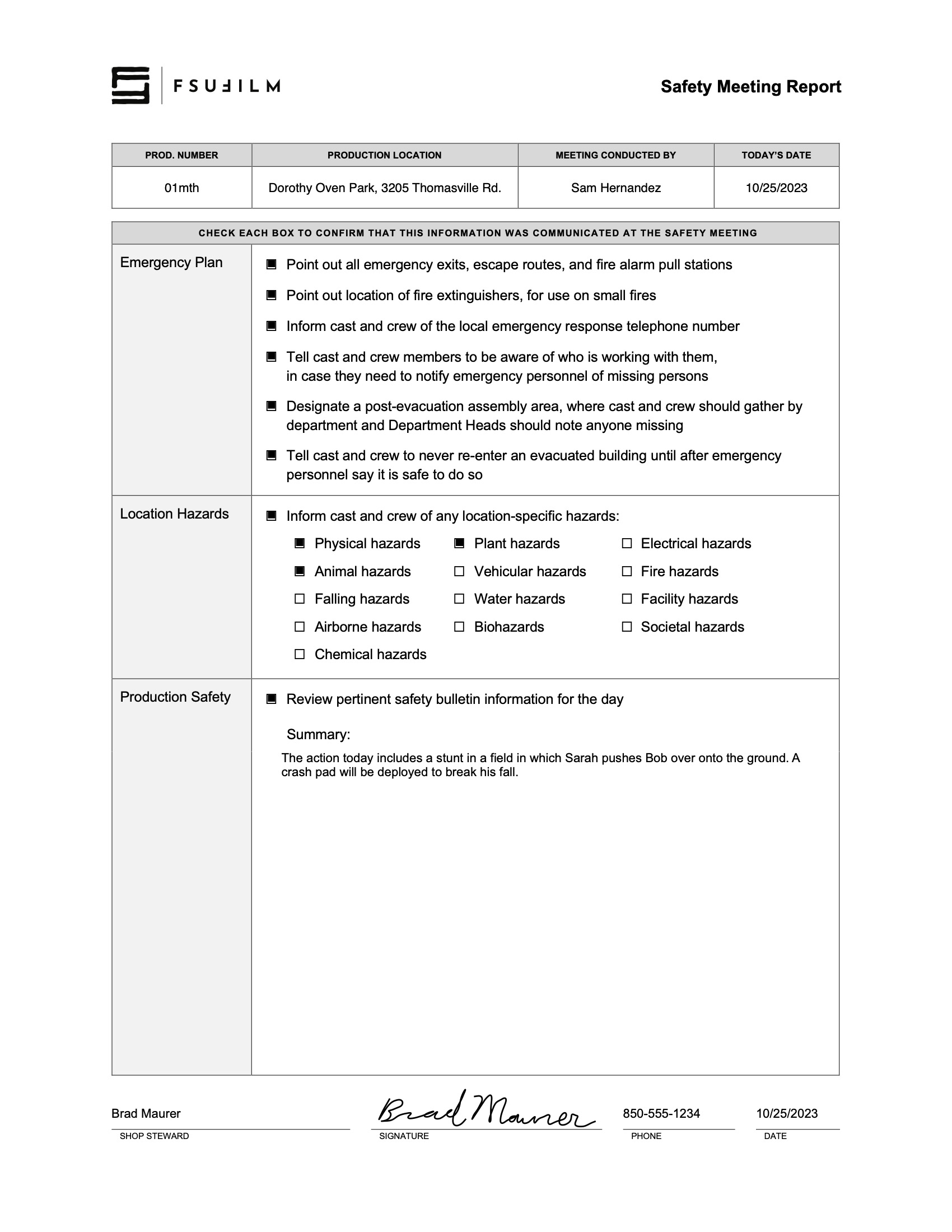
SAMPLE
Here’s a sample of what the completed report should look like:
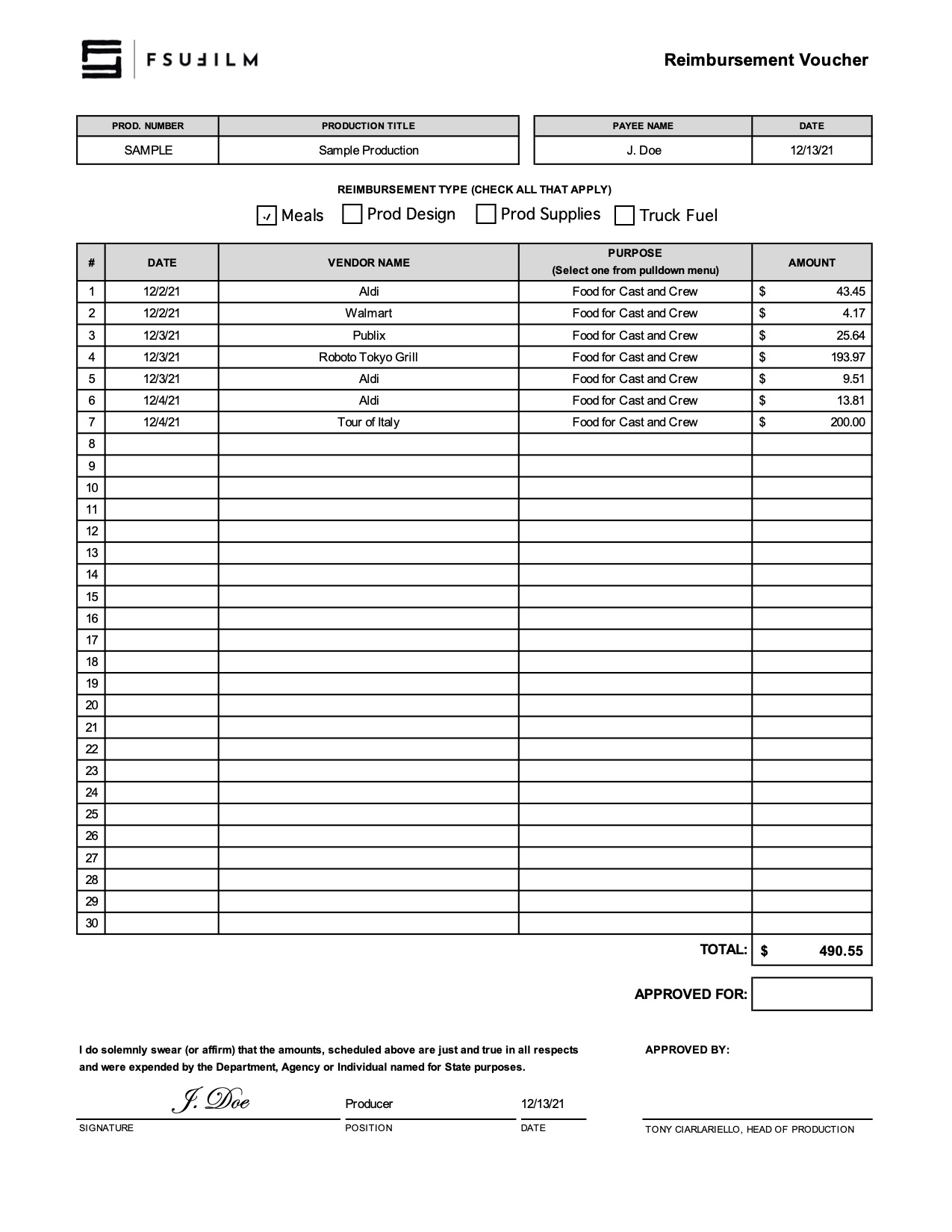
A reimbursement voucher is used when a student or production seeks repayment for approved out-of-pocket expenses made on behalf of a production or related project activity. This process typically requires documentation such as receipts, purchase records, and supporting information verifying that the expense complied with approved production or university guidelines.
Because university funds and production budgets require careful financial oversight, reimbursement requests must be documented accurately and submitted according to established procedures. Maintaining organized reimbursement records helps ensure accountability, supports accurate financial tracking, and reinforces professional habits related to production expense management.
Students should submit this log to the Film School Accountant for reimbursements for meals, production design, production supplies, and/or truck fuel that were used on a production.
FSU does not allow for film school funds to be used on tips. Therefore, make sure you only list the subtotal BEFORE any tip amount is added.
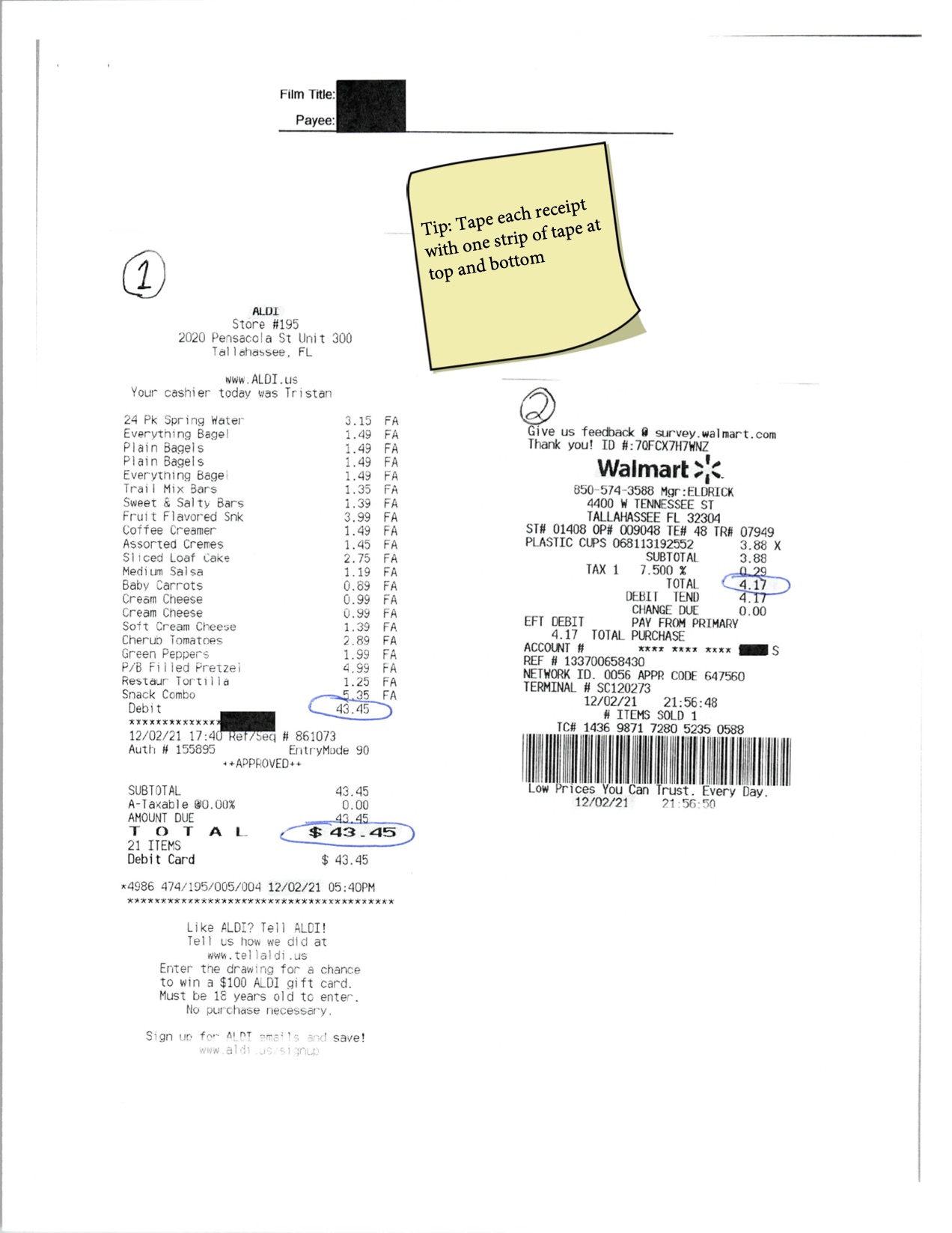
Tape receipts on supplemental sheets, ensuring that each receipt is taped at both the top and the bottom edge of the receipt.
Sample
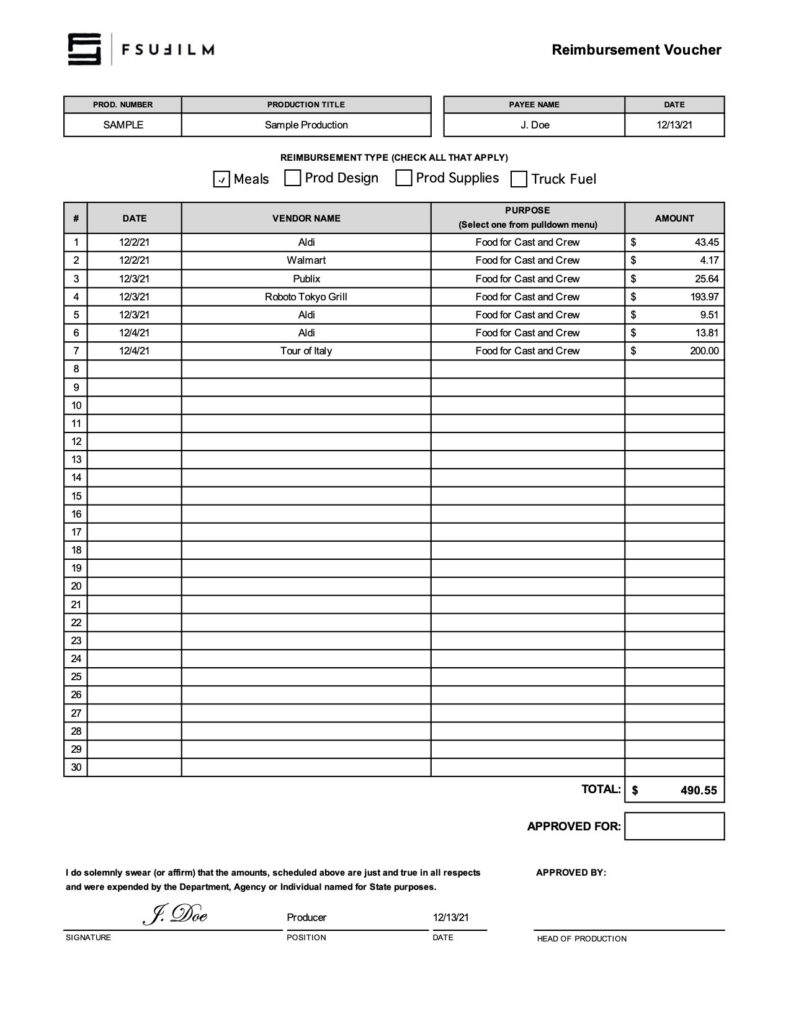
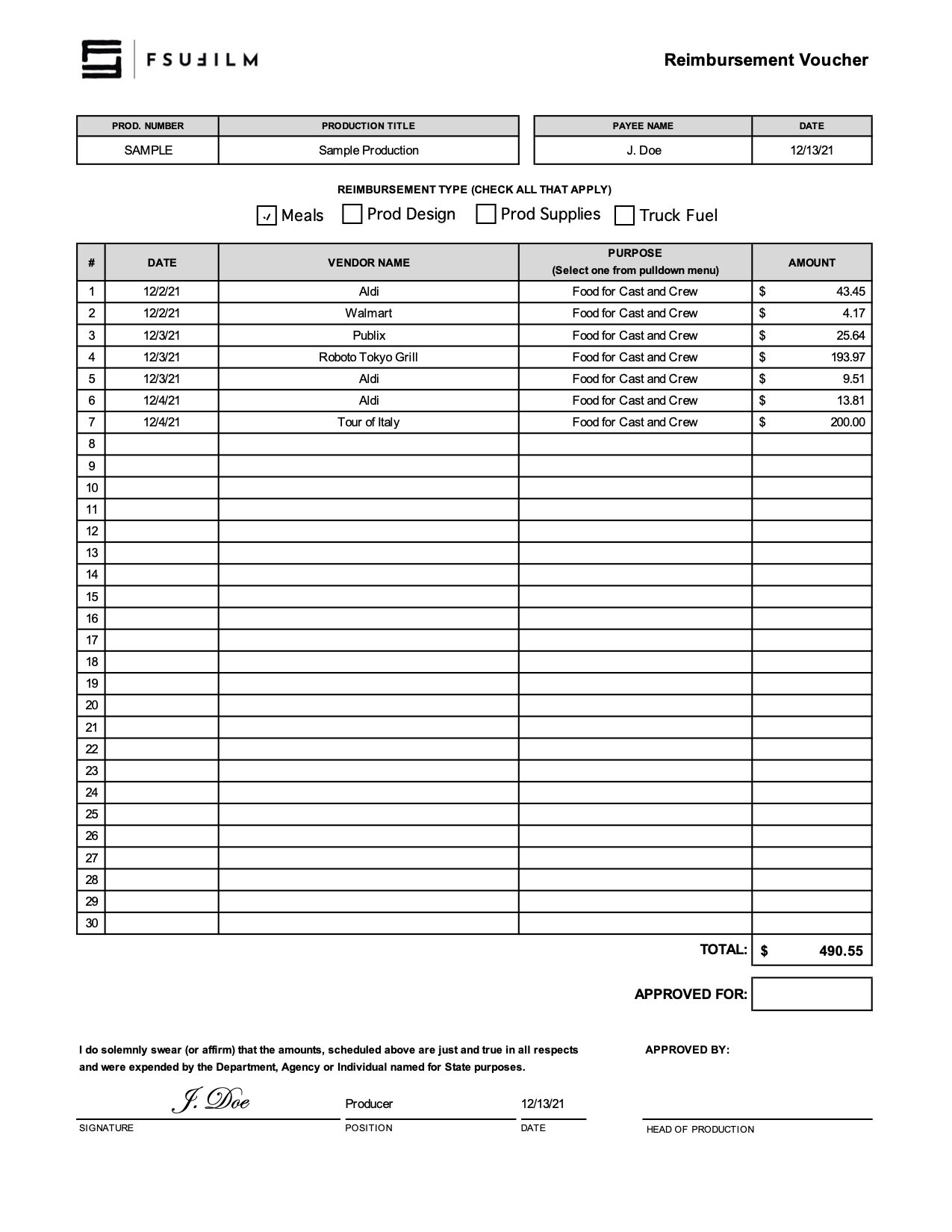
Here’s a sample of what the completed form should look like:
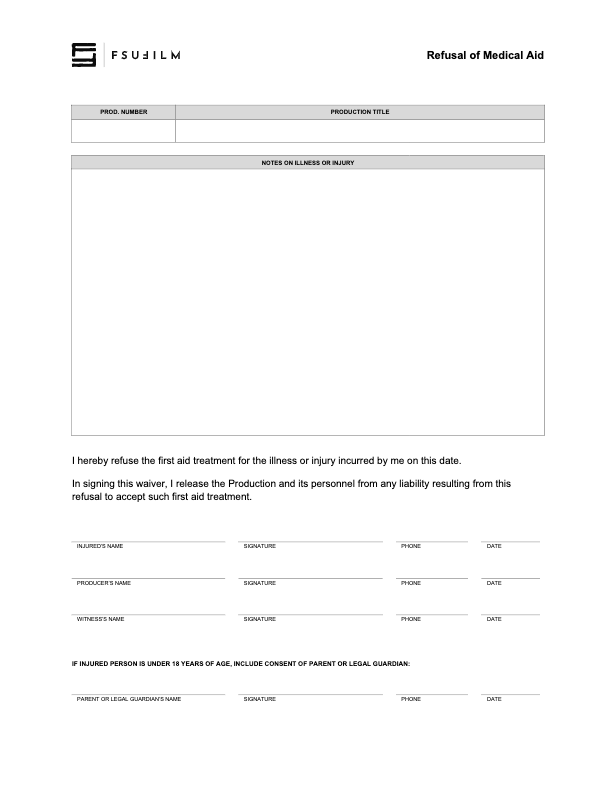
The Refusal of Medical Aid form documents situations in which an individual involved in a production declines medical assistance after an incident, injury, or safety-related event occurring during production activity.
Proper documentation of medical incidents is important because productions have a responsibility to maintain clear records related to on-set safety, injuries, and incident response. Recording a refusal of medical aid helps establish accurate documentation of the situation while reinforcing the importance of communication, accountability, and safety procedures within production environments.
If a person is injured or experiences a medical emergency during the workday, the standard procedure to prioritize getting the person medical attention. There are circumstances, however, where an individual may choose to not get medical aid.
This form should only be used after an injury, illness, or medical incident in which an individual declines first aid, medical treatment, or transport after assistance has been offered. The form exists to document that the individual voluntarily refused care and understood the risks associated with that decision.
The form should be completed as soon as possible following the incident. Producers or set safety personnel should ensure that all sections are filled out clearly and accurately, including:
the date and location of the incident;
the nature of the illness or injury;
the medical aid or treatment that was offered;
the reason the individual declined assistance, if provided.
The injured or ill individual should personally complete and sign the form whenever feasible. A witness should also sign the form.
Signing the form documents that care was declined at the time of the incident and that the individual has released the production from any liability resulting from the refusal of medical aid. Signing the form does not prevent the individual from later seeking medical care.
This form should be retained with the production’s safety paperwork and incident documentation. If the situation appears serious or life-threatening, students should immediately contact emergency services and notify faculty, even if the individual initially refuses assistance.
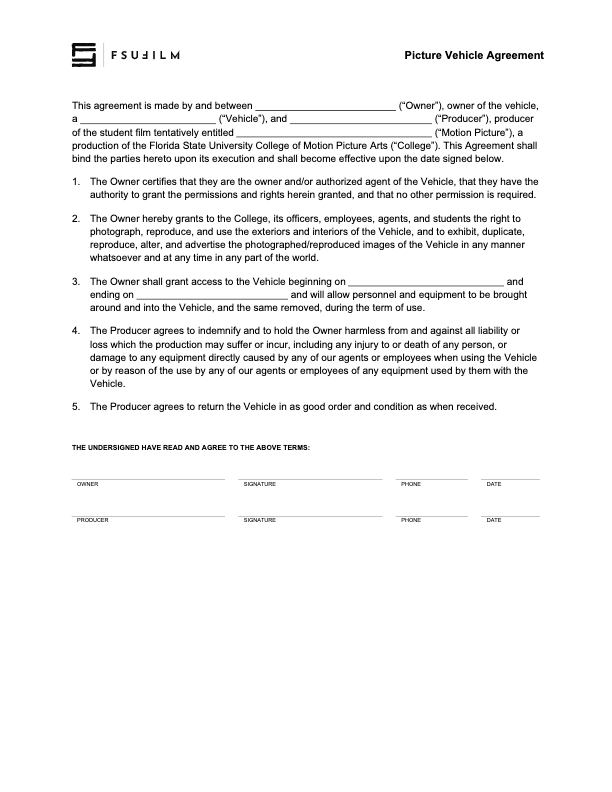
A picture vehicle agreement documents permission and terms related to the use of a privately owned or externally provided vehicle appearing within a production as an on-camera element.
Because vehicles used on camera can involve liability, insurance, scheduling, and property-use considerations, productions must clearly document the terms under which the vehicle is being used. Proper agreements help protect both the production and the vehicle owner while reinforcing professional practices related to permissions, risk management, and production documentation.
The Producer should use this contract agreement with the Owner of a vehicle that will be used as a picture vehicle in a production.
The Producer is responsible for working with the Owner to determine the dates the vehicle will be used.
All other clauses in the agreement must remain unchanged, unless the Producer is authorized in advance by the Head of Production to make specific amendments to the contract.
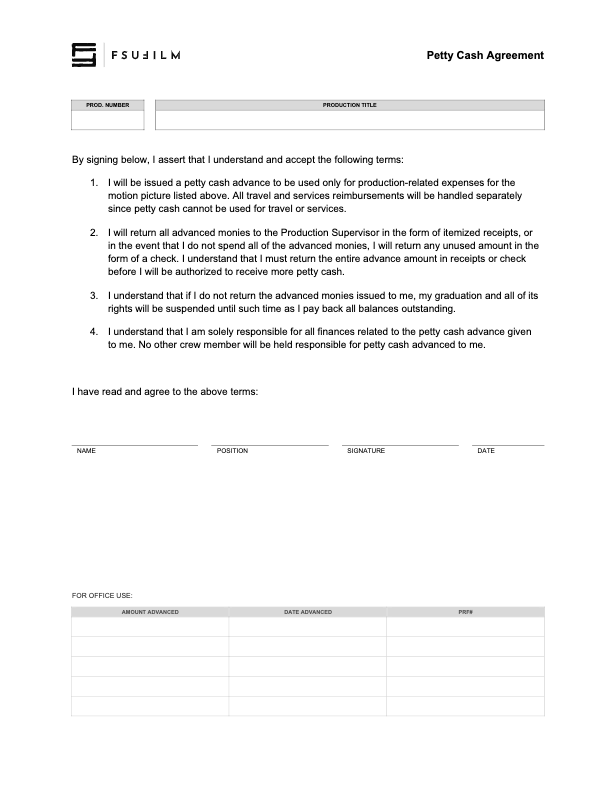
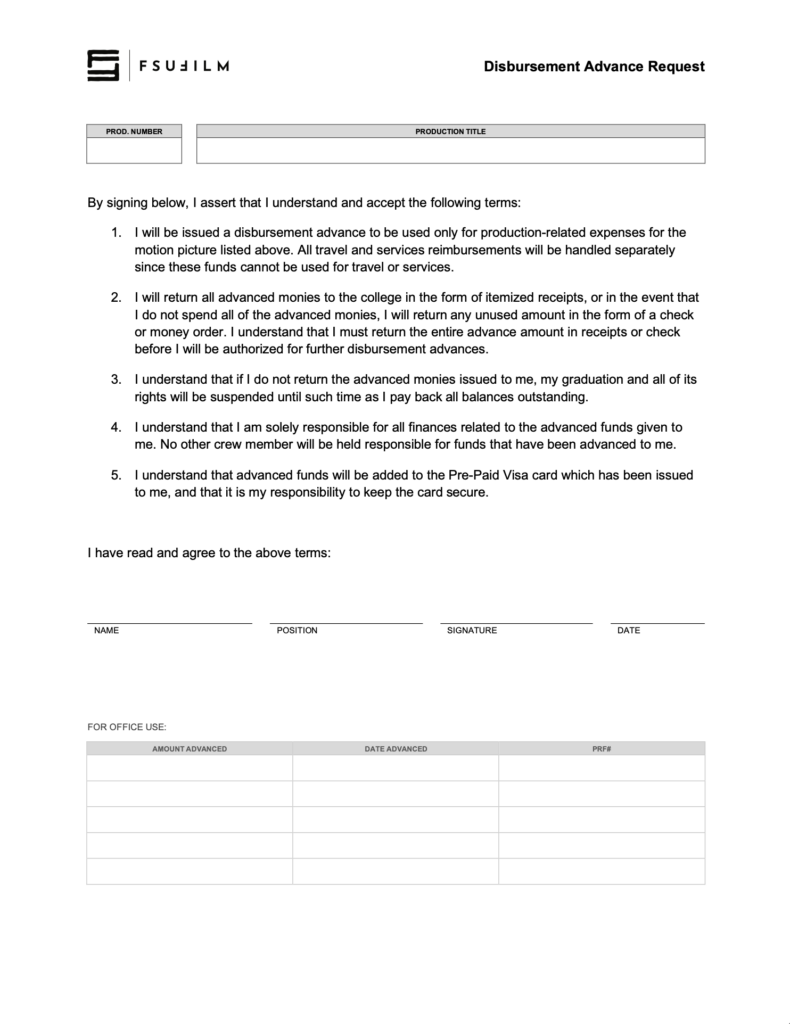
A disbursement advance request is used when productions seek access to approved funds in advance of anticipated production expenses, purchases, or operational needs.
Advance funding requests require careful oversight because productions must be able to document how institutional or production funds are being used and tracked throughout the production process. Establishing clear advance procedures helps maintain financial accountability, reduce confusion surrounding expenditures, and support more organized production budgeting workflows.
This form should be used in instances where a student is issued a disbursement advance for production-related expenses on a production. Advances will be issued to the student’s pre-paid Visa card.
Students are required to submit itemized receipts for all expenses and to return any unused monies.
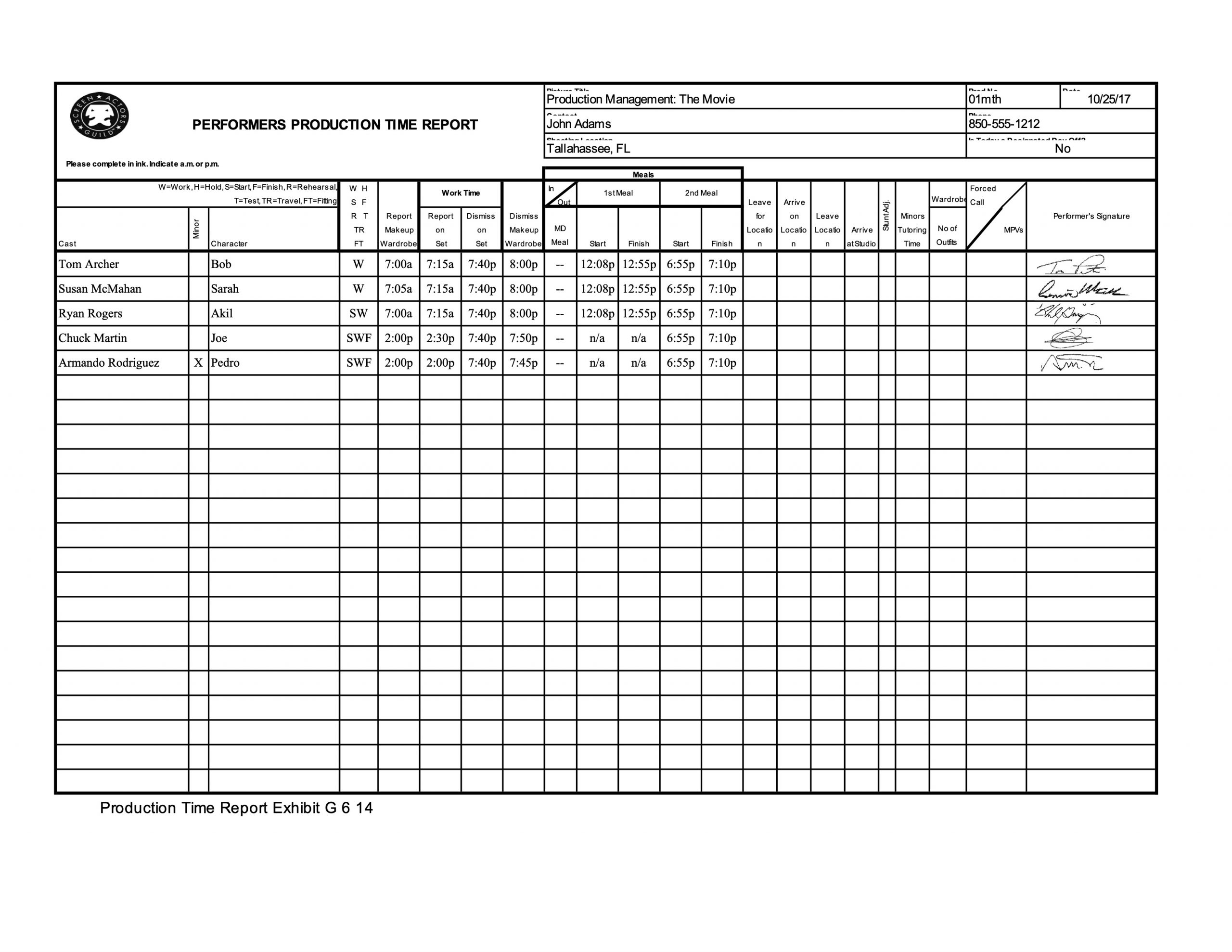
A performers time report documents the hours, dates, and participation details associated with performers working on a production. These records help track performer involvement throughout production activities and maintain organized documentation related to scheduling and production participation.
Accurate time reporting is important because productions depend heavily on reliable scheduling, coordination, and record-keeping across cast and crew activity. Maintaining organized performer records also supports professional production management practices and helps ensure that participation details are documented consistently throughout the course of production.
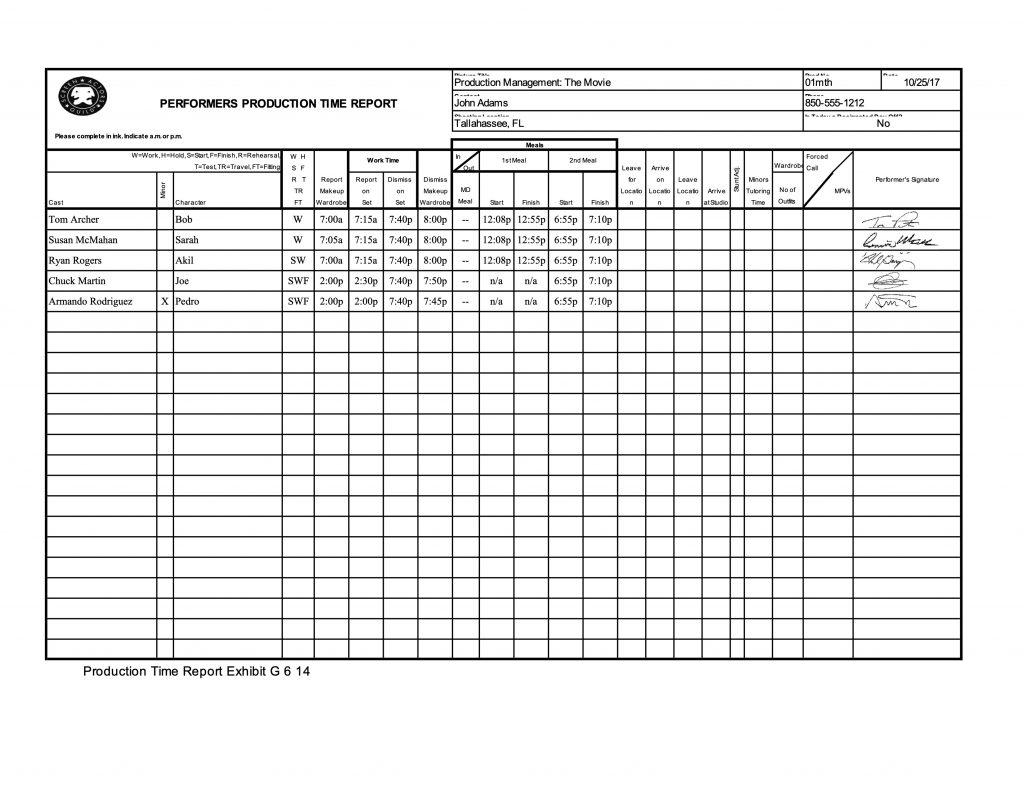
The 2nd AD should complete the Performers Time Report for each production day, ensuring that each performer signs the report before they are dismissed for the day. If a show does not have an assigned 2nd AD, the Producer shall assume the responsibility.
Sample
Here’s a sample of what the completed form should look like:
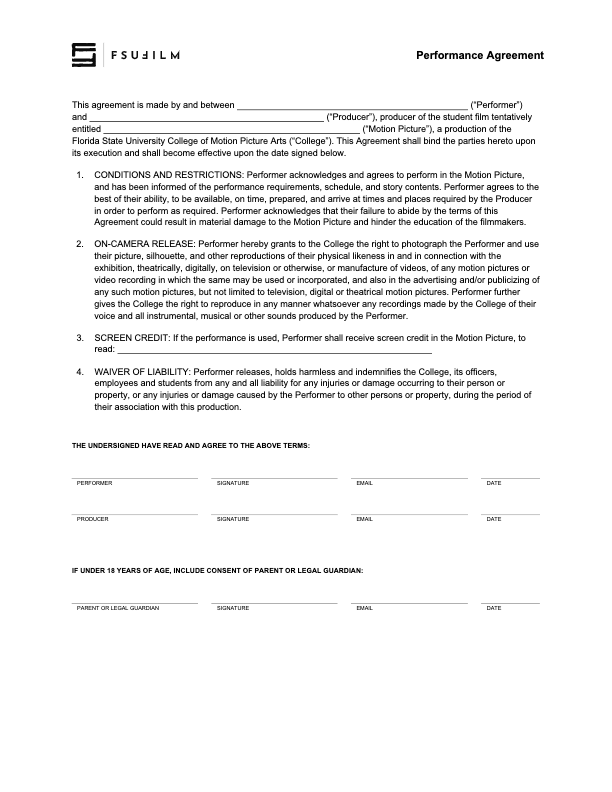
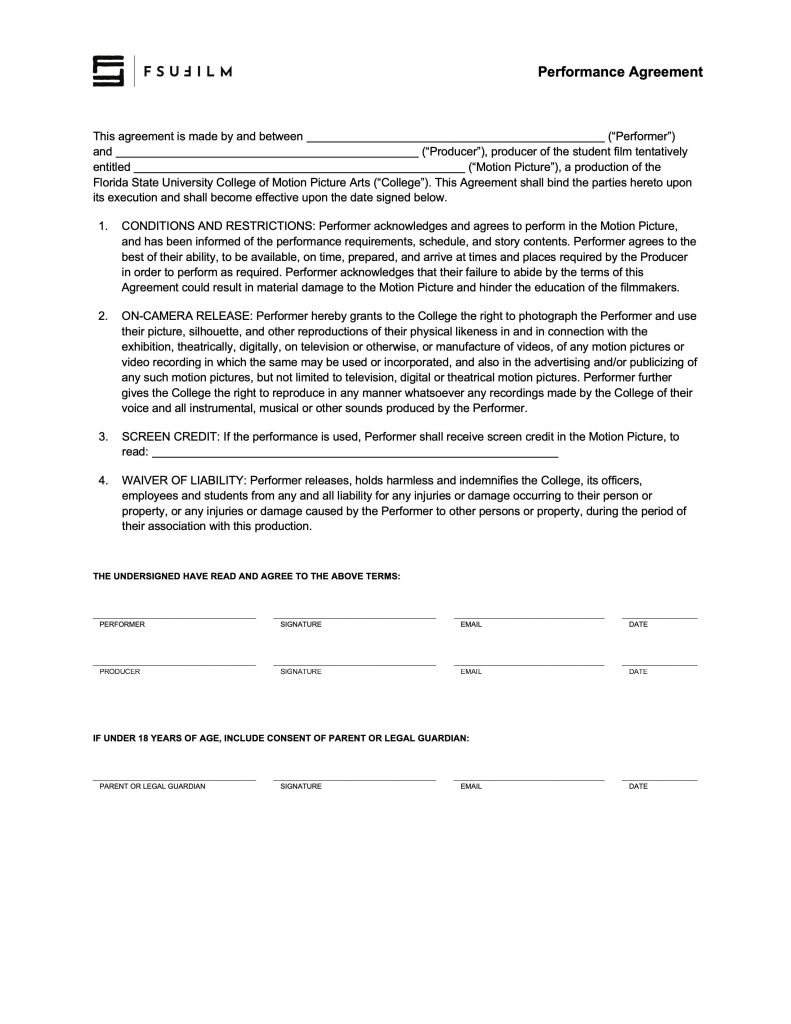
A performance agreement establishes the terms under which an actor or performer participates in a production, including permissions related to recording, usage of the performance, and the production’s right to exhibit and distribute the completed project.
Clear performer agreements are essential because productions must secure documented permission to use recorded performances within films intended for exhibition, festivals, online distribution, or archival purposes. Proper agreements help protect both the production and the performer while reinforcing professional standards related to contracts, releases, and production legal workflows.
The Producer should use this contract agreement with a Performer, in order to have the right to record their voice and likeness for the film.
The Producer is responsible for working with Performer to determine the screen credit in the finished film.
All other clauses in the agreement must remain unchanged, unless the Producer is authorized in advance by the Head of Production to make specific amendments to the contract.