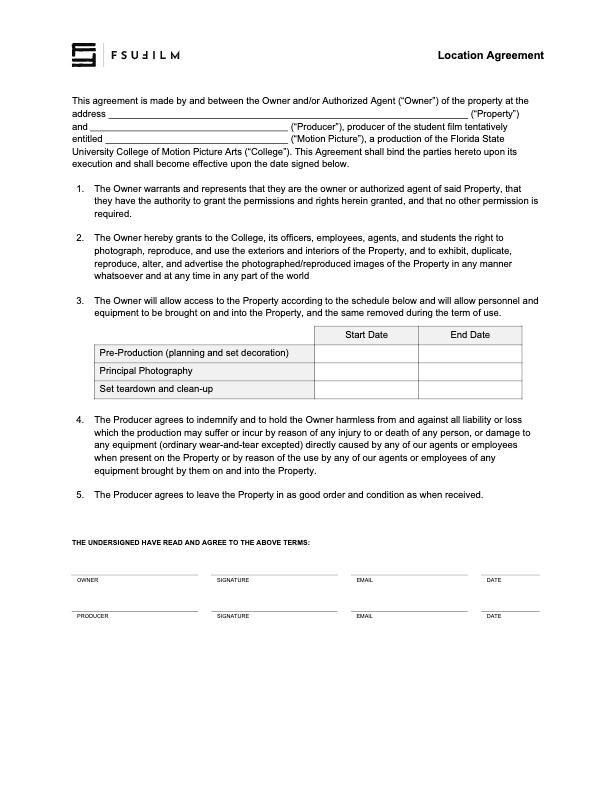
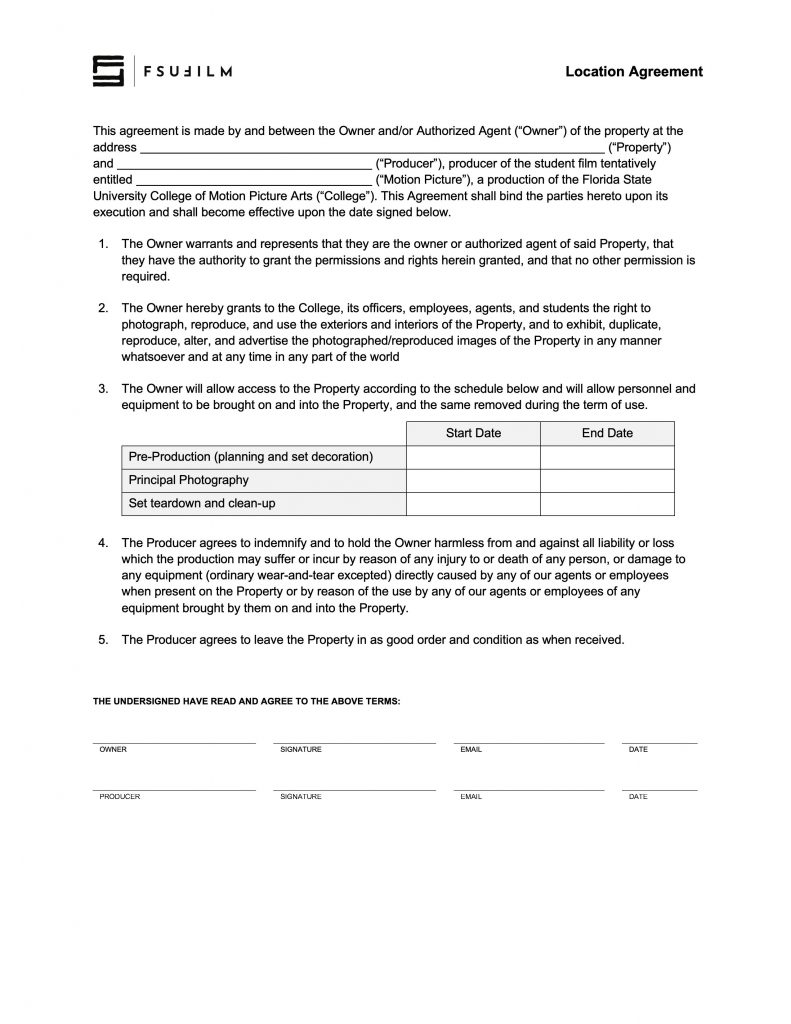
The Location Agreement is used with a location owner or authorized agent to secure permission for a production to use and photograph a property. It establishes the production’s right to film at the location and documents the basic terms of that access.
This agreement is essential because productions cannot assume permission to film on private or controlled property. Written approval protects the production, the school, and the property owner by clarifying access, usage rights, and the conditions under which the location may appear in the finished film.
The Producer should use this contract agreement with the Location Owner (or authorized agent), in order to have the right to use and photograph the interiors and exteriors of the property.
The Producer is responsible for working with the Location Owner to determine the start and end dates for when the show will have access to the location. (The Producer is additionally responsible for drafting a Location Shooting Plan Agreement with the Location Owner.)
All other clauses in the agreement must remain unchanged, unless the Producer is authorized in advance by the Head of Production to make specific amendments to the contract.
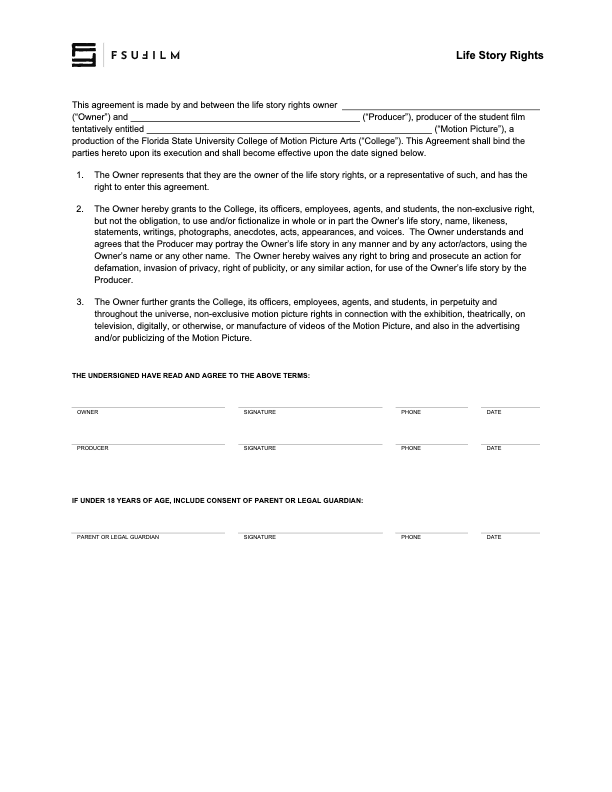
The Life Story Rights agreement is used when a production wants to use or fictionalize a person’s life story, name, likeness, statements, writings, photographs, anecdotes, acts, appearances, or voice. The Producer works with the owner of those rights to secure permission through the approved agreement.
This agreement is important because stories based on real people can involve significant personal, legal, and ethical considerations. Proper documentation helps ensure that the production has permission to use the material and that any changes to the agreement are approved in advance by the Head of Production.
The Producer should use this contract agreement with the Owner of the life story rights, in order to use and/or fictionalize the Owner’s life story, name, likeness, statements, writings, photographs, anecdotes, acts, appearances, and voices.
All clauses in the agreement must remain unchanged, unless the Producer is authorized in advance by the Head of Production to make specific amendments to the contract.
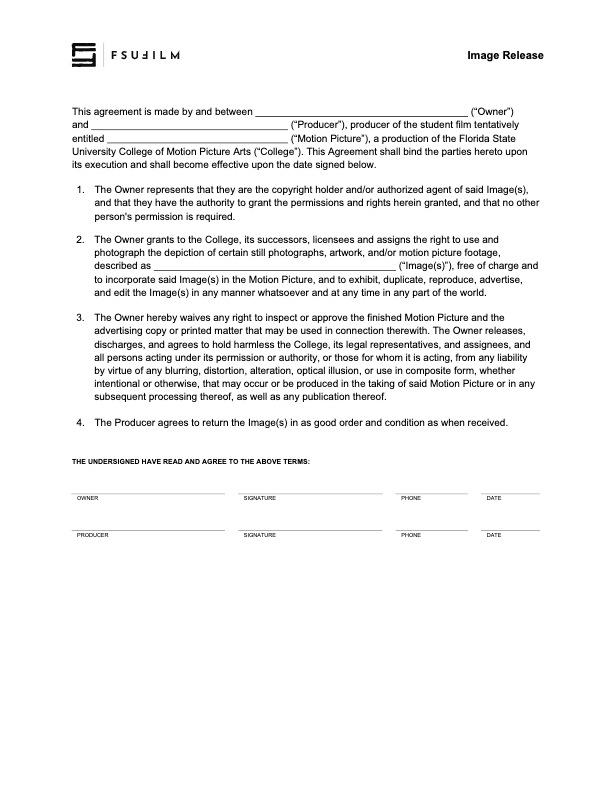
The Image Release is used when a production wants permission to use or photograph a still image, artwork, graphic, or other copyrighted visual material in a film. The Producer secures the release from the copyright holder or authorized agent.
This form is important because images found online, in books, in archives, or in personal collections are not automatically available for use in student films. Proper releases help productions avoid rights issues during delivery, festival submission, online exhibition, or future distribution.
The Producer should use this contract agreement with the copyright holder (or authorized agent) for the right to use and photograph the depiction of still photographs, artwork, and/or motion picture footage.
All clauses in the agreement must remain unchanged, unless the Producer is authorized in advance by the Head of Production to make specific amendments to the contract.
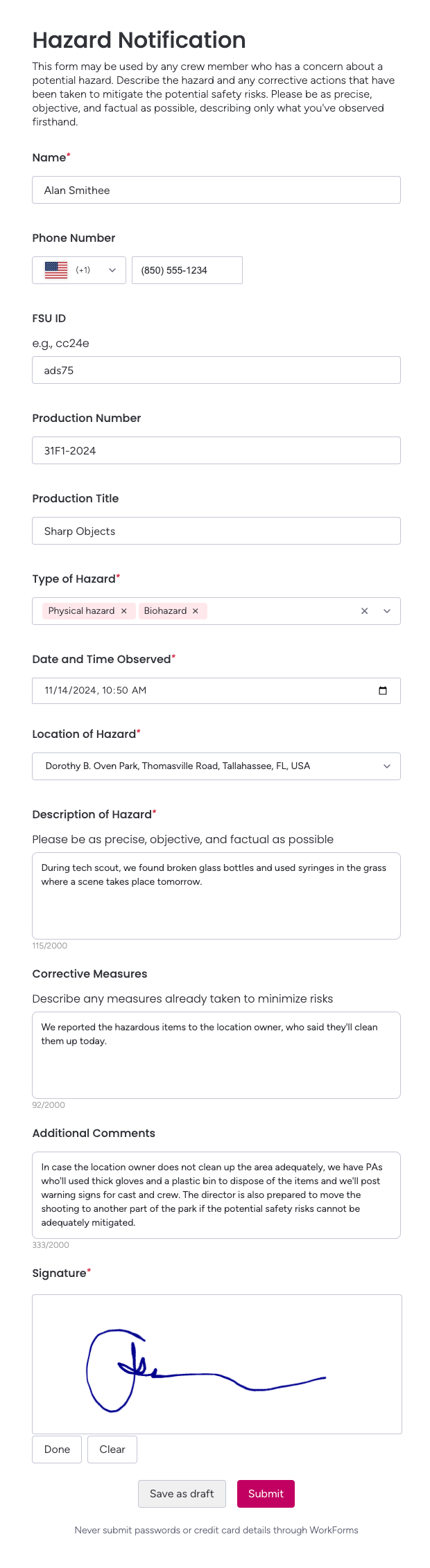
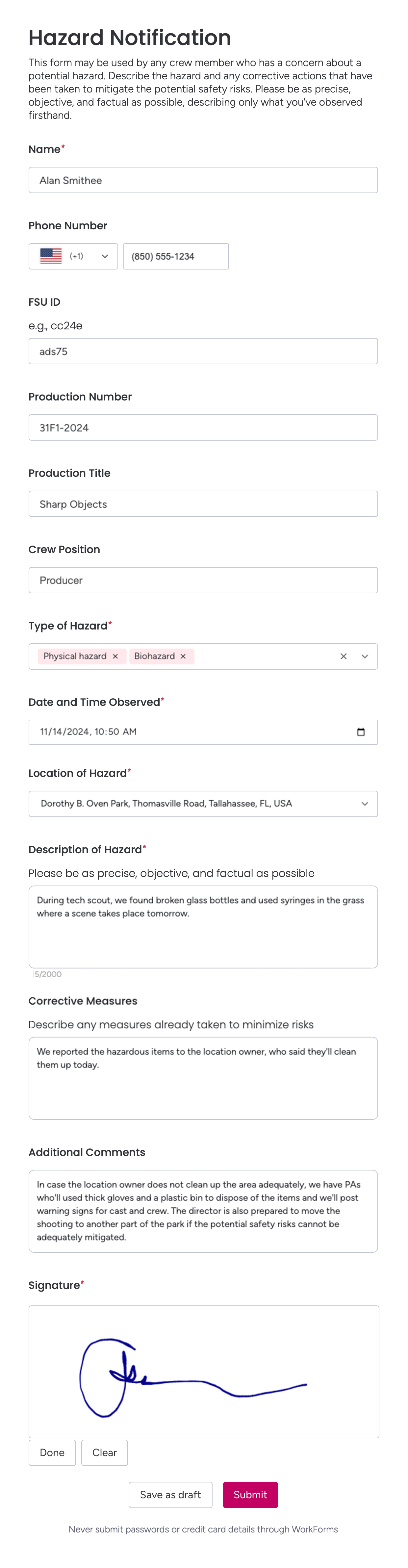
The Hazard Notification form may be used by any crew member who has a concern about a potential hazard during production. The form allows the crew member to describe the hazard and identify any steps they believe may be needed to address it.
This process is important because safety responsibility does not belong only to producers, department heads, and shop stewards. Giving any crew member a clear way to report hazards helps productions identify risks earlier, respond more responsibly, and reinforce a culture where safety concerns are taken seriously.
Instructions
The Hazard Notification form may be used by any crew member who has a concern about a potential hazard. Use the form to describe the hazard and to describe any corrective actions that have been taken (or could be taken). Please be as precise, objective, and factual as possible, describing only what you’ve observed first-hand.
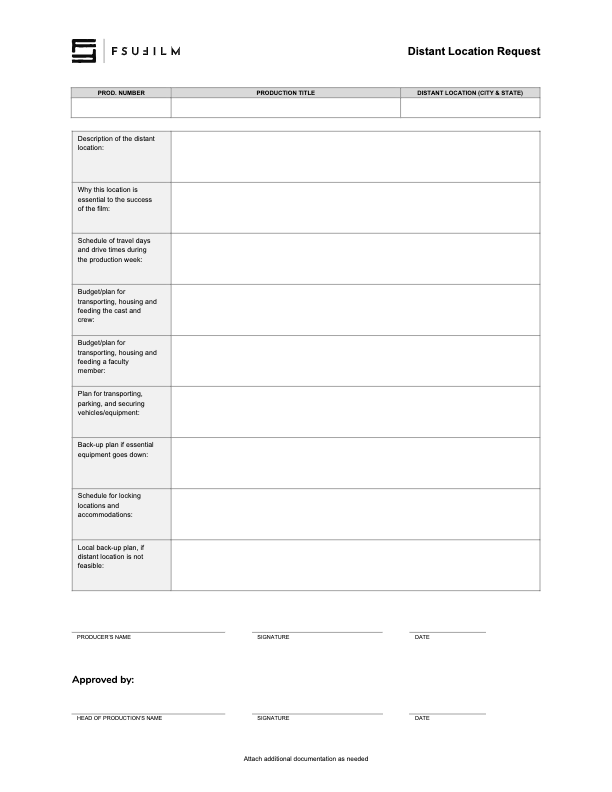
The Distant Location Request is used when a capstone production seeks permission to film outside the school’s studio zone. The Producer must present a detailed plan addressing the location’s importance, travel schedule, transportation, lodging, meals, equipment security, faculty support, contingency plans, deadlines, and a local backup option.
This process exists because distant locations add significant complexity, cost, wear on equipment, and stress on the crew. Approval is not automatic; productions must demonstrate that the location is essential, that the plan is realistic, and that the added demands can be managed responsibly within school expectations.
BFA and MFA capstone productions may request permission to film at a distant location outside the studio zone. Because distant productions place additional demands on equipment, personnel, and university resources, approval is not automatic. It is a privilege granted only to productions that demonstrate careful planning, logistical readiness, and a safe, realistic production plan.
Proposal Requirements
The Producer must submit a distant location request to the Head of Production that includes:
A description of the proposed location.
An explanation of why the location is creatively and/or logistically necessary.
A production schedule showing all travel days, drive times, and shooting days.
A transportation, lodging (if required), and meal plan and budget for the cast and crew.
A transportation, lodging (if required), and meal plan and budget for the assigned faculty member.
A plan for transporting, parking, securing, and maintaining school vehicles and equipment.
A contingency plan if critical production equipment becomes inoperable.
A production timeline showing key logistical deadlines.
A viable local backup plan if the request is denied or the location becomes unavailable.
Travel Times
As a general guideline, distant locations should be within approximately 2.5 hours (each way) of the College of Motion Picture Arts.
Travel time counts as part of the production day and reduces the available filming time in accordance with the program’s production day policies. For example: A production travels to a location that’s 90 minutes away and returns the same day. In the morning, any travel in excess of 30 minutes counts against the 12-hour work day. The same is true for the return journey at the end of day. Therefore, there’s 60 minutes in the morning and 60 minutes at the end of day (120 minutes total) that need to be deducted from the available shooting time that day.
Overnights
Depending on the travel distance and production schedule, the Head of Production may require overnight lodging for cast and crew. When overnight accommodations are required, the production is responsible for providing appropriate lodging and all required meals—including breakfast, lunch, and dinner as dictated by the approved schedule.
Expenses
The production budget should include all anticipated travel-related expenses, including fuel, parking, tolls (where applicable), drinking water, and other essential crew supplies.
All additional costs associated with an approved distant location are the responsibility of the production. The College of Motion Picture Arts does not provide funding beyond the standard production resources allocated to all productions.
Deadlines & Approvals
Requests should be submitted as early as possible during development and pre-production, and no later than two weeks before the first day of principal photography.
Distant location requests are reviewed by the Head of Production in consultation with the Head of Set Operations and the cycle faculty. The Head of Production has sole authority to approve, deny, or conditionally approve a request. Any conditions attached to an approval are mandatory, and the Head of Production’s decision is final.
Approval of a distant location does not constitute approval of the production plan. The Head of Production may require revisions to schedules, lodging, transportation, staffing, budgets, or other logistical arrangements as a condition of approval. Failure to meet the approved production timeline for the show may result in permission being revoked.
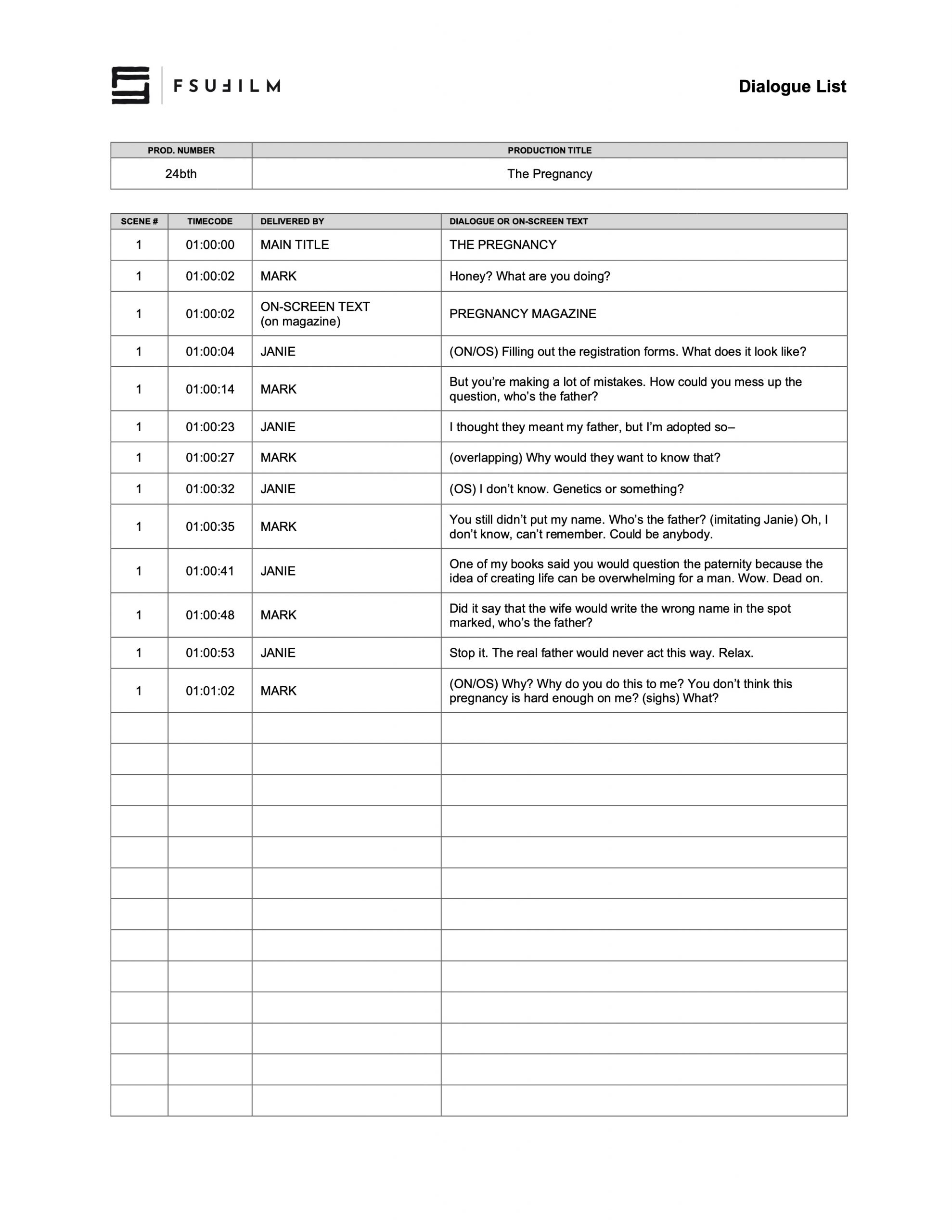
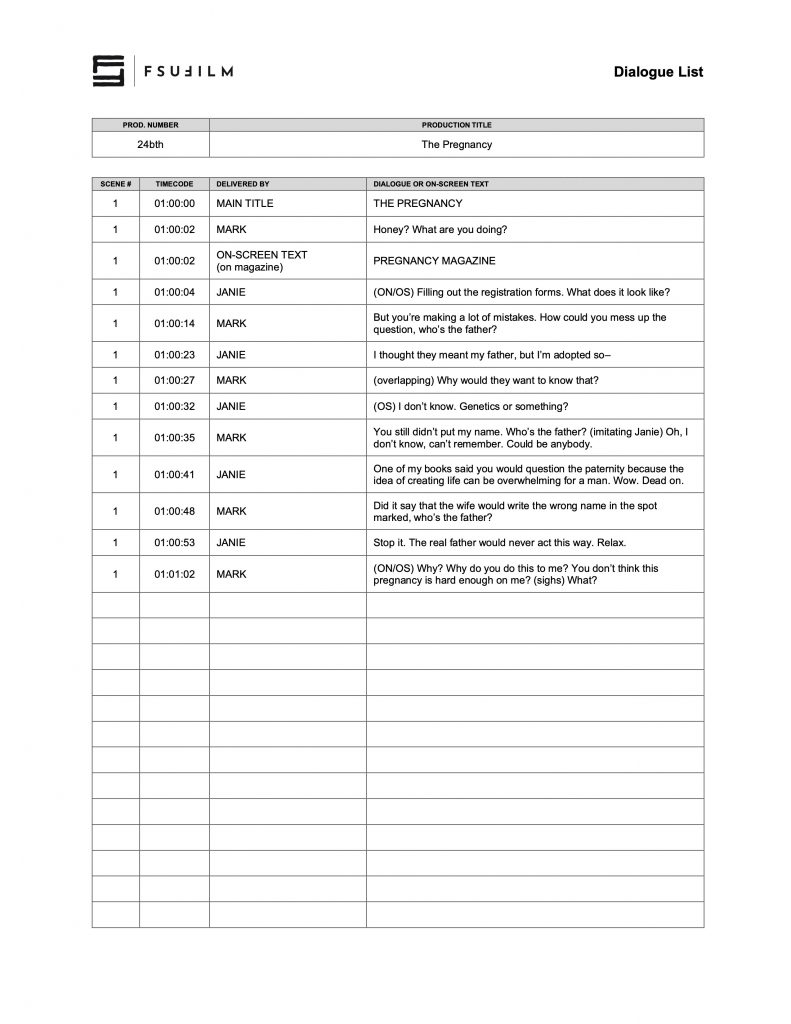
The Dialogue List is a delivery document that identifies and organizes all spoken dialogue and on-screen text appearing in the finished film. This is used for captions, subtitles, accessibility workflows, sound post-production reference, and final delivery documentation.
Accurate dialogue documentation is important because downstream workflows such as captioning, subtitling, localization, accessibility compliance, and archival delivery depend on having a reliable written record of the film’s spoken content. Maintaining a clean and organized dialogue list also helps productions avoid inconsistencies or omissions during final delivery.
When a film is sent to a foreign language film festival, the festival will add subtitles in the local language based on this Dialogue List. The form should include all spoken dialogue and on-screen text that is in the final film, including the timecode of when each occurs.
SAMPLE
Here’s a sample of what the completed form should look like:
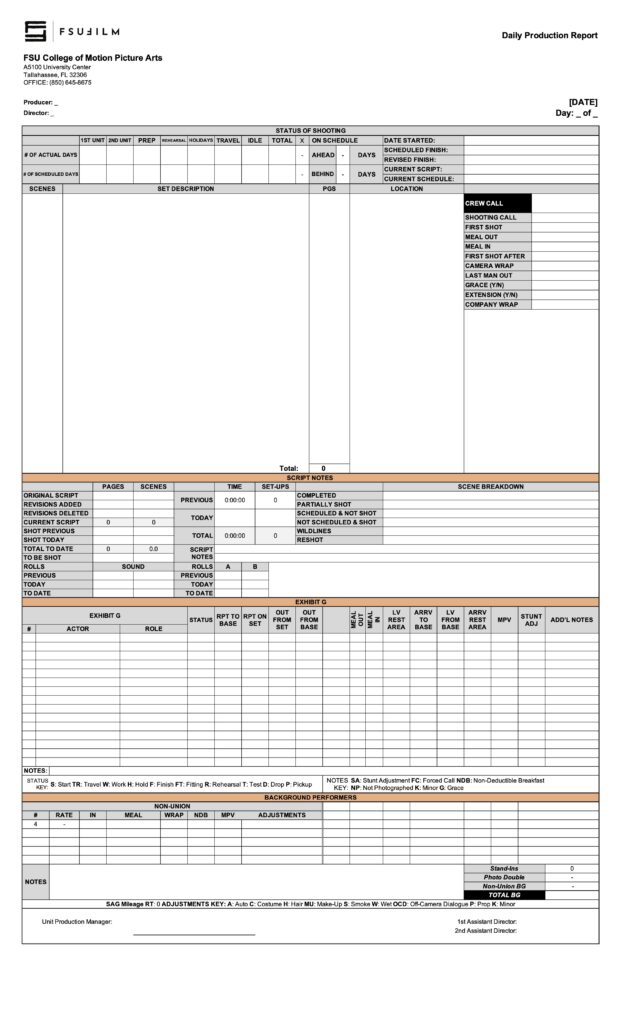
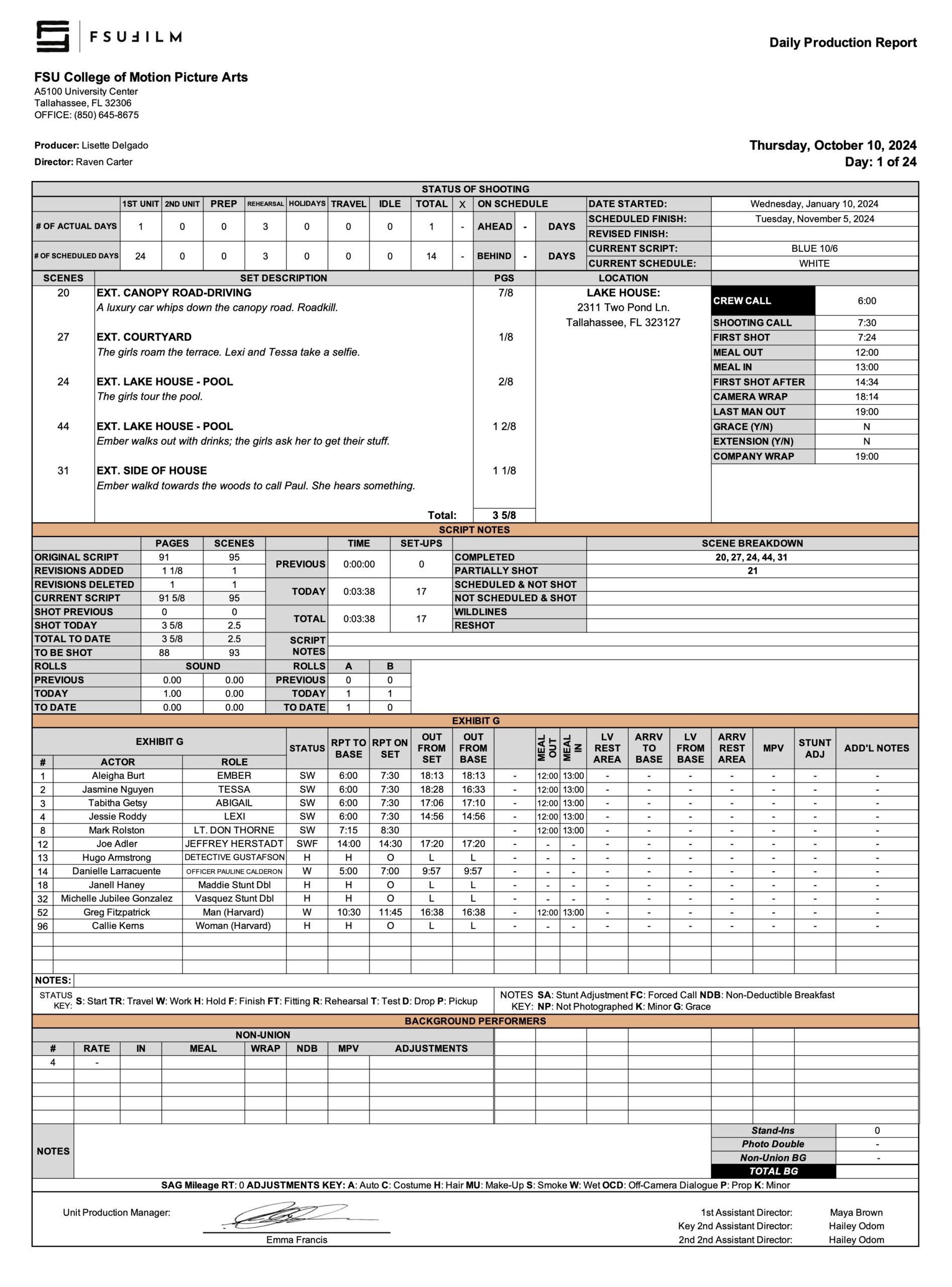
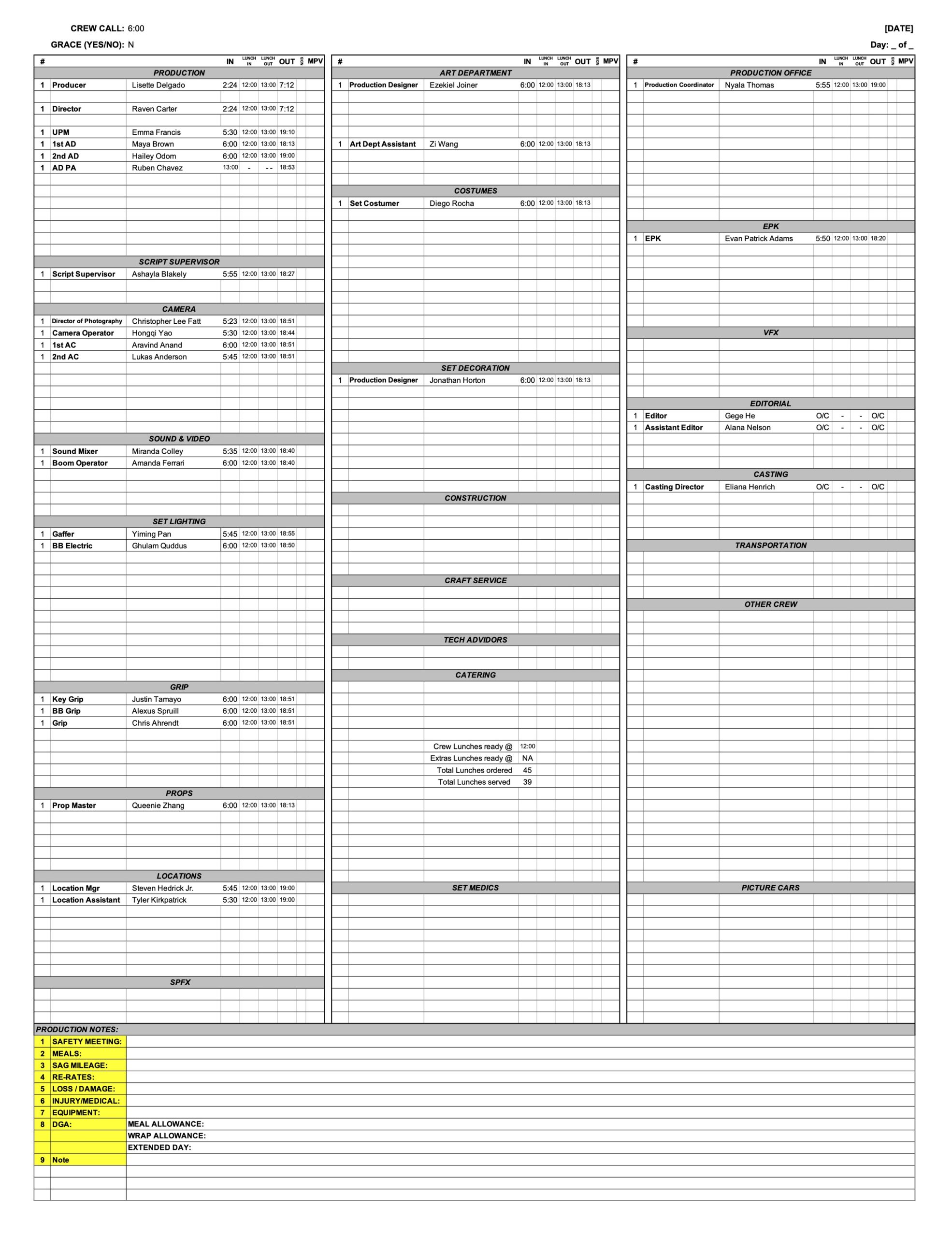
The Daily Production Report documents the major activities, progress, delays, incidents, scheduling information, and operational details associated with a production day. It serves as an official record of what occurred during filming and is completed at the end of each shoot day.
Daily reporting is important because productions rely on accurate records to track progress against the schedule, communicate between departments, identify emerging issues, and maintain accountability throughout the shoot. Consistent reporting also creates a valuable reference for post-production, faculty oversight, and future review of production operations.
The Second Assistant Director is responsible for sending out a PDF of the Daily Production Report (DPR) at the end of every shooting day, no later than two hours after wrap. If the production does not have a dedicated Second Assistant Director, the First Assistant Director or Producer shall assume the responsibility.
The purpose of the DPR is to communicate important information from the day’s production, such as number of setups, start and end times, in and out times, reports on delays, and reports on equipment problems. If an urgent problem or situation arises on set, however, do not wait until the end of day to report it; contact the appropriate individuals immediately. (Make sure it is documented on the DPR at the end of the day as well, though.)
Post the completed DPR the “DPRs” channel on Teams. The PDF file should be formatted with production number and show title as follows:
01f3-DPR-Day1.pdf
DPR Sample
Here’s a sample of what the completed form should look like:
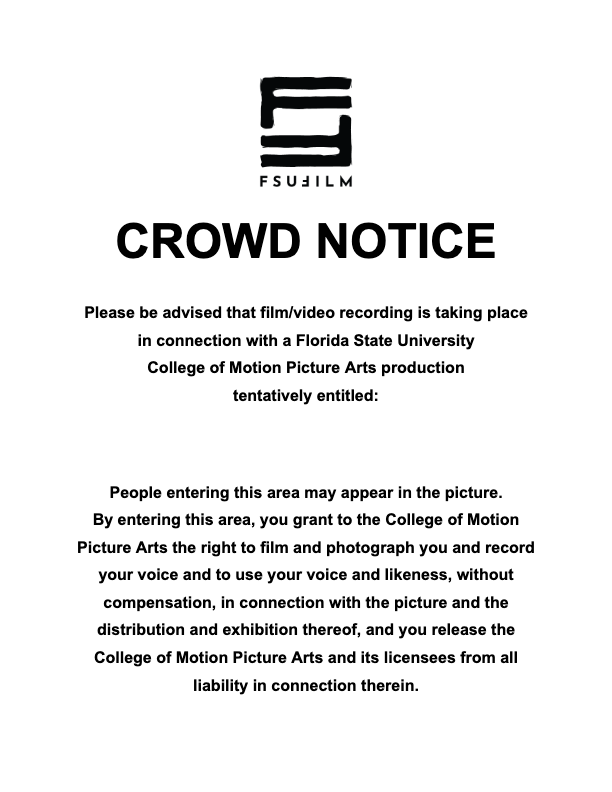
A Crowd Release grants the production permission to photograph and use the likenesses of individuals appearing as part of a crowd scene or public group within the film. It should be posted in highly visible places when a production cannot lock down a public space and get signed releases from all passersby.
This release is important because productions must secure permission to use identifiable individuals in footage intended for exhibition, festivals, online release, or distribution. Crowd releases help productions manage situations involving large groups more efficiently while still ensuring that participants have authorized the use of their image in the finished project.
In some situations, especially in public spaces that the production cannot lock down, it is not always possible to get signed releases from every individual that appears in a shot. This Crowd Notice sign can be used in such situations to alert passersby that, by entering an area, their voice and likeness may be recorded and used in the film.
If a production plans to use this signage, the Producer should check in advance with the Location Owner to make sure they are okay with the signs being posted around the location.
When posting the signs, pay particular attention to the flow of passersby through the area. Identify strategic positions for placing the signs so that they are clearly visible to any passersby, but out of view of the camera.
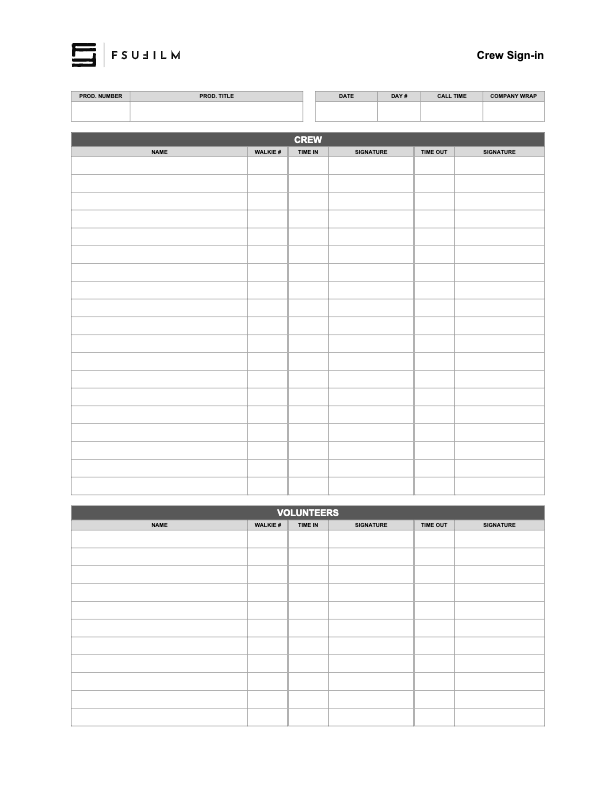
The Crew Sign In form is used to document crew attendance during production activities. It provides a record of which crew members were present on a given production day and is used to track arrival times, departure times, and walkie numbers.
Maintaining accurate attendance records helps productions stay organized and supports communication, scheduling, safety oversight, and administrative documentation throughout the shoot. Consistent sign-in procedures also help reinforce professional production practices related to accountability and crew coordination.
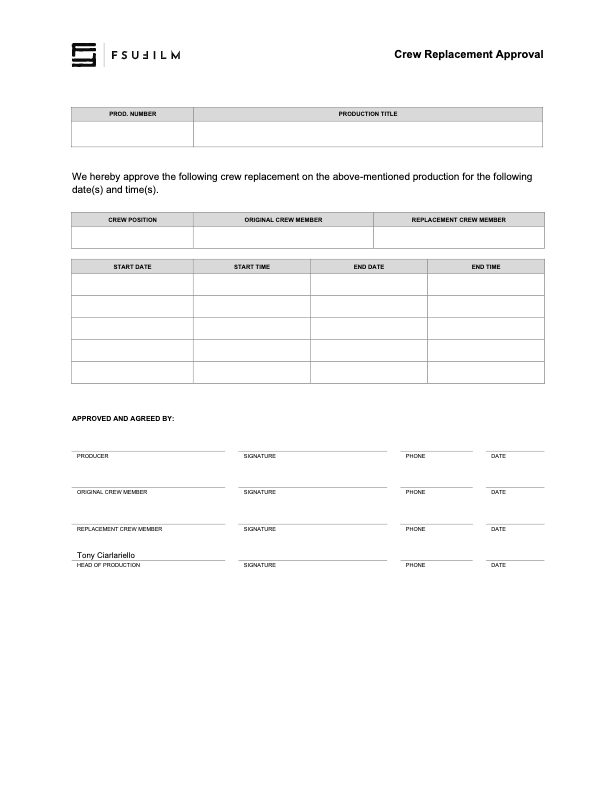
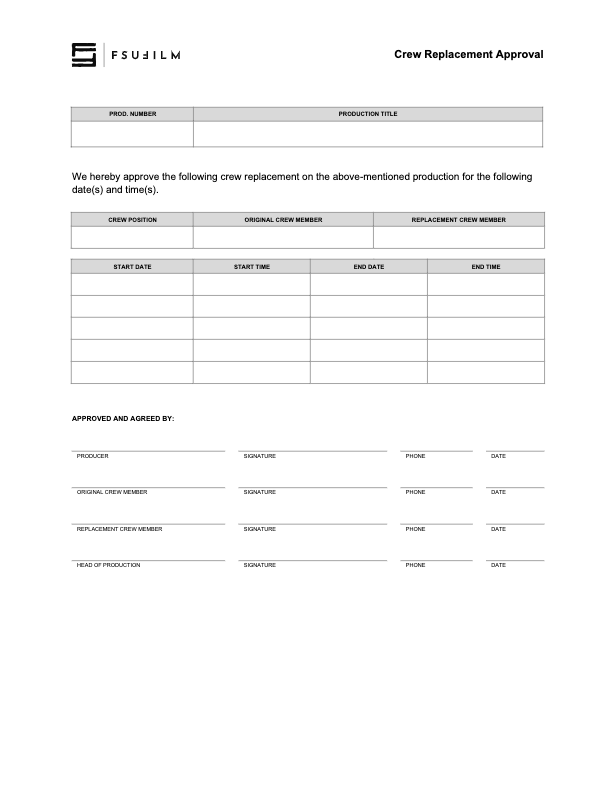
The Crew Replacement Approval process is used when a production seeks permission to replace a crew member after assignments have already been finalized.
Crew changes can affect scheduling, training, department continuity, collaboration, and the overall balance of the production structure. Requiring formal approval helps the school evaluate whether the proposed change is appropriate, manageable, and consistent with the educational and operational needs of the production.
This paperwork should be submitted when requesting that a crew member be replaced by another student. It requires the signatures of both the original crew member and their replacement, as well as the Producer and the Head of Production.
If crew members are switching positions on a productions, a separate form should be submitted for each crew position.