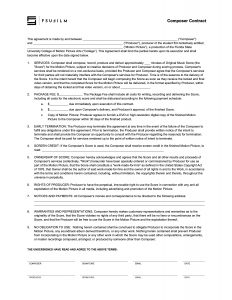
The Composer Contract establishes the agreement between the production and the composer creating original music for the film. The contract addresses the scope of the work, ownership and usage rights, delivery expectations, screen credits, and the production’s ability to use the music within the completed project.
Clear agreements with composers are important because original music involves both creative collaboration and intellectual property considerations. Proper documentation helps ensure that the production has the rights necessary to exhibit and distribute the film while also establishing clear expectations regarding deadlines, revisions, and ownership of the musical work.
The Producer should use this contract agreement with a Composer who is writing the musical score for a production. It should be used regardless of whether or not the composer is being paid for their services.
The Producer is responsible for working with the Composer to determine the due date, the compensation structure, and the screen credit in the finished film.
It is advisable to make the delivery date of the score (in Section 1 of the contract) as early as is feasible, in order to provide some padding. It is not uncommon for composers on student films to miss their deadline, so it’s better to assume that that might happen than to hope for the best. Most ideal would be setting delivery of the score for a date during the sound editing phase, so that you have a better sense of how everything’s coming together. If that’s not viable, set delivery for as many days before the mix date as your composer’s schedule will allow.
All other clauses in the agreement must remain unchanged, unless the Producer is authorized in advance by the Head of Production to make specific amendments to the contract.
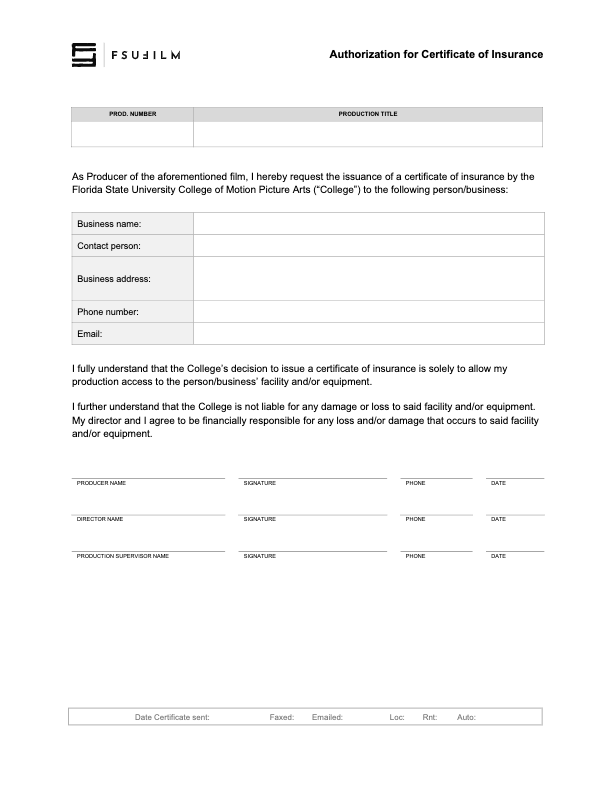
A Certificate of Insurance is a document issued by the university’s insurance provider verifying that approved production activities are covered under the institution’s insurance policies. Productions may need to provide this document to property owners, vendors, municipalities, or other outside parties before filming or conducting production-related activities.
Many locations and organizations require proof of insurance before granting permission for production activity to take place. The certificate helps demonstrate that the production has institutional coverage in place while supporting safer and more professionally managed relationships with outside partners and locations.
The Producer of a film should submit this form to the Head of Production to request the issuance of a Certificate of Insurance by the College of Motion Picture Arts to a business or individual that has requested one.
If the College issues a Certificate of Insurance, it is solely to allow access to the facility and/or equipment that the business or individual is offering the production. The College is not liable for any damage or loss to said facility and/or equipment. The Producer and Director will be financially responsible for any damage or loss to said facility and/or equipment.
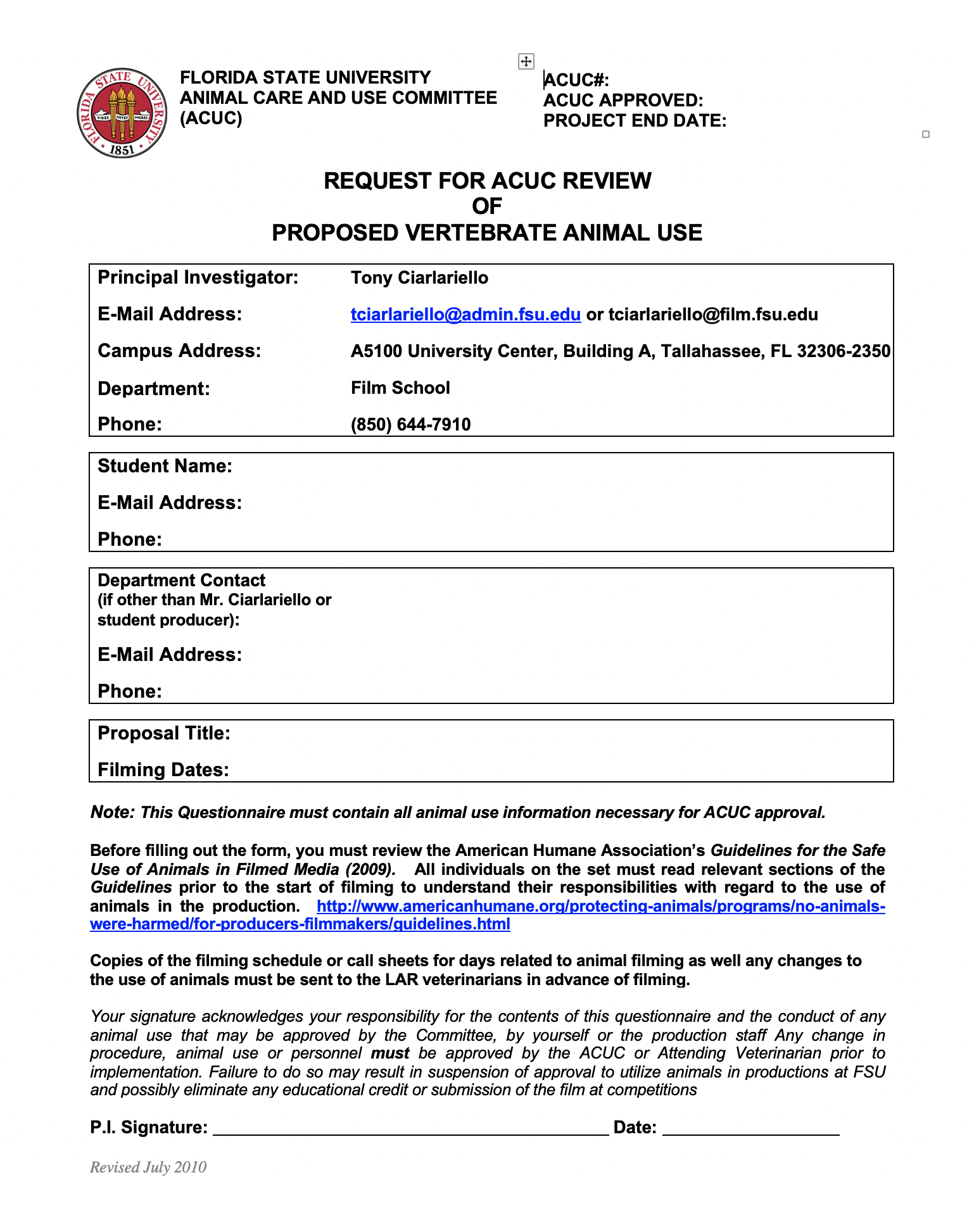
Productions wishing to include animals in filming activities must complete an Animal Use Request describing the proposed use of the animal, the conditions under which filming will occur, and the safety and handling procedures that will be followed during production. Approval comes from the FSU Animal Care and Use Committee.
Animals introduce additional safety, liability, scheduling, and welfare considerations that require careful review before approval is granted. The request process helps ensure that productions are planning responsibly, protecting the well-being of both the animal and the crew, and complying with university expectations regarding safe production practices.
FSU Animal Care and Use Committee
Producers are required by Florida State University policies to file a request for review of animal use on the production by the FSU Animal Care and Use Committee (ACUC).
Approval is required by federal regulation, but it also enhances the relationship of FSU with the public, demonstrating to the public that the University is concerned with all use of animals by the University community.
This request must be submitted well in advance of the start of the production, as it will usually take a number of weeks for a request to be approved. If a production does not receive approval from the ACUC in time for production, the use of an animal is not permitted.
Should a production require ACUC approval, ACUC requires that the ACUC Film School Protocol Form and a PDF of the script (highlighting the parts that contain animals) be submitted at least two weeks prior to any animal use. This will permit the Committee to perform its federally mandated oversight function to ensure University compliance with Federal regulations. Students are strongly encouraged to allow for more than two-weeks of turnaround time, in case delays occur or revisions are needed. Again—if the request is not approved in time for production, the use of an animal is not permitted.
The application is submitted to the ACUC Coordinator in the Department of Laboratory Animal Resources (LAR) office. The ACUC Coordinator then forwards a copy of the protocol to the LAR veterinarians for a pre-review. These individuals conduct a preliminary review with an eye to helping eliminate any stumbling blocks to approval by the full Committee. Suggested modifications and questions are provided to the person that has filed the protocol. The LAR staff is available for consultation and is often able to assist with locating animals suitable for the productions.
If last minute modifications to the production are necessary following approval, students are required to contact one of the LAR Veterinarians for approval prior to making any changes. The LAR Veterinarian will then report on the modification at the next ACUC meeting.
On occasion projects request the use of animal tissue rather than live animals. These productions/projects also must be reviewed by the FSU Animal Care and Use Committee for reasons related both to public concern over source and health reasons related to the handling of animal parts. Individuals should follow the above instructions for protocol submission. Also, individuals should be aware that certain precautions are necessary when handling animal carcasses or tissue.
This resource is intended for property owners and representatives considering allowing a student production to film at their location. It explains the general nature of the production process, what filming activity may involve, and how productions coordinate logistics, scheduling, insurance, and location agreements.
Thank you for considering allowing one of our students to use your property as a filming location. Each year, our students create nearly 200 films, and your generosity makes this possible. We value your time and support, and we are committed to maintaining the highest standards of professionalism, safety, and respect for your property.
WHAT TO EXPECT
How many people will be on site?
A typical student film crew includes 12-15 students, plus actors and possibly a few additional volunteers. Please feel free to ask the student for a specific headcount of crew, cast, and support personnel.
What will they bring?
Film productions require various equipment, including cameras, lights, sound gear, stands, cables, sandbags, rigging, dollies, and sometimes generators. Our students are trained to handle this equipment safely. They will confirm with you in advance where vehicles (trucks and cars) can be parked and where equipment can be staged.
How long will they be here?
A standard shoot day is up to 12 hours, plus a one-hour lunch break. Crews typically arrive about 30 minutes before the official start time and take an additional 30 minutes afterward for cleanup and packing. Students may also visit the location on separate days for planning, tech scouting, or set dressing. They will confirm with you in advance the start and end times for each prep and shoot day.
Location agreements
If you choose to allow the use of your property, here’s what to expect in terms of paperwork:
Script Review
The student will provide a copy of the script and answer any questions about the project, including sensitive content.
Location Shooting Plan Agreement
Together, you and the student will complete an agreement which outlines:
The specific spaces they will use.
Where vehicles may park.
Access times.
Any special conditions or restrictions you’d like to include.
Location Agreement
This legal document grants permission to use your property and waives your liability in the event of a student injury during production.
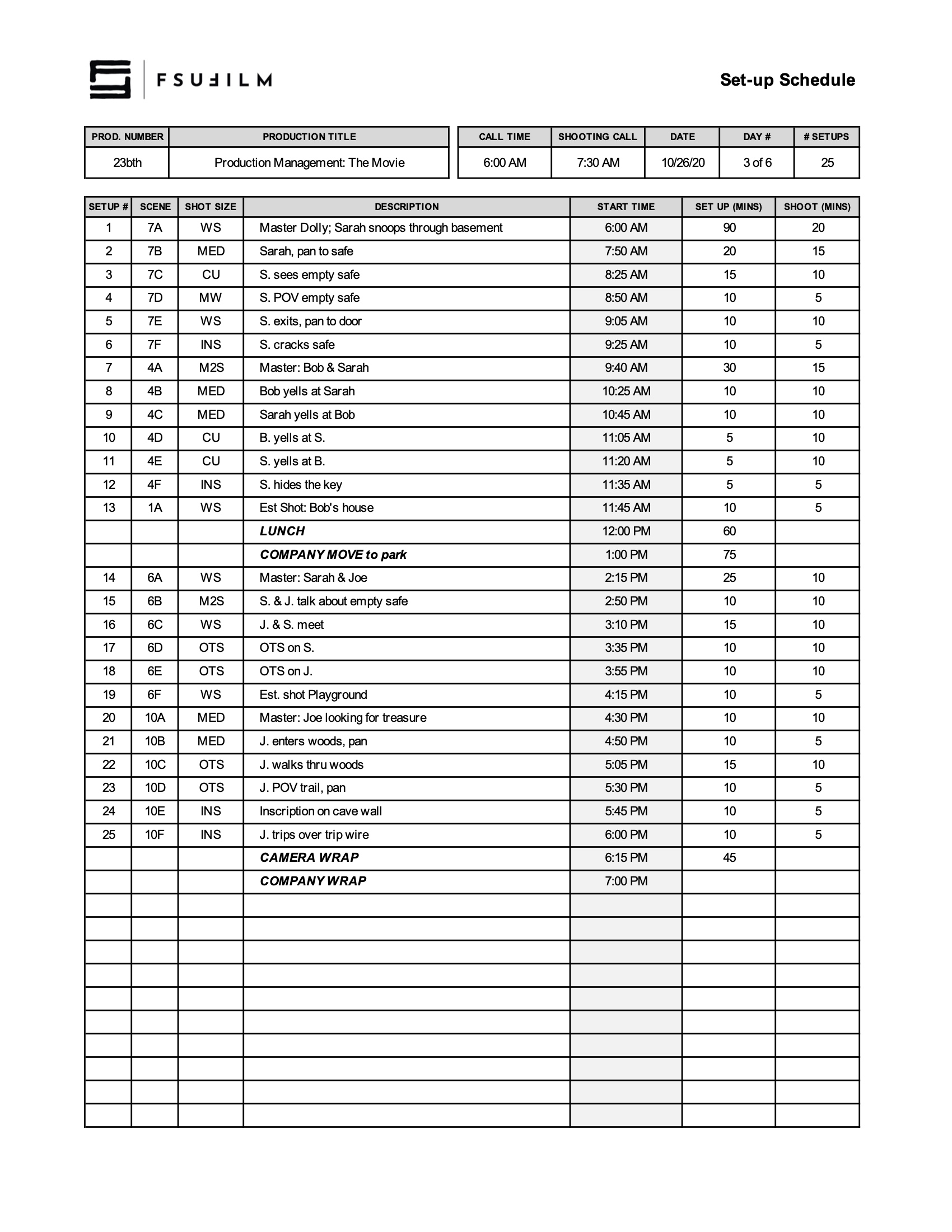
The set-up schedule outlines the planned timing and workflow for preparing and shooting each set-up throughout a given production day.
Careful setup planning is important because productions rely on efficient coordination between departments before cameras begin rolling. Structured setup schedules help reduce delays, improve communication, support safer working conditions, and give crews a clearer understanding of how production operations are expected to unfold throughout the day.
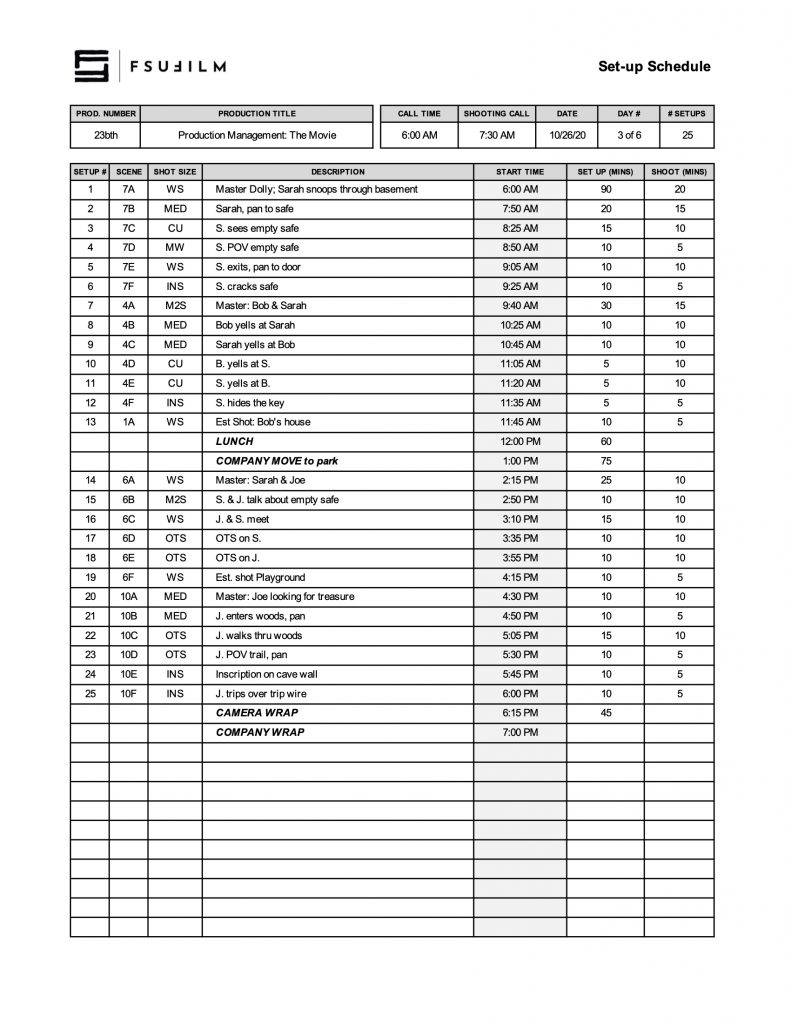
After the Director and DP have created a provisional shot list, the 1st AD will meet with the Director and DP to schedule the order of shots for each day. Using this Set-up Schedule, the shots should be listed in the order you intend to shoot them, including estimated times to set up and shoot each one.
Be sure to budget adequate time load-ins, load-outs, wraps, lunch, and any company moves.
SAMPLE SET-UP SCHEDULE
Here’s a sample of what the completed set-up schedule should look like:
This resource compiles public domain and Creative Commons materials that students may use when searching for music, images, footage, sound effects, or other media assets for productions and related projects.
Understanding public domain and Creative Commons licensing is important because productions must ensure that all third-party materials are being used legally and appropriately. Learning how to evaluate licensing terms, attribution requirements, and permitted usage helps students develop stronger professional practices related to copyright, rights clearance, and media sourcing within film production workflows.
Some Words of Caution
The Internet is a wonderful place for finding videos, images, motion graphics, clip art, music, and sound effects that can be used in your films.
Beware, however, that the Internet is also a terribly unreliable place and the burden of proof will fall on Producers to document that the production has the rights to use the materials, so that there’s a clear chain of title.
For works in the public domain, this can sometimes take a fair amount of research, as licensing information can be unclear, unreliable, or hard to track down. Any works published 95 years ago or earlier are now in the public domain. Any works published in the past 95 years should be assumed to be under copyright, unless otherwise confirmed. Be aware that new versions of works in the public domain — e.g., a New York Symphony Orchestra’s recent recording of Beethoven’s 9th Symphony — are copyrighted. In other words, while you could perform the composition yourself and be alright, you couldn’t use the New York Symphony Orchestra’s recording without clearing it first.
For Creative Commons work, some license types (such as “NoDerivs” and “ShareAlike”) are not compatible with the work we do. Productions are only permitted to use work licensed as “Attribution” or “Attribution-NonCommercial”.
Discover original artworks from a library of public domain books and chromolithographs. Art prints scanned and digitally enhanced into high resolution, available to download under the CC0 license.
Free vector images. Find the best royalty free vectors and illustrations for your design, with thousands of new images added every day. Download free backgrounds, graphics, clipart, drawings, icons, logos and more that are safe for commercial use.
Safety bulletins provide guidance, procedures, and recommended practices related to specific production hazards, equipment, environments, or activities that may arise during filmmaking—and they must be included alongside call sheets when relevant.
Because film production can involve physically demanding environments, technical equipment, transportation, electrical systems, weather exposure, stunts, weapons, animals, and other potential hazards, productions must approach safety proactively rather than reactively. Safety bulletins help crews identify risks earlier, develop safer working practices, and reinforce a culture of shared responsibility around production safety.
How They Work
The safety bulletins we utilize are researched, written, and distributed by the Industry-Wide Labor-Management Safety Committee for use by the motion picture industry. The committee is composed of guild, union, and management representatives active in industry safety and health programs.
Safety bulletins are recommended guidelines. They are not binding laws or regulations. State, federal, and/or local regulations override these guidelines. Modifications in these guidelines should be made, as circumstances warrant, to ensure the safety of the cast and crew.
A PDF of all relevant safety bulletins must be attached to call sheets. Be sure to download the most recent version of a safety bulletin before attaching one to a call sheet, as the Industry-Wide Labor-Management Safety Committee does update their bulletins periodically.
All crew are required to read distributed Safety Bulletins prior to commencing the work day. Failure to do so may result in disciplinary action, including immediate dismissal from the school.
Download Bulletins
To download the latest versions of the safety bulletins, click here:
A list of all the available Industry-Wide Labor-Management Safety Committee’s safety bulletins is outlined below.
Safety Bulletins
Recommendations For The Use Of Firearms, Blanks, And Dummy Rounds
Prohibitions And Special Restrictions On The Use Of Live Ammunition
Guidelines Regarding the Use of Helicopters in Motion Picture Productions
Addendum A – Helicopter External Loads
Stunts
Addendum A – Specialized Activities
Safety Awareness
Animal Handling Rules for the Motion Picture Industry
Recommendations For Diving Operations
Guidelines for Traditional Camera Cars
Addendum A – Process Trailer/Towed Vehicle
Addendum B – Camera Boom Vehicles
Addendum C – Power Line Distance Requirements
Recommended Guidelines for Working In and Around Base Camps
Addendum A – Base Camp Inspection Checklist
Guidelines Regarding the Use of Artificially Created Atmospheric Fog & Haze
Addendum A – Technical Awareness Sheet
Guidelines Regarding the Use of Fixed-Wing Aircraft in Motion Picture Productions
Addendum A – External Load Guidelines
Guidelines for the Use of Venomous Reptiles
Recommended Guidelines When Using Combustible & Flammable Fuels and Associated Equipment
Parachuting and Skydiving
Guidelines for Boating/Watercraft Safety for Film Crews
Recommended Guidelines for Safety with Pyrotechnic Special Effects
Water Hazards
Guidelines for Safe Use of Stunt Air Bags, Boxes or Other Freefall Catch Systems
Recommended Guidelines for the Use of Open Flame on Production
Guidelines for the Safe Use of Motorcycles
Guidelines for Appropriate Clothing and Personal Protective Equipment
Guidelines for the Use of Scissor Lifts (Elevating Work Platforms) and Aerial Boom Lifts (Extensible Boom Platforms)
Addendum A – Power Line Distance Requirements
Guidelines for Working with Portable Power Distribution Systems and Other Electrical Equipment
Addendum A – Power Line Distance Requirements
Addendum B – Basic Electrical Safety Precautions for Motion Picture and Television Off Studio Lot Location Productions
Addendum C – Working With 480 Volt Systems
Addendum D – Common Motion-Picture/Television Tasks and Associated Personal Protective Equipment
Addendum E – Guidelines for Meeting National Electrical Code (NEC) Grounding Requirements for Portable Generators Supplying Portable Equipment in the Motion Picture and Television Industry
California OSHA Safety Requirements for Handling of Blood and Other Potentially Infectious Materials
Camera Cranes
Addendum A – Power Line Distance Requirements
Preparing Urban Exterior Locations for Filming
Poisonous Plants
Guidelines for Railroad Safety
Guidelines for Safe Use of Hot Air Balloons
Addendum A – External Load Guidelines
Recommended Guidelines for Safely Working with Edged, Piercing, and Projectile Props
Safety Awareness When Working Around Indigenous Wildlife
Los Angeles County Approved Film Production Food Services
Addendum A – Los Angeles County Approved Film Production Food Services
Special Safety Considerations when Employing Infant Actors (15 days to Six Months Old)
Guidelines for Working in Extreme Cold Temperature Conditions
Addendum A – Wind Chill Chart
Safety Considerations for the Prevention of Outdoor Heat Illness
Recommended Guidelines for Safely Working Around Unmanned Aircraft Systems (UAS) a.k.a Drones
Appendix A – Federal Aviation Administration (FAA) Rules & Regulations
Vehicle Restraint Systems – Seat Belts & Harnesses
Guidelines For Inclement Or Severe Weather
Appendix A – Lightning Safety
Safety Guidelines for Using Foam(ed) Plastics in Set and Prop Construction
Guidelines for Non-Camera Utility Vehicles
Recommended Guidelines for Safely Working On and Around Gimbals
Guidelines for Alternative Driving Systems
Recommended Guidelines for Free Driving
Guidelines for Working Safely with Radiofrequency (RF) Transmitters
Guidelines For Long or Successive Takes
Procedural Guidelines
Special Procedures For Minors Performing Physical Activities
Informational Fact Sheets
General Code of Safe Practices for Production
Extended or Successive Takes
Guidelines for Handling Freshly Painted or Printed Backdrops and Other Graphic Arts
Photographic Dust Effects
Guidelines for Reducing the Spread of Influenza-Like Illness
Fair use is a limited legal doctrine that may, under certain circumstances, allow copyrighted material to be used without permission for purposes such as commentary, criticism, education, scholarship, parody, or transformative use. This resource outlines the basic principles of fair use and how they may apply within student film projects.
Fair use is intentionally narrow and context-dependent, and productions should not assume that the educational setting of the school automatically makes copyrighted material permissible to use. Understanding fair use helps students make more informed decisions about copyrighted content while recognizing the legal and ethical responsibilities associated with media usage, distribution, and exhibition.
How It Works
As a rule-of-thumb, copyrighted materials need to be licensed in order for them to be included in a film, so that there is a clear chain of title.
In certain circumstances, a fair use claim can be made for including copyrighted materials if the use falls under one of four categories described below.
Please note, however, that fair use is a legal defense; it is not a protected right. Many filmmakers have lost litigation when they thought they were covered by fair use. For this reason, the Head of Production has final say over whether the use of copyrighted materials will be permitted.
Social, political, cultural critique
Case: Employing copyrighted material as the object of social, political, or cultural critique
Use: Specific copyrighted work is held up for critical analysis in the same way that a newspaper might review a new book and quote from it by way of illustration. This activity is at the very core of the fair use doctrine as a safeguard for freedom of expression. So long as the filmmaker analyzes or comments on the work itself, the means may vary, the use may be as extensive as is necessary to make the point, permitting the viewer to fully grasp the criticism or analysis.
Limitations: The use should not be so extensive or pervasive that it ceases to function as critique and becomes, instead, a way of satisfying the audience’s taste for the thing (or the kind of thing) critiqued. In other words, the critical use should not become a market substitute for the work (or other works like it).
Illustration of an argument or point
Case: Quoting copyrighted works of popular culture to illustrate an argument or point
Use: Here material of whatever kind is used not because it is, in itself, the object of critique but because it aptly illustrates some argument or point that a filmmaker is developing—as clips from fiction films might be used (for example) to demonstrate changing American attitudes toward race. The possibility that the quotes might entertain an audience as well as illustrate a filmmaker’s argument takes nothing away from the fair use claim. The filmmaker is not presenting the material for its original purpose but harnessing it for a new one.
Limitations: Documentarians should assure that the material is properly attributed, to the extent possible materials are drawn from a range of different sources, each usage is no longer than is necessary to achieve the intended effect, the material is not employed merely in order to avoid the cost or inconvenience of shooting equivalent footage.
Incidentally captured material
Case: Capturing copyrighted media content in the process of filming something else
Use: Documentarians often record copyrighted sounds and images when they are filming sequences in real-life settings. Common examples are the text of a poster on a wall, music playing on the radio, and television programming heard (perhaps seen) in the background. In a documentary, the incidentally captured material is an integral part of the ordinary reality being documented. Where a sound or image has been captured incidentally and without prevision, as part of an unstaged scene, it should be permissible to use it, to a reasonable extent, as part of the final version of the film.
Limitations: Documentarians should take care that particular content played or displayed in a scene being filmed was not requested or directed; incidentally captured media content included in the final version of the film is integral to the scene/action; content is properly attributed; the scene has not been included primarily to exploit the incidentally captured content in its own right; and the captured content does not constitute the scene’s primary focus or interest. In the case of music, the content does not function as a substitute for a synch track (as it might, for example, if the sequence containing the captured music were cut on its beat, or if the music were used after the filmmaker has cut away to another sequence).
Historical sequence
Case: Using copyrighted material in a historical sequence
Use: In many cases the best (or even the only) effective way to tell a particular historical story or make a historical point is to make selective use of words that were spoken during the events in questions, music that was associated with the events, or photographs and films that were taken at the time. In many cases, such material is available, on reasonable terms, under license. On occasion, however, the licensing system breaks down.
Limitations: Documentarians show that: the film project was not specifically designed around the material in question; the material serves a critical illustrative function, and no substitute exists with the same general characteristics; the material cannot be licensed, or the material can be licensed only on excessive terms relative to the reasonable budget for the film; the use is no more extensive than is necessary to make the point in question; the film does not rely predominantly or disproportionately on any single source for illustrative clips; the copyright owner of the material used is properly identified.
Universal Production Music is a production music library available to students for approved use within film projects and related productions. This resource provides information about accessing the library, searching for music, and incorporating licensed tracks into student productions under the program’s agreement.
Using properly licensed production music is important because films intended for festival exhibition, online release, or public distribution must have clear rights documentation for all music used within the project. Access to a professional music library also helps students develop stronger practices related to music selection, licensing, and post-production workflow management.
How it Works
The College of Motion Picture Arts pays an annual fee to Universal Production Music (UPM)—the worlds largest music catalog—for the licenses to the library music they provide on their site.
All the music in UPM is pre-approved for use in any of our student productions. Each track should be credited in the end titles of the finished film, but no releases need to be signed for the use of this music, so long as you remain in accordance with the licensing agreement. Simply include a copy of the license in the final paperwork delivery for the project.
Contact the post-production staff if you need the login credentials.
Music rights refer to the legal permissions and ownership interests associated with the use of music within a film or media project. This includes rights connected to musical compositions, sound recordings, synchronization, master recordings, and other forms of music usage and licensing.
Understanding music rights is essential because productions cannot assume that music may be used simply because it is publicly available or easy to access online. Proper rights clearance helps productions avoid legal and distribution problems while reinforcing professional practices related to copyright, licensing, and responsible media usage.
Important Rules and Restrictions
Unfortunately, music rights are often neglected until the very end of post-production. This is a mistake that could come back to haunt you. Acquiring music rights is often a more difficult and time-consuming process than one might realize. It is therefore in your best interest to start thinking about the music in your film early—ideally during pre-production.
For this reason, all F1 and M1 projects are only permitted to use music from the Universal Production Music library, since the school has already licensed that music.
Producers on all other production cycles may use the other methods of acquiring music that are described below, but they should start the process of clearing rights as early as possible.
A show will not be permitted to mix with a piece of music if the music rights have not been 100% cleared.
An alternate track from the Universal Production Music library should always also be prepared as a back-up—in case unanticipated issues arise with the music rights and so that an alternate, screenable version of the film remains available after any music rights may have expired.
Working with a Composer
If you want your film scored, then you will want to contact several composers during pre-production. Explain to them what your story is about and ask them to send a demo reel. If you like their work, then ask them to produce a temp track based on the ideas expressed in the script. If you like the temp track, hire them to score the film. You should have them sign the School’s Composer Contract at the moment of hiring before they begin any work.
Provide them with copies of early cuts as well as the final cut of your film. The composer will then compose the score and submit it to you.
Licensed Music
If you want to use pre-existing music, then you will need to obtain the proper licenses in order to use the music in your film. You must get each license for at least:
Two-years
Film festival
Non-commercial
World rights
Getting the music rights could be as simple as sending letters to the publisher and record label, having them sign and return them. However, you may be required to complete their licensing agreements instead. If this is the case, make sure you have the Head of Production review the agreement before you sign it, to ensure we have the proper releases.
There are typically two different types of licenses that you will need to acquire:
This is the right to reproduce a specific musical composition in your film. It must be obtained from the copyright owner of the composition, which is usually the publisher. You can find out who the publisher is by searching by song title at either www.ascap.com or www.bmi.com.
Almost every song is represented by one of these two companies. Songs that are not represented by ASCAP or BMI might be found at the National Music Publishers’ Association “Songfile” website (www.nmpa.org). You will be provided with a contact at the publisher’s Business Affairs or Licensing Department.
Note that you will need to get a synchronization license from the publisher, even if you are making your own sound recording of that song. For example, if you have your actor sing or recite lyrics, whistle or hum the tune, play the song on a musical instrument, or in any way make your own sound recording of the song, you will need to get the synchronization license from the publisher.
This is the right to synchronize a sound recording with your visual image. You clear this right with the record label who owns the sound recording you would like to use. Check the liner notes of the recording to find out which company this is. Alternatively, you can get contact information for record labels by contacting either ASCAP or BMI (see above). You will be provided with a contact at the record label’s Business Affairs Department.
Library Music
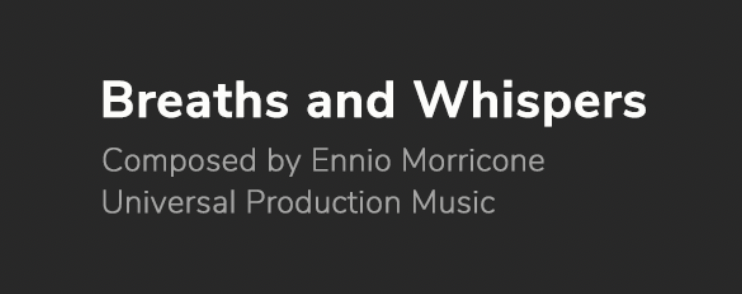
The school pays an annual fee to Universal Production Music for licenses to their library music. You are free to use any and all of the music in that library and no releases need to be signed. You will need to credit the song title and composer in the finished film for each piece of music that you use. Here’s an example:
[su_spacer size=”15″]
Public Domain Music
If you want to use a piece of music currently in the public domain, be careful. Know for sure that the piece of music is actually in the public domain. This can sometimes take a fair amount of research, as there is often unclear and unreliable information circulating about works that are supposedly in the public domain. All songs and musical works published in 1925 or earlier are in the public domain; anything published after 1925 should be assumed to be under copyright, unless otherwise stated. If the piece of music is in the public domain, then you can use it.
However, be aware that just because a musical composition may be in the public domain, that does not necessarily mean the sound recording of that composition is in the public domain. For example, the musical composition of Beethoven’s 9th Symphony is in the public domain, but the New York Symphony Orchestra’s recent recording of it is not. If you would like to use that particular recording in your film, you will need to get a license from the publishing company that holds the rights to that specific recording. You could, however, hire your own musicians to perform the 9th Symphony without needing to acquire a license to use the composition.
Creative Commons
Creative Commons is a community that offers an alternative copyright model for authors of creative works who would like others to be able to share, remix, sample, or build upon their work. Creative Commons provides a range of licenses that authors can attach to their creative works, giving other people greater or lesser degrees of permission to share or modify the work.
You may use Creative Commons work in your film if the original work has been licensed with one of the following license types, so long as you provide attribution in your film’s end credits:
Some of the Creative Commons licenses, however, do not play nicely with how we make movies. If you see licenses on works that include either of the following terms, you will most likely not be permitted to use those works:
NoDerivs. This license does not permit derivative works and requires that the original work is passed along unchanged and in whole, which is unlikely to happen in the context of our films.
ShareAlike. This license requires you to also license your work with a ShareAlike license. However, since the College owns the copyright on all student films, students are not permitted to license their films with a Creative Commons license, which makes it impossible for you to honor the original Creative Commons license.
Note, however, that many authors who’ve opted for a NoDerivs or ShareAlike license may be open to giving you permission to use their work if you contact them directly. If they are willing, you’ll need to follow the College’s usual process of acquiring a licensing agreement for a copyrighted work.